Supreme Court Examines Ad Hoc Information Commissions
Source:The Hindu ↗
Why It Matters
This development is critical for UPSC aspirants as it directly addresses the functioning, independence, and structural challenges of key statutory bodies (Information Commissions and Human Rights Commissions) listed in GS Paper 2. It highlights the tension between optimizing state expenditure and maintaining the institutional capacity required to enforce transparency and fundamental rights.
Summary
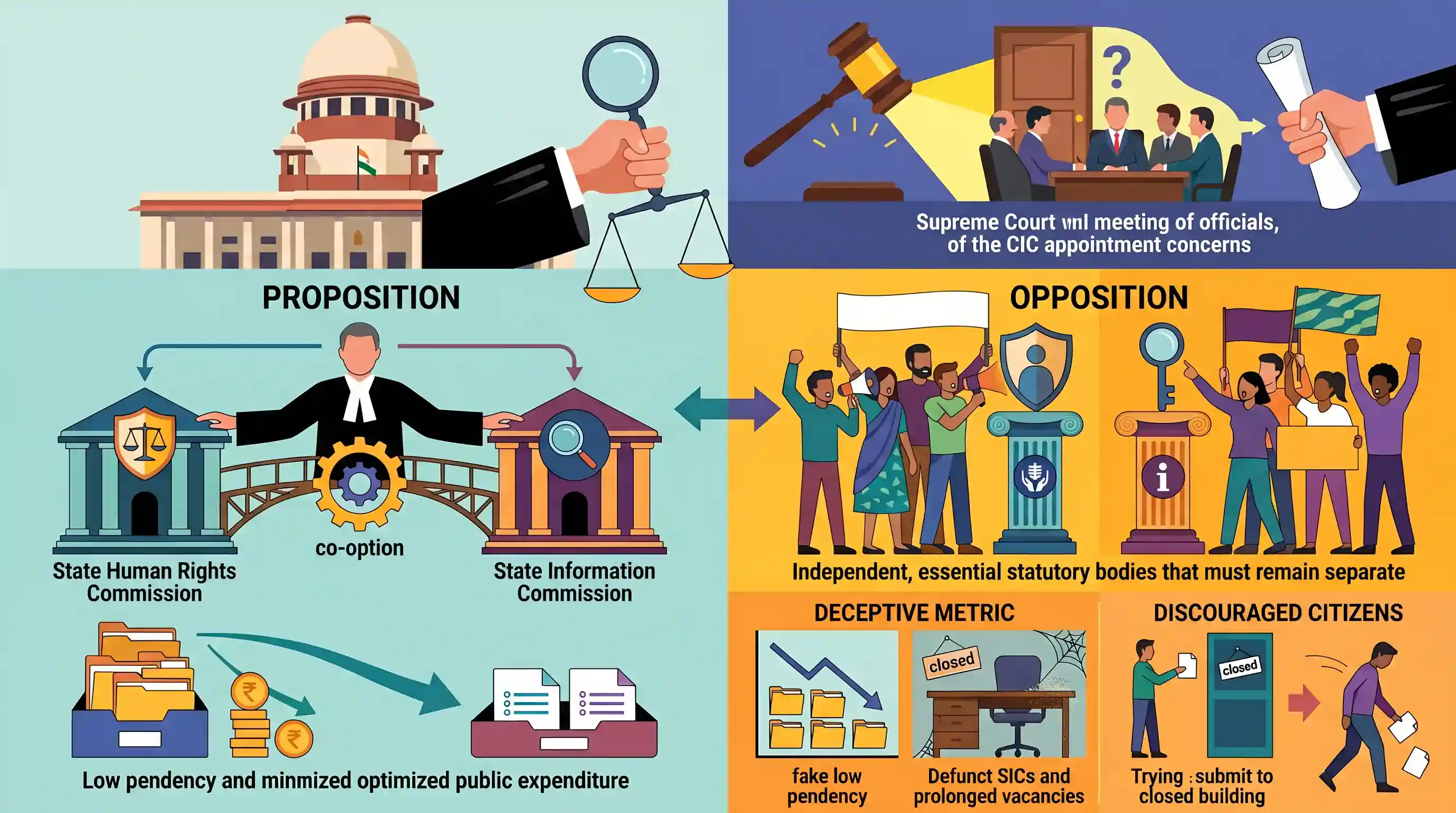
The Supreme Court of India is exploring whether State Human Rights Commissions (SHRCs) could serve as ad-hoc State Information Commissions (SICs) in states with minimal Right to Information (RTI) appeals to optimize public expenditure. However, RTI activists vehemently opposed this proposition, arguing that SICs are vital independent statutory bodies essential for ensuring government accountability and transparency. They contended that low pendency of appeals is a deceptive metric, primarily caused by SICs becoming defunct due to prolonged vacancies, which discourages citizens from filing. Additionally, the Court has sought a status report from the Union government on recent appointments to the Central Information Commission (CIC) amidst concerns over a lack of transparency in the selection process.
Key Points
- The Supreme Court suggested allowing State Human Rights Commissions to act as ad-hoc State Information Commissions in states with very few RTI appeals to save taxpayer money.
- RTI activists strongly opposed the idea, emphasizing that Information Commissions are crucial independent institutions that enforce the fundamental right to information and hold governments accountable.
- Petitioners pointed out that the low volume of appeals in certain states is not due to a lack of need, but because SICs often remain defunct for years due to unfilled vacancies, which deters citizens from filing appeals.
- The Supreme Court ordered the Union government to submit a status report on recent Central Information Commission (CIC) appointments following allegations of an opaque selection process.
Important Terms
Right to Information (RTI) Act, 2005

A landmark 2005 law granting citizens the legal right to access information from public authorities. It aims to foster transparency, ensure accountability, and curb corruption in Indian governance.
UPSC context
GS-II: Governance/Transparency. A core theme for questions on institutional accountability and citizen empowerment.
Central Information Commission (CIC)
The national-level statutory body established under the RTI Act to adjudicate appeals and complaints concerning information requests from Central Government departments and Union Territories.
UPSC context
GS-II: Statutory Bodies. Tests knowledge of oversight mechanisms and the independence of regulatory institutions.
State Information Commission (SIC)
A statutory body created by state governments under the RTI Act to oversee transparency in state-level public authorities and decide on second appeals from dissatisfied RTI applicants.
UPSC context
GS-II: Important Aspects of Governance. Essential for understanding the decentralised implementation of RTI.
State Human Rights Commission (SHRC)
A statutory body established under the Protection of Human Rights Act, 1993, to safeguard rights relating to life, liberty, and dignity within a specific state's jurisdiction.
UPSC context
GS-II: Statutory and Quasi-judicial Bodies. Tests knowledge of human rights protection frameworks.
Statutory Body
An organization established by an Act of Parliament or State Legislature. These bodies are not mentioned in the Constitution but derive authority from specific legislation.
UPSC context
GS-II: Polity. A fundamental distinction for identifying the origin and powers of various Indian institutions.
Quasi-judicial Body
A non-judicial body or individual with powers resembling those of a court, such as the ability to summon witnesses and evidence, typically used for administrative adjudication.
UPSC context
GS-II: Regulatory/Quasi-judicial Bodies. Relevant for discussing the enforcement powers of commissions like the CIC and SIC.
Prelims Trap
The Supreme Court has mandated State Human Rights Commissions to function as State Information Commissions in smaller states.
This is merely an exploration/suggestion by the Supreme Court to save public money, not a legal provision or a court mandate. Activists vehemently oppose it.
Static Concepts Connected
How are Information Commissioners appointed at the Central and State levels?
- CIC Selection Committee: For CIC, it includes the PM (Chairperson), Leader of Opposition in Lok Sabha, and a Union Cabinet Minister nominated by the PM.
- SIC Selection Committee: For SICs, it includes the Chief Minister, Leader of Opposition in the Legislative Assembly, and a State Cabinet Minister nominated by the CM.
- Appointment and Tenure: Appointed by the President (CIC) or Governor (SIC). Once appointed, they are not eligible for reappointment to the same post.
What are the foundational and statutory differences between SHRCs and SICs?
- Enabling Statutes: SHRCs are established under the Protection of Human Rights Act, 1993, while SICs are created under the Right to Information Act, 2005.
- Core Mandates: SHRCs focus on violations of life, liberty, equality, and dignity. SICs strictly enforce transparency, access to records, and government accountability.
- Penal Powers: SHRCs can only recommend action (advisory), whereas SICs have the power to impose direct monetary penalties on Public Information Officers for non-compliance.
Cross-Topic Patterns
Rationalizing statutory bodies and tribunals
The SC's cost-saving suggestion echoes the Tribunal Reforms Act, 2021, where the government rationalized tribunals by merging overlapping jurisdictions, sparking similar debates on the dilution of specialized appellate bodies.
Chronic vacancies in accountability institutions
The argument that low pendency masks defunct SICs mirrors the institutional crisis in Lokayuktas and Police Complaints Authorities, where deliberate delays in appointments render accountability frameworks ineffective.

Expect a multi-statement question contrasting the appointment, removal, and mandates of NHRC/SHRCs with those of CIC/SICs in 2026 Prelims.
Linked PYQs · 2
Linked PYQs · 2
- 2020MainsGS2
Recent amendments to the Right to Information Act will have profound impact on the autonomy and independence of the Information Commission". Discuss.
- 2014MainsGS2
National Human Rights Commission (NHRC) in India can be most effective when its tasks are adequately supported by other mechanisms that ensure the accountability of a government. In light of the above observation assess the role of NHRC as an effective complement to the judiciary and other institutions in promoting and protecting human rights standards.
