Addressing time toxicity and care burden in Indian oncology
Source:The Hindu ↗
Why It Matters
It shifts the public health narrative from merely addressing 'financial costs' (out-of-pocket expenditure) to the 'time and socio-economic costs' of care. This is a highly analytical perspective for Mains GS-2 (Issues relating to Health) and GS-1 (Role of Women / Unpaid Care Work), illustrating how infrastructural bottlenecks perpetuate social inequality.
Summary
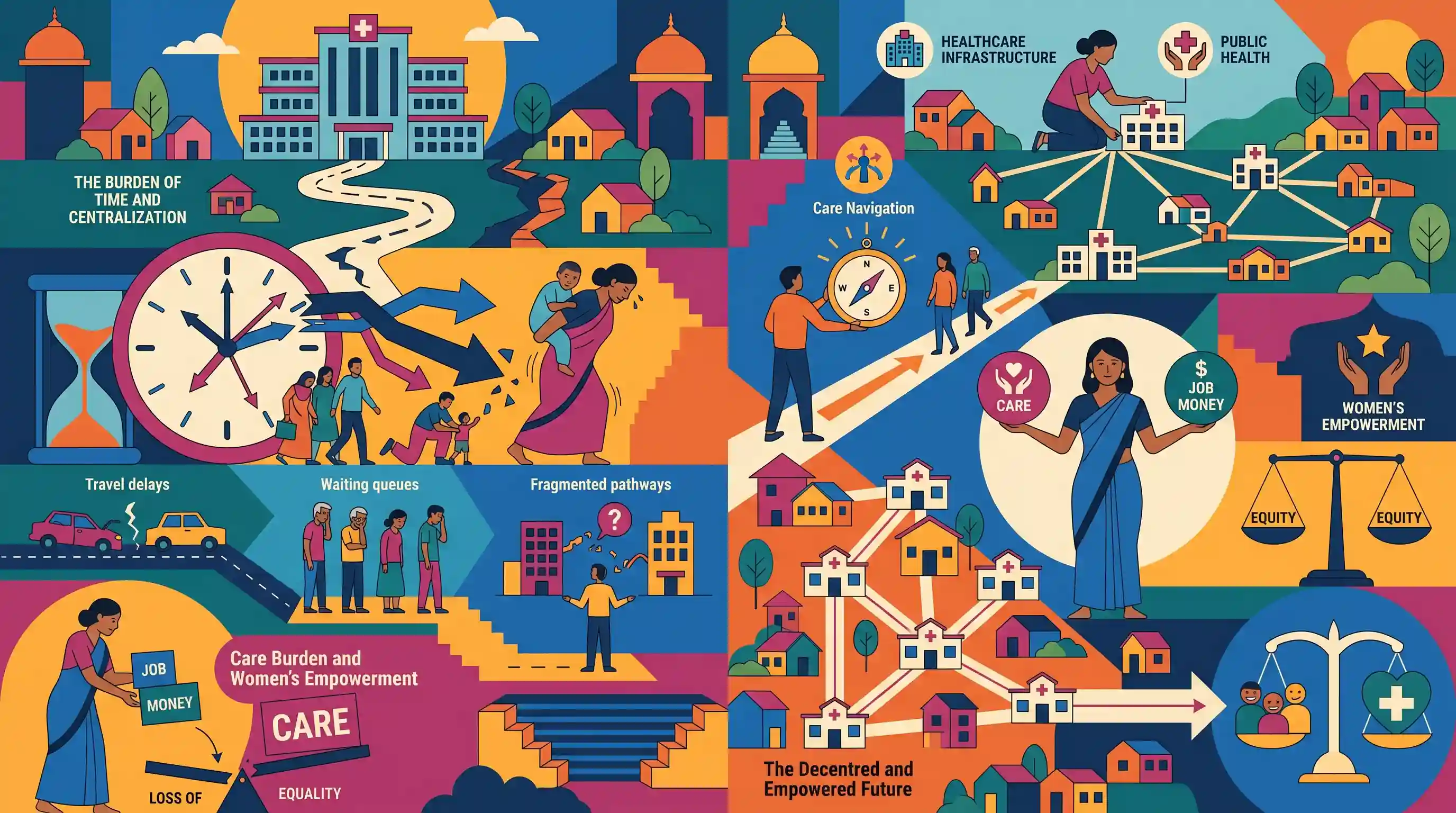
The article highlights a critical yet often overlooked dimension of India's healthcare system: the immense 'time burden of care' associated with chronic illnesses like cancer. While health policies traditionally focus on reducing out-of-pocket financial expenditure, patients and their families suffer from 'time toxicity'—spending countless hours traveling to centralised urban hospitals, waiting in long queues, and navigating fragmented care pathways. This burden disproportionately affects women, who typically assume the role of unpaid caregivers, thereby impacting their employment and financial independence. The piece argues that India must evolve its healthcare framework to decentralise oncology services, improve care navigation, and recognize the indirect socio-economic costs of treatment to make healthcare truly accessible and equitable.
Key Points
- Beyond financial out-of-pocket expenditure, cancer patients and families face severe 'time toxicity', involving long hours traveling, waiting, and navigating complex healthcare bureaucracies.
- The burden of unpaid caregiving falls disproportionately on women, leading to lost wages, career sacrifices, and widening the gender gap in economic participation.
- Highly centralised tertiary cancer centres force rural and semi-urban patients to migrate to major cities, overwhelming existing infrastructure and increasing the indirect costs of treatment.
- While schemes like Ayushman Bharat address the direct costs of hospitalization, they fail to mitigate the immense indirect costs associated with the 'time burden of care'.
- Decentralising oncology services, strengthening primary and secondary healthcare tiers, and integrating care navigators into the system are essential to streamline patient pathways.
Important Terms
Ayushman Bharat

India's flagship health initiative launched to achieve Universal Health Coverage. It comprises two pillars: Ayushman Arogya Mandirs for primary care and the PM-JAY insurance scheme for secondary and tertiary care.
UPSC context
GS Paper II (Social Justice/Health); tests knowledge of integrated healthcare delivery and Universal Health Coverage goals.
Pradhan Mantri Jan Arogya Yojana (PM-JAY)
The insurance arm of Ayushman Bharat providing ₹5 lakh annual coverage per family for secondary and tertiary hospitalization. It targets the bottom 40% of India's population for cashless treatment.
UPSC context
GS Paper II (Government Schemes); tests understanding of financial protection and reducing catastrophic health expenditure.
NPCDCS
A national initiative launched in 2010 focusing on infrastructure, human resources, and early diagnosis of non-communicable diseases (NCDs) like cancer and diabetes at district and sub-district levels.
UPSC context
GS Paper II (Public Health); evaluates awareness of specific vertical programs targeting India’s rising NCD burden.
Time Toxicity
The time spent by patients in healthcare-related activities (travel, waiting, procedures) that offsets survival benefits. It is a critical "hidden cost" in chronic disease management like oncology.
UPSC context
GS Paper II (Health/Social Justice); tests ability to analyze indirect barriers to equitable healthcare beyond just financial costs.
Care Economy
The sector encompassing both paid and unpaid activities that provide care for children, the elderly, and the ill. In India, women disproportionately bear the unpaid care burden.
UPSC context
GS Paper I (Sociology/Women) and Paper III (Economy); explores the link between healthcare, gender, and labor force participation.
Out-of-Pocket Expenditure (OOPE)
The direct payments made by individuals to healthcare providers at the point of service, not covered by insurance. High OOPE is a primary driver of poverty in India.
UPSC context
GS Paper III (Indian Economy/Infrastructure); measures the effectiveness of social security and public health financing systems.
Prelims Trap
"Ayushman Bharat PM-JAY eliminates Out-of-Pocket Expenditure (OOPE) for cancer care by covering both direct medical expenses and indirect treatment costs."
PM-JAY covers in-patient hospitalisation (direct costs). It does not cover outpatient care, travel, or wage loss (indirect costs), which heavily contribute to India's OOPE and 'time toxicity'.
Static Concepts Connected
What constitutes Out-of-Pocket Expenditure (OOPE) in India's health sector?
- Definition: Direct payments made by individuals to healthcare providers at the time of service use, excluding insurance premiums or tax-based funding.
- Indirect Costs Excluded: It covers direct medical costs (medicines, fees) but not indirect costs like travel or lost wages, though indirect costs still financially ruin families.
- Current Status: Despite PM-JAY, OOPE remains around 39% of Total Health Expenditure (THE), largely driven by outpatient care and medicine costs not covered by insurance.
How is 'unpaid care work' measured and recognized in India?
- Measurement (TUS): It is quantified via the Time Use Survey (TUS) conducted by the NSSO (MoSPI), which measures the amount of time people spend on various activities.
- Gender Gap: The 2019 survey revealed Indian women spend nearly 10 times more time on unpaid domestic and caregiving services than men.
- Economic Exclusion: Unpaid care work remains unaccounted for in standard GDP calculations, directly suppressing the female Labour Force Participation Rate (LFPR).
Cross-Topic Patterns
Care Economy + Female LFPR
The 'time toxicity' of chronic disease care directly suppresses female workforce participation, linking healthcare infrastructure deficits to India's low female LFPR and the struggle to realize its demographic dividend.
NCD Burden + Centralised Infrastructure
The epidemiological shift toward Non-Communicable Diseases (NCDs) requires decentralised chronic care, exposing the flaws of a health system heavily skewed toward urban, tertiary hospitals built for episodic treatments.

Mains GS-2 in 2026 will likely link the 'care economy' and NCD disease burden to constraints on female LFPR and PM-JAY's limitations.
Linked PYQs · 3
Linked PYQs · 3
- 2024MainsGS2
In a crucial domain like the public healthcare system the Indian State should play a vital role to contain the adverse impact of marketisation of the system. Suggest some measures through which the State can enhance the reach of public healthcare at the grassroots level.
- 2021MainsGS2
“Besides being a moral imperative of a Welfare State, primary health structure is a necessary precondition for sustainable development.” Analyze.
- 2015MainsGS2
Public health system has limitations in providing universal health coverage. Do you think that the private sector could help in bridging the gap? What other viable alternatives would you suggest?
