Paris Agreement Article 6 Offers Climate Finance Potential for India
Source:The Hindu ↗
Why It Matters
Carbon markets and climate finance are central to global climate negotiations. Understanding Article 6 of the Paris Agreement is crucial for answering questions on India's climate strategy, NDC financing, and the transition to a low-carbon economy.
Summary
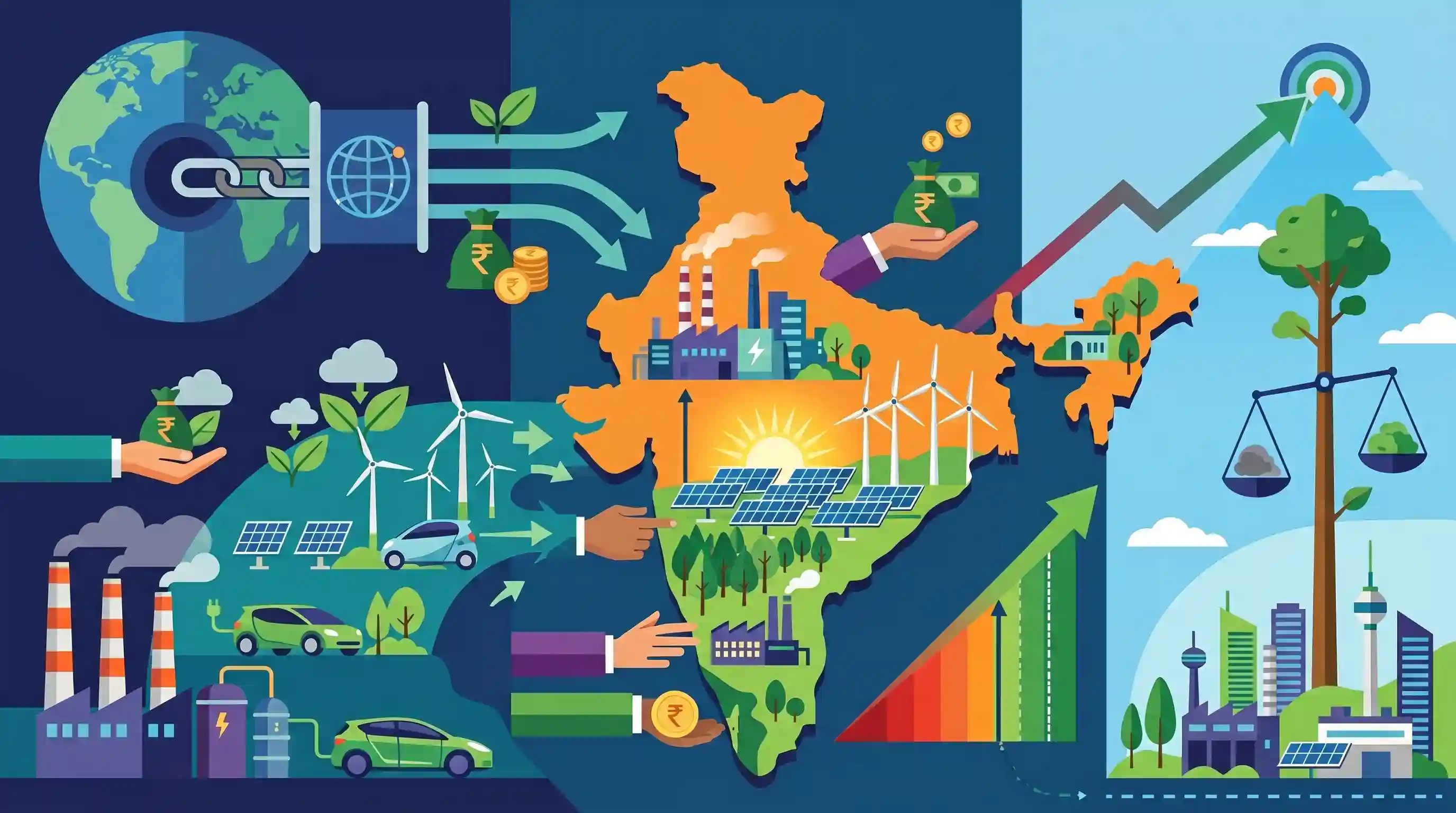
The article analyzes the strategic importance of Article 6 of the Paris Agreement for India, emphasizing its role in unlocking international carbon markets. By facilitating the trade of carbon credits and Internationally Transferred Mitigation Outcomes (ITMOs), Article 6 provides India with a lucrative opportunity to attract foreign climate finance and advanced green technologies. Capitalizing on its massive potential for emission reductions and its history with the Clean Development Mechanism, India can use these new market structures to economically viability green projects. This financial and technological influx is vital for realizing India's updated Nationally Determined Contributions (NDCs) and its ambitious target of achieving Net Zero emissions by 2070.
Key Points
- Article 6 of the Paris Agreement establishes a framework for international carbon markets and cooperative approaches, enabling countries to trade emission reductions to meet their Nationally Determined Contributions (NDCs).
- It comprises Article 6.2 (bilateral trading of Internationally Transferred Mitigation Outcomes or ITMOs), Article 6.4 (a centralized global carbon market replacing the CDM), and Article 6.8 (non-market approaches).
- For India, Article 6 serves as a critical avenue to attract global climate finance and technology transfers, which are essential for funding its transition to renewable energy and sustainable practices.
- With a strong history as a leading supplier of carbon credits under the Kyoto Protocol, India is uniquely positioned to monetize its vast domestic emission reduction potential across sectors like energy, agriculture, and forestry.
- Aligning domestic policies, such as the emerging Carbon Credit Trading Scheme (CCTS), with Article 6 mechanisms will accelerate India's progress toward its long-term goal of reaching Net Zero by 2070 (Panchamrit).
Important Terms
Article 6 of the Paris Agreement

A provision enabling countries to voluntarily cooperate to reach their climate targets (NDCs) through market-based carbon trading (6.2 and 6.4) and non-market collaborative approaches (6.8).
UPSC context
GS III (Environment). Essential for understanding international climate finance, global carbon markets, and multilateral environmental negotiations.
Nationally Determined Contributions (NDCs)
Country-specific climate action plans required under the Paris Agreement, detailing emissions reduction targets and adaptation strategies. India's 2022 update targets a 45% emissions intensity reduction by 2030.
UPSC context
GS III (Environmental Pollution). Tests knowledge of India's specific global commitments and international climate policy frameworks.
Internationally Transferred Mitigation Outcomes (ITMOs)
Tradable units representing verified emission reductions or removals achieved in one country and transferred to another under Article 6.2 to count toward the buyer's NDC.
UPSC context
GS III (Environment). Key technical term for Prelims/Mains concerning the operationalization of international carbon trading.
Carbon Credit Trading Scheme (CCTS)
India's domestic compliance market framework (2023) enabling the trading of Carbon Credit Certificates (CCCs) to incentivize industrial sectors to reduce greenhouse gas emissions.
UPSC context
GS III (Energy/Environment). Important for evaluating India’s legislative and policy steps toward its domestic and international climate goals.
Clean Development Mechanism (CDM)
A Kyoto Protocol mechanism where developed nations funded emission-reduction projects in developing countries; it is the historical predecessor to the new Article 6.4 mechanism.
UPSC context
GS III (Environment). Essential for tracing the evolution of international climate treaties from the Kyoto to Paris regimes.
Net Zero 2070
India's long-term commitment to achieve a balance between greenhouse gases emitted and those removed from the atmosphere by the year 2070.
UPSC context
GS III (Environment). A foundational target driving India's energy transition, industrial policy, and overall climate strategy.
Prelims Trap
"Article 6 of the Paris Agreement exclusively deals with market-based carbon trading mechanisms."
False. While Articles 6.2 and 6.4 create carbon markets, Article 6.8 explicitly establishes a framework for non-market approaches like capacity building and tech transfer.
Static Concepts Connected
How do Paris Agreement carbon markets differ from Kyoto Protocol mechanisms?
- Universal Targets: Kyoto only bound developed nations. Paris requires all countries to have NDCs, creating complex global accounting needs.
- Corresponding Adjustments: Paris introduces this accounting rule to ensure a traded carbon credit isn't counted toward the NDCs of both the host and buyer nations.
- CDM Transition: Kyoto's Clean Development Mechanism (CDM) is officially being transitioned into the centralized global market under Paris Article 6.4.
What is the difference between a carbon tax and cap-and-trade?
- Carbon Tax: Sets a fixed price per ton of emissions. It provides price certainty for businesses but uncertain total emission reduction outcomes.
- Cap-and-Trade: Sets a strict quantitative limit on total emissions. It guarantees exact emission reductions but leaves the carbon price to fluctuate based on market forces.
Cross-Topic Patterns
CCTS absorbing the PAT scheme
India's Carbon Credit Trading Scheme (CCTS), enabled by the Energy Conservation (Amendment) Act 2022, signals a shift from the energy-efficiency-focused Perform, Achieve, and Trade (PAT) scheme to broad-based carbon pricing.
CBAM vs. Article 6 Markets
While Article 6 fosters cooperative UN-backed carbon trading, the EU's Carbon Border Adjustment Mechanism (CBAM) imposes unilateral trade tariffs, creating a direct clash between UNFCCC goals and WTO trade rules.

Expect a 2026 multi-statement question distinguishing between Article 6.2 (ITMOs), 6.4 (CDM successor), and 6.8 (non-market approaches).
Linked PYQs · 4
Linked PYQs · 4
- 2025PrelimsGS1
Consider the following statements : Statement I: Article 6 of the Paris Agreement on climate change is frequently discussed in global discussions on sustainable development and climate change. Statement II: Article 6 of the Paris Agreement on climate change sets out the principles of carbon markets. Statement III : Article 6 of the Paris Agreement on climate change intends to promote inter-country non-market strategies to reach their climate targets. Which one of the following is correct in respect of the above statements?
- 2023PrelimsGS1
Consider the following statements: Statement-I: Carbon markets are likely to be one of the most widespread tools in the fight against climate change. Statement-II: Carbon markets transfer resources from the private sector to the State. Which one of the following is correct in respect of the above statements?
- 2025MainsGS3
Write a review on India's climate commitments under the Paris Agreement (2015) and mention how these have been further strengthened in COP26 (2021). In this direction, how has the first Nationally Determined Contribution intended by India been updated in 2022?
- 2021MainsGS3
Describe the major outcomes of the 26th session of the Conference of the Parties (COP) to the United Nations Framework Convention on Climate Change (UNFCCC). What are the commitments made by India in this conference?
