Strategic Significance of US Russia Summit in Alaska
Source:The Hindu ↗
Why It Matters
The summit is a defining moment in contemporary geopolitics, with direct consequences for the resolution of the Russia-Ukraine war, the strategic balance of NATO, and the efficacy of international legal institutions like the ICC.
Summary
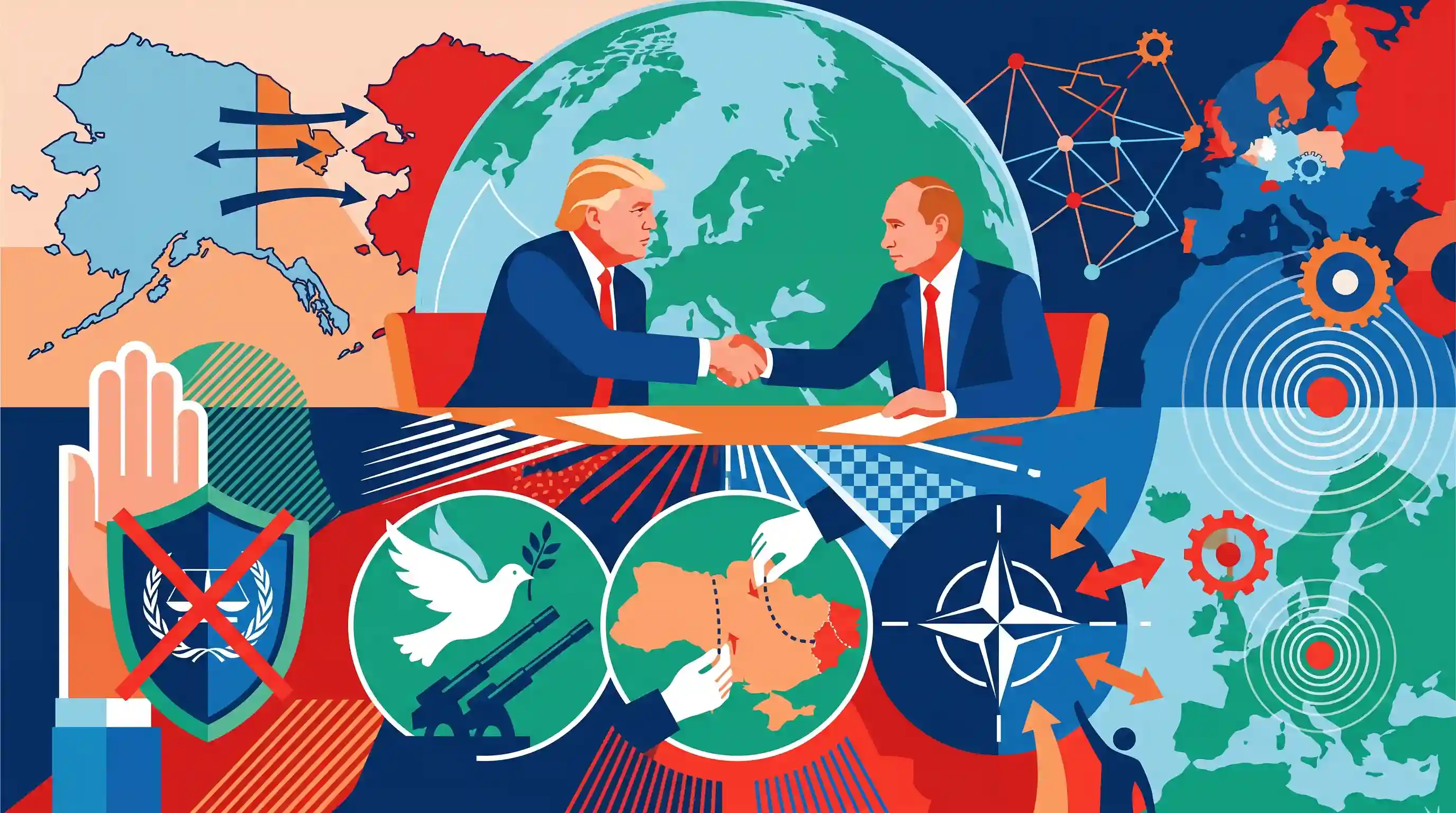
US President Donald Trump and Russian President Vladimir Putin are convening in Alaska for a crucial summit focused on resolving the Russia-Ukraine conflict. The choice of Alaska provides significant logistical and geopolitical advantages: its proximity to Russia via the Bering Strait offers a convenient meeting point, while the US's non-signatory status to the Rome Statute protects Putin from an active International Criminal Court (ICC) arrest warrant. The negotiations are expected to tackle major global security issues, including potential ceasefire terms, controversial territorial concessions, and the future of NATO expansion, carrying profound implications for European and global stability.
Key Points
- US President Donald Trump and Russian President Vladimir Putin are meeting in Alaska to negotiate terms regarding the ongoing Russia-Ukraine war.
- Alaska serves as a strategic and symbolic middle ground due to its close geographical proximity to Russia across the Bering Strait.
- The US is not a signatory to the Rome Statute, meaning Putin can visit US territory without facing arrest from the International Criminal Court (ICC) warrant against him.
- The summit's high-stakes agenda revolves around potential ceasefires, territorial concessions by Ukraine, and the future of NATO expansion.
Important Terms
International Criminal Court (ICC)

An international tribunal headquartered in The Hague that prosecutes individuals for genocide, war crimes, crimes against humanity, and the crime of aggression.
UPSC context
GS Paper II (International Relations). Tests understanding of global governance, international justice, and jurisdictional challenges for non-signatories like India.
Rome Statute
The 1998 foundational treaty that established the International Criminal Court (ICC) and defines the crimes under its jurisdiction and its operational framework.
UPSC context
GS Paper II (International Relations). Critical for understanding international law and India’s stance on sovereignty and the UN Security Council's role.
NATO
An intergovernmental military alliance of 32 North American and European countries established in 1949 to provide collective security against external threats.
UPSC context
GS Paper II & III (International Relations/Security). Central to the geopolitics of the Russia-Ukraine conflict and the collective defense principles of Article 5.
European Union
A supranational political and economic union of 27 member states in Europe that operates through a single market and common governing institutions.
UPSC context
GS Paper II (International Relations). Exemplifies regional integration and is a major strategic and trade partner for India in the 21st century.
Prelims Trap
As a UN Security Council permanent member, the US is legally obligated to execute the ICC arrest warrant against Vladimir Putin.
The ICC is not a UN organ. The US, like Russia, China, and India, has not ratified the Rome Statute and is exempt from executing ICC warrants.
Static Concepts Connected
How does the ICC differ from the International Court of Justice (ICJ)?
- Jurisdiction: The ICC prosecutes individuals for war crimes and genocide; the ICJ settles legal disputes between recognized UN member states.
- UN Affiliation: The ICJ is a principal UN organ. The ICC is an independent international organization established by the 1998 Rome Statute.
- Membership: All UN members are automatically party to the ICJ. The ICC requires explicit Rome Statute ratification, which India, the US, and China rejected.
What is the geographical and strategic significance of the Bering Strait?
- Waterbodies connected: It acts as a narrow maritime gateway connecting the Arctic Ocean (Chukchi Sea) to the Pacific Ocean (Bering Sea).
- Geopolitical borders: It physically separates the United States (Seward Peninsula, Alaska) from Russia (Chukchi Peninsula), positioning it as a direct superpower frontier.
- International Date Line: The strait serves as the passage for the International Date Line, dictating time zone boundaries between the Eastern and Western hemispheres.
Cross-Topic Patterns
ICC jurisdiction and India's Rome Statute stance
India's refusal to sign the Rome Statute mirrors the US stance. UPSC frequently tests this intersection of national sovereignty, international tribunals, and the Global South's perspective.
Arctic shipping routes and the Bering chokepoint
With Arctic ice melting, the Bering Strait is emerging as a crucial chokepoint for the Northern Sea Route, linking this summit's location to shifting global maritime trade patterns.

Expect a 2026 Prelims question mixing ICC vs ICJ jurisdiction with the non-signatory status of major powers like the US and India.
Linked PYQs · 4
Linked PYQs · 4
- 2023MainsGS2
‘The expansion and strengthening of NATO and a stronger US-Europe strategic partnership works well for India.’ What is your opinion about this statement ? Give reasons and examples to support your answer.
- 2025MainsGS2
"The reform process in the United Nations remains unresolved, because of the delicate imbalance of East and West and entanglement of the USA vs. Russo-Chinese alliance.” Examine and critically evaluate the East-West policy confrontations in this regard.
- 2008PrelimsGS1
Which one of the following straits is nearest to the International Date Line?
- 2024PrelimsGS1
The longest border between any two countries in the world is between :
