Tata Sons Board and Tata Trusts Governance Conflict Dynamics
Source:The Hindu ↗
কেন এটি গুরুত্বপূর্ণ
It provides a case study on corporate governance, the interplay between philanthropic trusts and commercial boards, and the systemic regulatory challenges inherent in India's major corporate conglomerates.
সারসংক্ষেপ
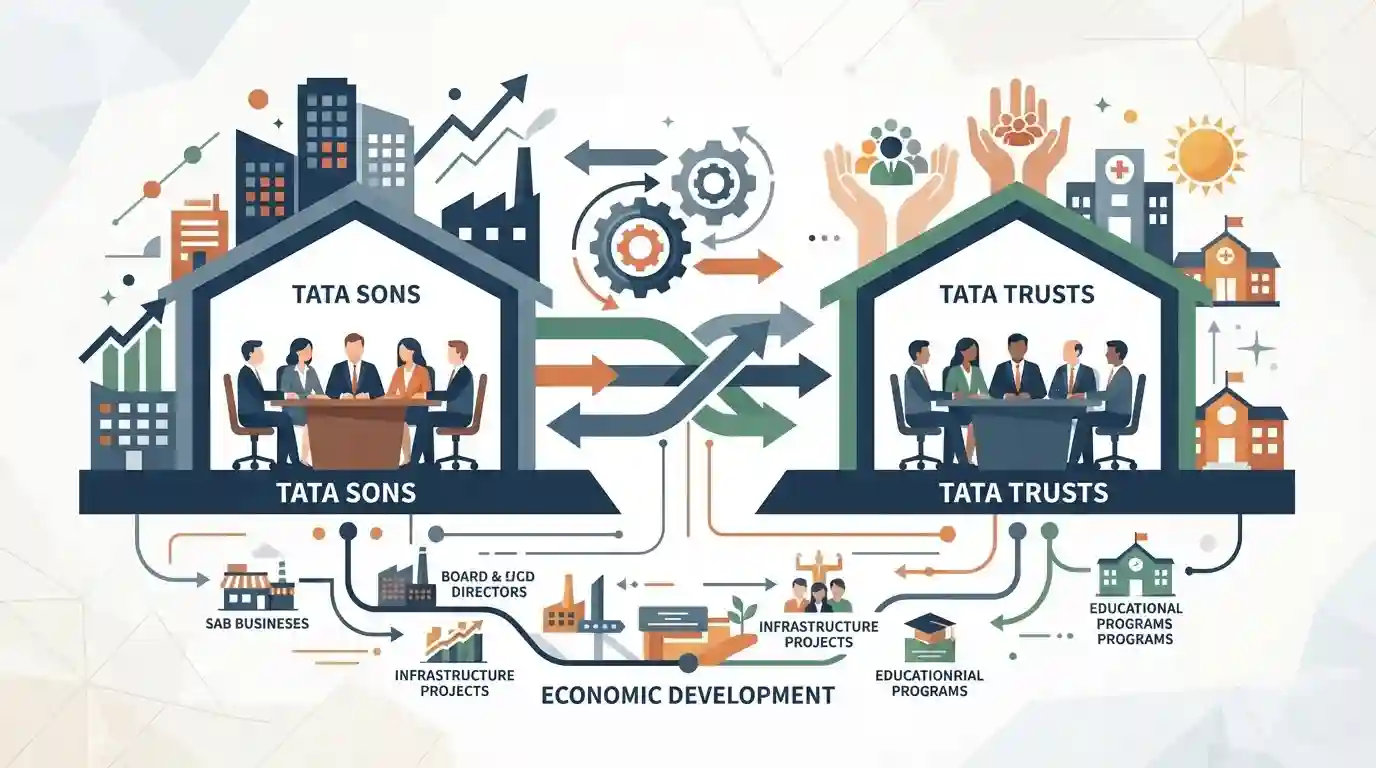
The article explains the underlying tensions and governance friction between the board of Tata Sons and its majority owner, Tata Trusts, highlighting the complexities of managing commercial conglomerates dominated by philanthropic entities.
মূল বিষয়
- The conflict between Tata Sons and its majority shareholder, Tata Trusts, highlights governance challenges unique to philanthropic ownership models in commercial enterprises.
- Tata Trusts holds a dominant stake in Tata Sons, creating distinctive dynamics between trust-based objectives and commercial board management.
- Issues such as board control, succession planning, and strategic alignment often trigger governance friction in large conglomerate structures with dual leadership or trust-majority formats.
গুরুত্বপূর্ণ শব্দ
Companies Act

The principal legislation regulating the incorporation, responsibilities, directors, and governance of companies in India, balancing shareholder democracy and minority rights.
UPSC context
UPSC Paper II / GS III (Indian Economy & Corporate Governance): Tests understanding of regulatory frameworks governing corporate management, oppression, and mismanagement.
Tata Sons
The principal investment holding company and promoter of the Tata group companies, holding major stakes across diverse commercial sectors.
UPSC context
UPSC GS III (Economic Development & Corporate Governance): Tests knowledge of corporate structures, conglomerate holding companies, and board-shareholder dynamics in India.
Tata Trusts
A group of philanthropic trusts holding a majority stake (~66%) in Tata Sons, steering group ideology and directing dividends toward social welfare.
UPSC context
UPSC GS III (Corporate Governance & Social Sector): Tests understanding of philanthropic ownership models, trust-governed enterprise control, and public interest vs. commercial objectives.
প্রিলিমস ফাঁদ
majority ownership by philanthropic trusts grants them absolute administrative and commercial autonomy over commercial board decisions without statutory friction.
Aspirants often assume that majority shareholders have absolute unfettered powers, overlooking that Articles of Association, minority protections, and RBI's Core Investment Company regulations heavily constrain holding entities.
সংযুক্ত স্থির ধারণা
What are the key regulatory provisions governing Core Investment Companies (CICs) in India?
- Asset Thresholds: RBI definition: CICs are non-banking financial companies holding not less than 90% of their net assets in investments in equity, debt, or loans for group companies.
- Regulatory Oversight: Systemically important: CICs with asset size of ₹100 crore and above are registered with the RBI and subjected to specific capital adequacy norms.
- Upper-Layer Mandate: Upper-Layer classification: Under RBI scale-based regulation, certain large CICs are designated as Upper-Layer NBFCs, triggering mandatory listing requirements.
আন্তঃবিষয় প্যাটার্ন
Holding Company Listings + RBI NBFC Norms
RBI's Upper-Layer NBFC framework forces large holding companies like Tata Sons to list publicly, creating a collision between SEBI market regulations and philanthropic governance mandates.
Nominee Directors + Fiduciary Duties in Conglomerates
The Tata-Mistry legal battles highlighted how dual fiduciary duties of nominee directors can strain boardroom consensus in trust-held corporate giants.

RBI's Upper-Layer NBFC rules mandating public listing for core investment companies vs legacy trust ownership will likely feature in Prelims.
সংযুক্ত PYQ · 1
সংযুক্ত PYQ · 1
- 2023MainsGS2
Discuss the role of the Competition Commission of India in containing the abuse of dominant position by the Multi-National Corporations in India. Refer to the recent decisions.
