Social Media Blocking Framework and Freedom of Speech in India
Source:The Hindu ↗
Why It Matters
It addresses the critical intersection of fundamental rights (Article 19), state powers under the IT Act for content blocking, and internal security management during civil unrest.
Summary
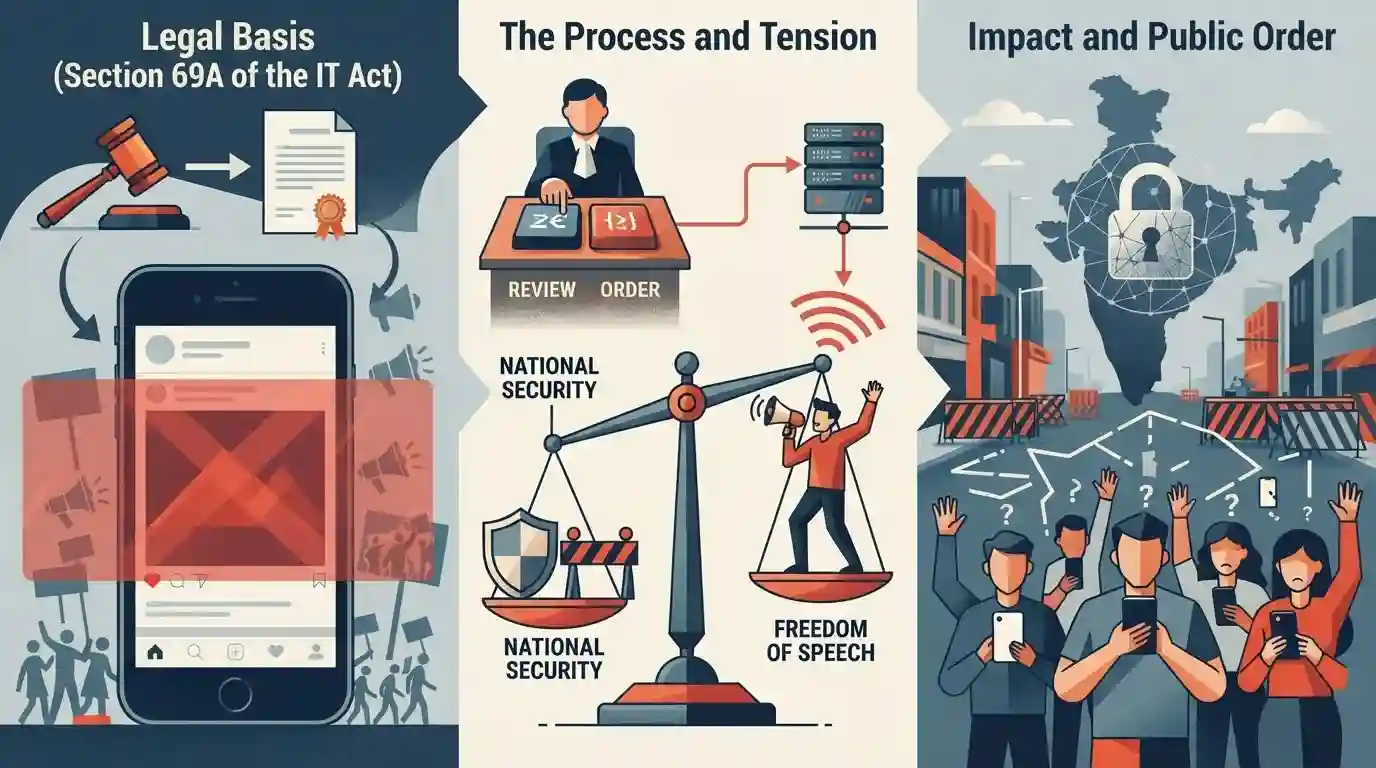
An examination of the legal mechanisms, primarily Section 69A of the IT Act, used by Indian authorities to block social media posts and accounts during protests, highlighting the tension between national security, public order, and freedom of speech.
Key Points
- Social media posts and accounts are frequently blocked in India under Section 69A of the Information Technology (IT) Act, 2000, which empowers the government to issue blocking directions in the interest of sovereignty, security, and public order.
- Protests often trigger heightened state surveillance and content-removal requests directed at platforms like X (formerly Twitter), Instagram, and YouTube to curb mobilization and manage public order.
- Critics argue that the lack of transparency in blocking orders, non-disclosure of reasons to content creators, and procedural opacity violate principles of natural justice and freedom of speech under Article 19(1)(a).
- Legal frameworks require confidentiality regarding blocking procedures under the Information Technology (Procedure and Safeguards for Blocking for Access of Information by Public) Rules, 2009, making judicial accountability challenging.
Important Terms
Information Technology Act

A provision empowering the Central Government to direct intermediaries to block public access to online information in the interest of sovereignty, security, public order, or friendly relations with foreign states.
UPSC context
GS Paper II (Polity & Constitution) and GS Paper III (Internal Security); tests understanding of statutory powers versus fundamental rights like free speech.
Information Technology Rules
Statutory rules outlining the procedural framework, safeguards, and committee review process that the government must follow when issuing content-blocking directions under Section 69A of the IT Act.
UPSC context
GS Paper II (Governance and Statutory Frameworks); evaluates administrative accountability and due process in digital regulation.
Ministry of Electronics and Information Technology
The Union government department responsible for formulating policies related to information technology, electronics, and internet governance, including issuing content takedown orders under Section 69A.
UPSC context
GS Paper II (Executive Bodies and Governance); tests the institutional mechanisms governing cyberspace and digital rights in India.
Supreme Court of India
The apex judicial body of India, which evaluates the constitutional validity of statutes like Section 69A and balances state security interests against fundamental rights under Article 19.
UPSC context
GS Paper II (Indian Constitution & Judiciary); examines judicial review, constitutional interpretation, and the enforcement of fundamental freedoms.
Static Concepts Connected
What are the procedural safeguards and grounds under Section 69A of the IT Act, 2000?
- Central Power: Empowering authority: Central Government (MeitY) can issue blocking directions to intermediaries or designated officers.
- Permissible Grounds: Exhaustive grounds: Sovereignty, integrity, defense, security of India, friendly relations with foreign states, or public order.
- Judicial Validation: Procedural safeguards: Shreya Singhal (2015) case upheld Section 69A, requiring a reasoned order and opportunity of hearing where feasible.
Cross-Topic Patterns
IT Act Blocking vs Telecom Shutdowns
Section 69A blocking orders intersect with Article 19(2) reasonable restrictions and emergency internet shutdown protocols under the Temporary Suspension of Telecom Services Rules, 2017.

Section 69A procedural safeguards vs Article 19(2) proportionality test will likely feature in a Mains GS-2 Polity question.
Linked PYQs · 2
Linked PYQs · 2
- 2024MainsGS3
Social media and encrypting messaging services pose a serious security challenge. What measures have been adopted at various levels to address the security implications of social media? Also suggest any other remedies to address the problem.
- 2014MainsGS2
What do you understand by the concept "freedom of speech and expression"? Does it cover hate speech also ? Why do the films in India stand on a slightly different plane from other forms of expression ? Discuss.
