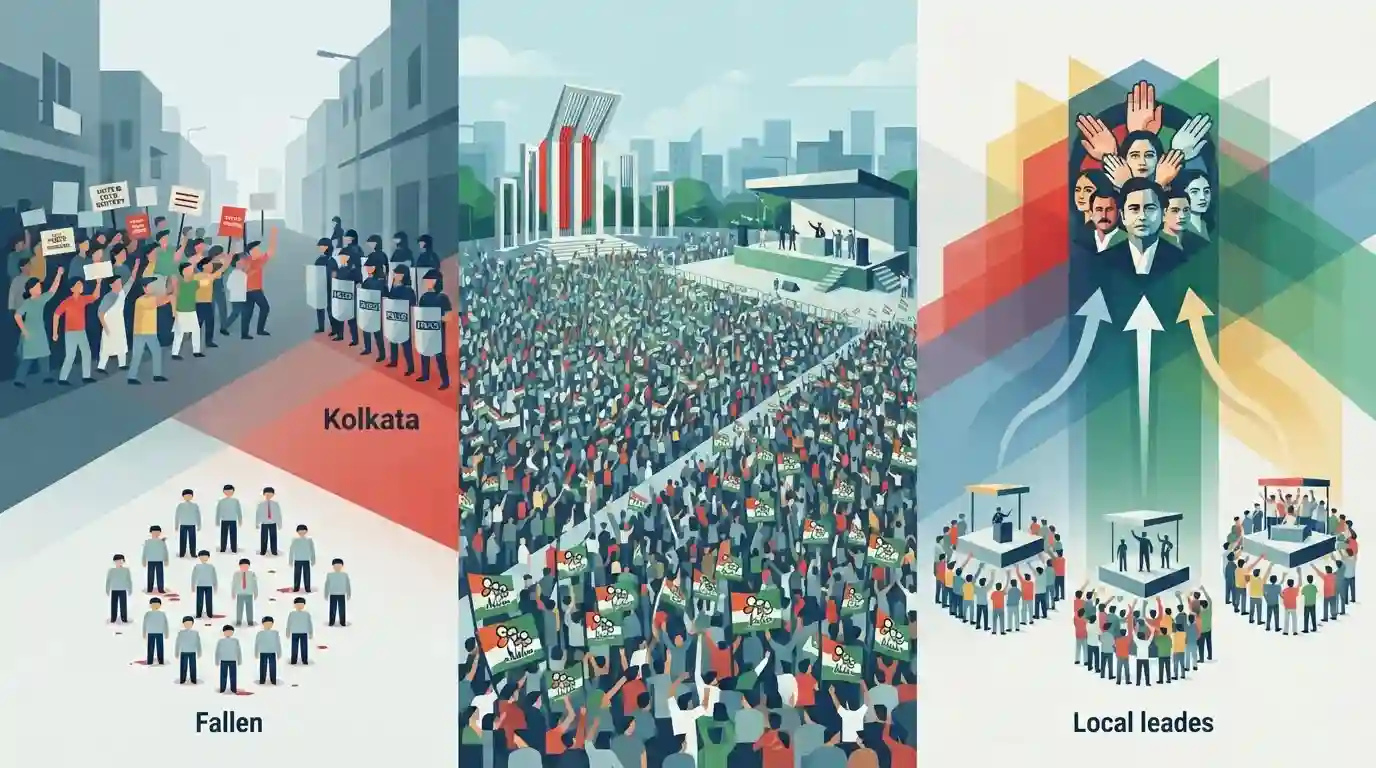
July 21 Martyrs Day rally history and political significance
Source:The Hindu ↗
Why It Matters
Understanding the historical context of political movements in West Bengal is important for State-specific questions. Additionally, the evolution of electoral reforms (like mandatory Voter IDs) is a key topic in Indian Polity.
Summary
The article explains the historical and political significance of the July 21 Martyrs' Day Rally in West Bengal, organized annually by the Trinamool Congress (TMC). The rally commemorates the 1993 police firing in Kolkata that killed 13 Youth Congress workers during a protest demanding mandatory voter ID cards. Today, the rally is a massive display of political strength for the TMC. Competing local factions within the party vying to organize the rally reflect underlying intra-party rivalry and the desire of local leaders to showcase their mass base and loyalty to the party's top leadership.
Key Points
- The July 21 Martyrs' Day rally commemorates the deaths of 13 Youth Congress workers in a police firing in Kolkata in 1993.
- The 1993 protest, led by Mamata Banerjee, demanded that voter ID cards be made the sole mandatory document to prevent electoral fraud.
- The rally has evolved into the most significant annual political event for the Trinamool Congress, serving as a display of mass support.
- Competition among rival TMC factions to hold the rally highlights intra-party factionalism and local leaders' efforts to demonstrate their political strength and loyalty.
Important Terms
Election Commission of India

An autonomous constitutional authority established under Article 324 of the Constitution, responsible for administering Union and State election processes in India.
UPSC context
Relevant for GS Paper II (Polity), testing knowledge of constitutional bodies, electoral reforms, and free and fair elections.
All India Trinamool Congress
A regional political party in India, founded by Mamata Banerjee in 1998, primarily active in West Bengal, currently serving as the ruling party there.
UPSC context
Relevant for GS Paper II (Polity), focusing on regional political parties, state politics, and the dynamics of federalism.
Indian Youth Congress
The youth wing of the Indian National Congress (INC) party, aimed at engaging young citizens in political activism and leadership.
UPSC context
Relevant for GS Paper II (Polity/Political Parties) and Modern History, showing the role of party wings in political mobilization.
Electoral Photo Identity Card
An identification card issued by the Election Commission of India to registered voters to prevent electoral fraud and ensure fair voting.
UPSC context
Relevant for GS Paper II (Electoral Reforms), testing understanding of measures taken to ensure transparent, free, and fair elections.
Prelims Trap
"Voter ID cards (EPICs) have been a mandatory constitutional requirement since the first general elections in 1951."
EPICs are not in the original Constitution. They were officially introduced in 1993 under CEC T.N. Seshan to curb impersonation, following the Dinesh Goswami Committee recommendations.
Static Concepts Connected
Which committees drove early electoral reforms regarding voter identity and fraud prevention?
- Dinesh Goswami Committee: This 1990 committee officially recommended the compulsory issuance of photo identity cards to all eligible voters to stop impersonation.
- T.N. Seshan Era: Chief Election Commissioner in 1993 strictly enforced the introduction of Voter Photo Identity Cards (EPICs) alongside the Model Code of Conduct.
- RPA 1950: Provides the statutory framework for the preparation, sanitization, and revision of electoral rolls.
What are the foundational Constitutional provisions for voting rights in India?
- Article 326: Grants universal adult suffrage. It was amended by the 61st Constitutional Amendment Act (1988) to lower the voting age from 21 to 18 years.
- Article 324: Vests the superintendence, direction, and control of elections in an independent, centralized Election Commission of India.
Cross-Topic Patterns
Intra-party democracy & Tenth Schedule
Frequent party factional rallies expose the absence of formalized intra-party elections in India, a structural flaw often masked by the rigid discipline imposed by the Anti-Defection Law.
Evolution of Electoral Tech
The 1993 push for physical EPICs bridges the historical shift from basic physical electoral rolls to modern electoral integrity tools like EVMs and VVPATs.

Expect a chronological sequencing question in Prelims linking major electoral milestones: 61st Amendment, EPIC introduction, EVMs, VVPATs.
Linked PYQs · 2
Linked PYQs · 2
- 2021WBCS_PRELIMSGS1
The Election Commission is constructed by the
- 2014WBCS_PRELIMSGS1
The Election Commission of India celebrates the National Voters Day on
