Intermediary Liability Rules and End to End Encryption Debates
Source:The Hindu ↗
Why It Matters
The confrontation involves the intersection of fundamental rights (Right to Privacy vs National Security), the mandate of regulatory bodies like the CCI to prevent monopolies, and the regulation of Big Tech in the digital economy. It is highly relevant for GS-2 (Regulatory Bodies, Constitution) and GS-3 (Cybersecurity, Data Protection).
Summary
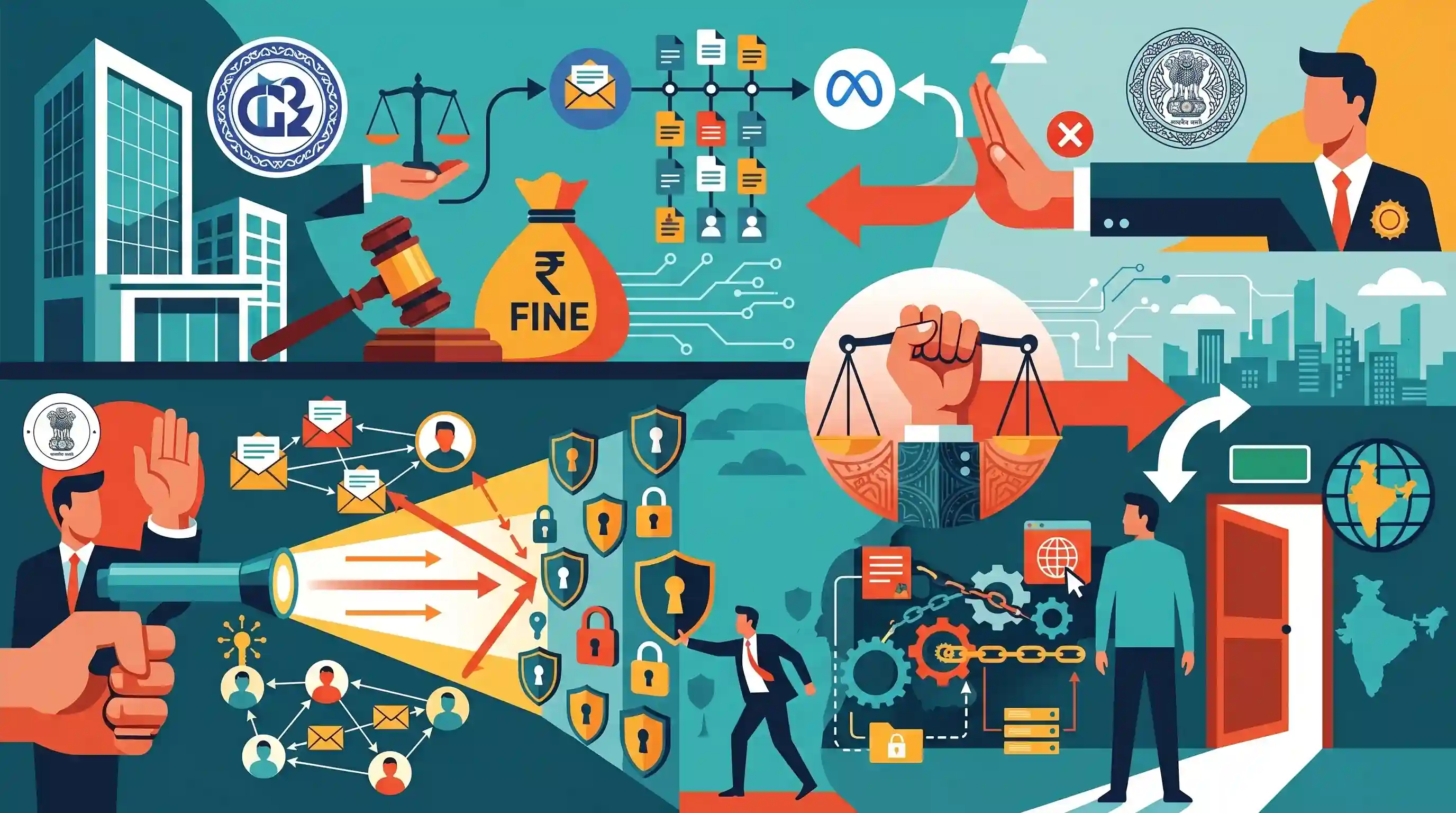
Meta and its subsidiary WhatsApp are facing intense judicial and regulatory ultimatums in India. The friction largely stems from two major fronts: the Competition Commission of India (CCI) imposing fines for WhatsApp's 2021 data-sharing policy which constituted an abuse of dominant market position, and the mandatory 'traceability' clause introduced in the IT Rules, 2021. The Indian government argues that traceability is essential to combat cybercrime and misinformation, while WhatsApp maintains that breaking end-to-end encryption to identify the 'first originator' of a message violates the fundamental Right to Privacy. The ongoing legal battles force Big Tech to choose between complying with stringent sovereign regulations or potentially exiting the Indian market, setting a critical precedent for tech regulation and digital privacy.
Key Points
- WhatsApp and Meta are facing strict regulatory action in India due to two parallel issues: anti-competitive data-sharing practices and the intermediary liability rules regarding traceability of messages.
- The Competition Commission of India (CCI) penalized Meta over its 2021 WhatsApp privacy policy, which mandated sharing user data across Meta companies, viewing it as an abuse of dominant market position.
- Under the IT Rules 2021, the Indian government requires significant social media platforms to enable the traceability of the 'first originator' of information to curb misinformation and cybercrimes.
- WhatsApp has challenged the traceability mandate in the Delhi High Court, arguing that it fundamentally breaks end-to-end encryption and infringes upon the users' fundamental Right to Privacy (Article 21).
- The judicial ultimatum signifies a critical turning point for Big Tech in India, highlighting the friction between national security/law enforcement, market regulation, and user privacy.
Important Terms
Information Technology (Intermediary Guidelines and Digital Media Ethics Code) Rules, 2021

Secondary legislation under the IT Act, 2000 that mandates due diligence, grievance redressal, and compliance requirements for social media intermediaries, OTT platforms, and digital news publishers.
UPSC context
GS Paper 2 (Government Policies) and Paper 3 (Cybersecurity); tests knowledge of intermediary liability and digital governance.
Competition Commission of India (CCI)
A statutory body established to promote fair competition, prevent anti-competitive agreements, and penalize the abuse of dominant market positions by major corporations.
UPSC context
GS Paper 2 (Statutory/Regulatory Bodies); relevant for topics concerning market regulation and big-tech oversight.
Competition Act, 2002
The primary legislation regulating business competition in India, replacing the MRTP Act to prohibit anti-competitive agreements and combinations that adversely affect market competition.
UPSC context
GS Paper 3 (Economy); vital for understanding legal frameworks governing corporate conduct and market fairness.
Digital Personal Data Protection Act, 2023
India’s comprehensive data protection law that establishes a framework for processing digital personal data, granting individuals rights while balancing lawful data use by fiduciaries.
UPSC context
GS Paper 2 (Polity/Fundamental Rights); central to discussions on digital sovereignty and the Right to Privacy.
Traceability Clause
A specific provision (Rule 4(2)) in the IT Rules 2021 requiring significant social media messaging platforms to identify the 'first originator' of information upon judicial or government order.
UPSC context
GS Paper 3 (Internal Security/Cybersecurity); tests the conflict between national security needs and end-to-end encryption.
Right to Privacy
A fundamental right under Article 21 of the Constitution, as affirmed by the K.S. Puttaswamy judgment (2017), protecting individuals from unauthorized intrusion into personal life and data.
UPSC context
GS Paper 2 (Fundamental Rights); essential for constitutional law and civil liberties themes.
Prelims Trap
CCI regulates and penalizes data privacy violations under the Digital Personal Data Protection Act.
CCI penalizes "abuse of dominant market position" under the Competition Act, 2002. Core data privacy violations fall under the DPDP Act, 2023, enforced by the Data Protection Board.
Static Concepts Connected
What is 'Safe Harbour' protection for tech intermediaries?
- Section 79: It is a legal immunity granted under Section 79 of the Information Technology Act, 2000.
- Immunity scope: Protects social media platforms and ISPs from legal liability for third-party user-generated content hosted on their networks.
- Conditional nature: This protection is conditional. Platforms must observe due diligence and comply with government guidelines (like IT Rules 2021) to retain it.
What is the Competition Commission of India (CCI)?
- Statutory origin: A statutory body established under the Competition Act, 2002, replacing the Monopolies and Restrictive Trade Practices (MRTP) Commission.
- Composition: Consists of a Chairperson and 2 to 6 other members, all appointed by the Central Government.
- Core mandate: Tasked with eliminating practices having an adverse effect on competition, promoting market competition, and preventing abuse of dominant market positions.
Cross-Topic Patterns
Antitrust meets Data Privacy
The line between competition law and data protection is blurring. Unfair data-sharing policies are now penalized as an "abuse of dominance" under antitrust laws, bridging GS2 governance with GS3 economy.
Article 21 vs. Cyber Security mandates
The 'traceability' mandate pits law enforcement and cybercrime prevention directly against the fundamental Right to Privacy (Puttaswamy judgment), illustrating the classic security vs. liberty debate for GS2 Mains.

Expect a Prelims MCQ on 'Safe Harbour' immunity conditions under the IT Act, paired with the exact mandate of CCI in digital markets.
Linked PYQs · 4
Linked PYQs · 4
- 2023MainsGS2
Discuss the role of the Competition Commission of India in containing the abuse of dominant position by the Multi-National Corporations in India. Refer to the recent decisions.
- 2024MainsGS2
Right to privacy is intrinsic to life and personal liberty and is inherently protected under Article 21 of the constitution. Explain. In this reference discuss the law relating to D.N.A. testing of child in the womb to establish its paternity.
- 2024MainsGS3
Describe the context and salient features of the Digital Personal Data Protection Act, 2023.
- 2018MainsGS3
Data security has assumed significant importance in the digitized world due to rising cyber crimes. The Justice B. N. Srikrishna Committee Report addresses issues related to data security. What, in your view, are the strengths and weaknesses of the Report relating to protection of personal data in cyber space?
