Maharashtra Onion Export Policies and Farmer Protests
Source:The Hindu ↗
Why It Matters
The ongoing onion farmer protests serve as a live case study for GS Paper 3 topics relating to agricultural pricing, APMC reforms, and the unintended consequences of trade policies. It highlights the conflict between anti-inflationary consumer policies and the goal of doubling farmer incomes, a recurring theme in UPSC Mains questions regarding the agriculture sector.
Summary
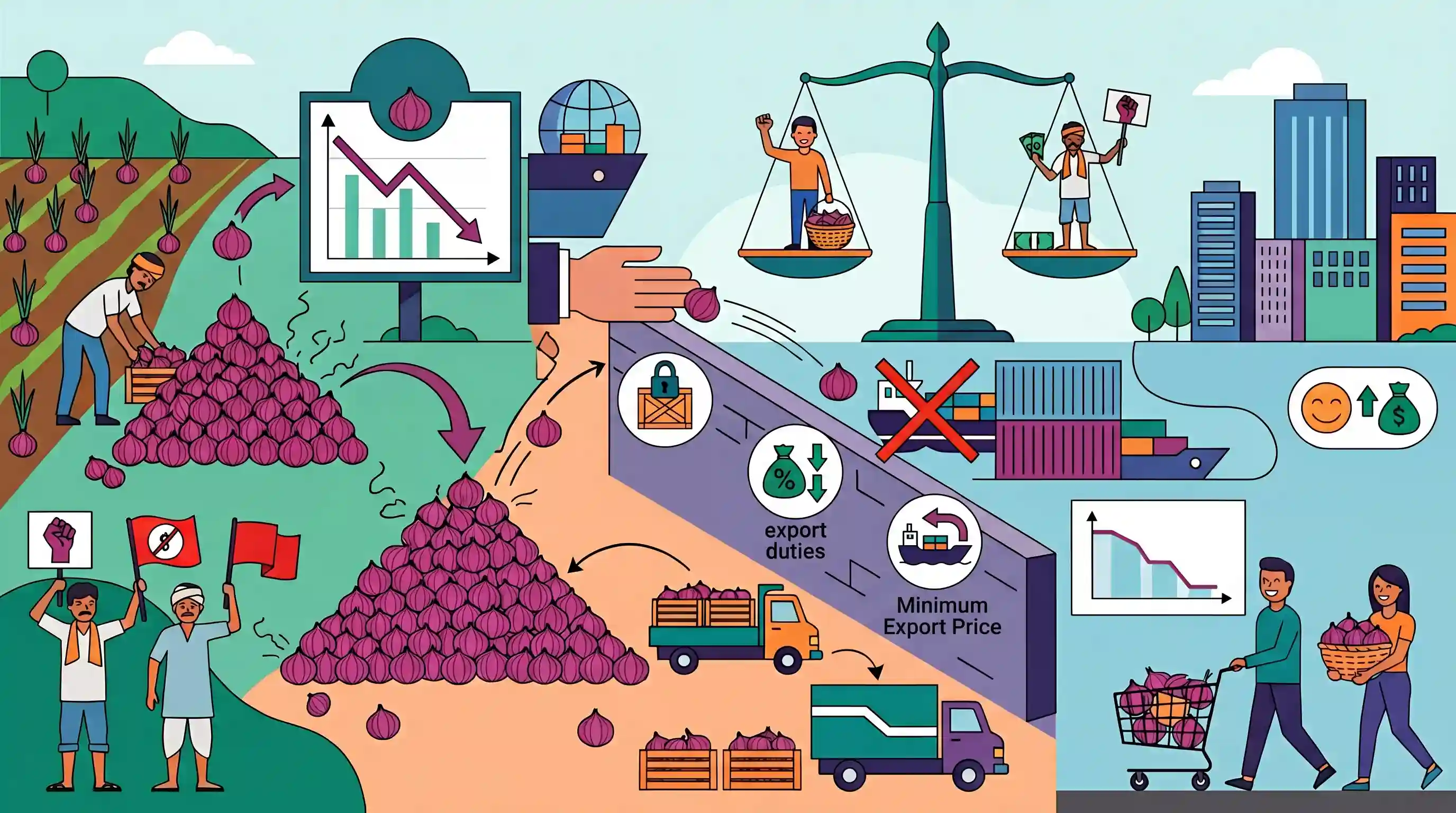
Maharashtra's onion farmers are engaged in persistent protests owing to a crash in wholesale prices, largely driven by the government's restrictive export policies. In a bid to control domestic food inflation and protect consumers, the government frequently imposes export bans, hefty export duties, and Minimum Export Prices (MEP) on onions. While successful in taming inflation, these measures sever farmers' access to lucrative global markets and create artificial domestic supply gluts, leading to unremunerative price realizations. Despite market intervention and buffer stock procurement by agencies like NAFED and NCCF, the scale remains insufficient to support prices at the APMC level. This scenario encapsulates the classic Indian agricultural policy dilemma: the trade-off between keeping food affordable for urban consumers and ensuring fair, predictable incomes for agricultural producers.
Key Points
- Onion farmers in Maharashtra, India's largest onion-producing state, are protesting due to plummeting wholesale prices at APMC markets.
- To control domestic food inflation and ensure adequate local supply, the Union government frequently uses ad-hoc trade policies like export bans, Minimum Export Price (MEP) thresholds, and high export duties.
- While these measures protect urban consumers from high prices, they artificially depress domestic wholesale prices and prevent farmers from capitalizing on lucrative international markets, causing immense revenue losses.
- Government agencies such as NAFED and NCCF procure onions for the national buffer stock to stabilize prices, but farmers argue the scale of procurement is often too small and delayed to prevent distress sales.
- The recurring crisis highlights structural issues in agricultural marketing for perishable commodities, including the lack of robust cold storage infrastructure, inadequate value addition, and the systemic tension between controlling inflation and ensuring remunerative farmer incomes.
Important Terms
Minimum Export Price (MEP) policy

The lowest price at which an exporter is permitted to sell a commodity abroad. It acts as a quantitative restriction to ensure domestic supply and control retail inflation by discouraging excessive exports.
UPSC context
GS-III: Trade policy and agricultural marketing. Relevant for food inflation and trade-offs between export earnings and domestic food security.
Price Stabilisation Fund (PSF)
A central fund established to mitigate price volatility of essential agri-horticultural commodities like onions. It finances procurement for buffer stocks, which are released strategically to stabilize market prices and protect consumers.
UPSC context
GS-III: Indian Economy and food security. Focuses on government interventions to manage inflation and stabilize prices of essential commodities.
Essential Commodities Act (ECA)
Legislation empowering the government to regulate the production, supply, and distribution of key goods. It allows for the imposition of stock limits and price controls to prevent hoarding and ensure food security.
UPSC context
GS-II & GS-III: Governance and Agriculture. Tests understanding of legal frameworks for market regulation and food security.
Agricultural Produce Market Committee (APMC)
State-governed marketing boards that regulate the first sale of agricultural produce. They operate "mandis" to ensure price discovery through auctions and protect farmers from exploitation by intermediaries or large retailers.
UPSC context
GS-III: Agricultural Marketing and Supply Chain. Key for analyzing market reforms and price discovery mechanisms.
National Agricultural Cooperative Marketing Federation of India (NAFED)
The apex body of agricultural marketing cooperatives in India. It acts as a central agency for procuring buffer stocks of onions and pulses under the Price Stabilisation Fund.
UPSC context
GS-III: Institutional framework for agriculture. Important for questions on cooperative marketing and government procurement operations.
National Cooperative Consumers' Federation of India (NCCF)
A national-level consumer cooperative that facilitates the procurement and distribution of essential goods. Along with NAFED, it intervenes in the market to build buffer stocks and ensure affordable food access.
UPSC context
GS-III: Agricultural Marketing. Relevant for the study of government agencies involved in food procurement and consumer welfare.
Prelims Trap
Minimum Export Price (MEP) is a guaranteed floor price paid by the government to farmers to encourage exports.
MEP is a trade restriction tool to stop cheap exports, not a support price paid to farmers. It hurts, rather than helps, farm incomes.
Static Concepts Connected
What is the mechanism for maintaining onion buffer stocks in India?
- PSF Mechanism: Managed by the Department of Consumer Affairs to mitigate price volatility of highly sensitive essential agri-horticultural commodities.
- Nodal Agencies: NAFED and NCCF serve as central agencies procuring onions directly from farmers or APMCs to build the national buffer.
- Market Intervention: Buffer stocks are released strategically into retail markets during lean seasons to cool down food inflation.
How does the Minimum Export Price (MEP) function as a trade policy tool?
- Definition: A statutory floor price set under the Foreign Trade Policy below which an exporter cannot sell goods abroad.
- Policy Objective: Used primarily to discourage outbound shipments, thereby augmenting domestic supply to check inflation of essentials.
- Economic Impact: Acts as an implicit tax on farmers by restricting their access to lucrative global markets during international price surges.
Cross-Topic Patterns
The 'Pro-Consumer Bias' in Agri-Policy
Frequent export bans and ECA limits to curb inflation inherently penalize farmers. Economic Surveys often term this reactive trade policy an 'implicit tax' on Indian agriculture.
Operation Greens and Perishable Logistics
Recurring price crashes in TOP (Tomato, Onion, Potato) crops highlight severe deficits in cold chains and value addition, proving that market intervention alone cannot replace infrastructure.

Multi-statement Prelims question expected contrasting MSP with MEP, alongside NAFED and NCCF's roles in the Price Stabilisation Fund.
Linked PYQs · 3
Linked PYQs · 3
- 2014MainsGS3
There is also a point of view that Agricultural Produce Market Committees (APMCs) set up under the State Acts have not only impeded the development of agriculture but also have been the cause of food inflation in India. Critically examine.
- 2024MainsGS3
What are the causes of persistent high food inflation in India? Comment on the effectiveness of the monetary policy of the RBI to control this type of inflation.
- 2020PrelimsGS1
Consider the following statements: 1. In the case of all cereals, pulses and oil-seeds, the procurement at Minimum Support Price (MSP) is unlimited in any State/UT of India. 2. In the case of cereals and pulses, the MSP is fixed in any State/UT at a level to which the market price will never rise. Which of the statements given above is/are correct?
