Global Landmine Casualties and Threats to Ottawa Convention
Source:The Hindu ↗
Why It Matters
Understanding the erosion of global disarmament frameworks like the Ottawa Convention and the humanitarian impacts of landmines is essential for analyzing modern conflicts, international law, and internal security challenges.
Summary
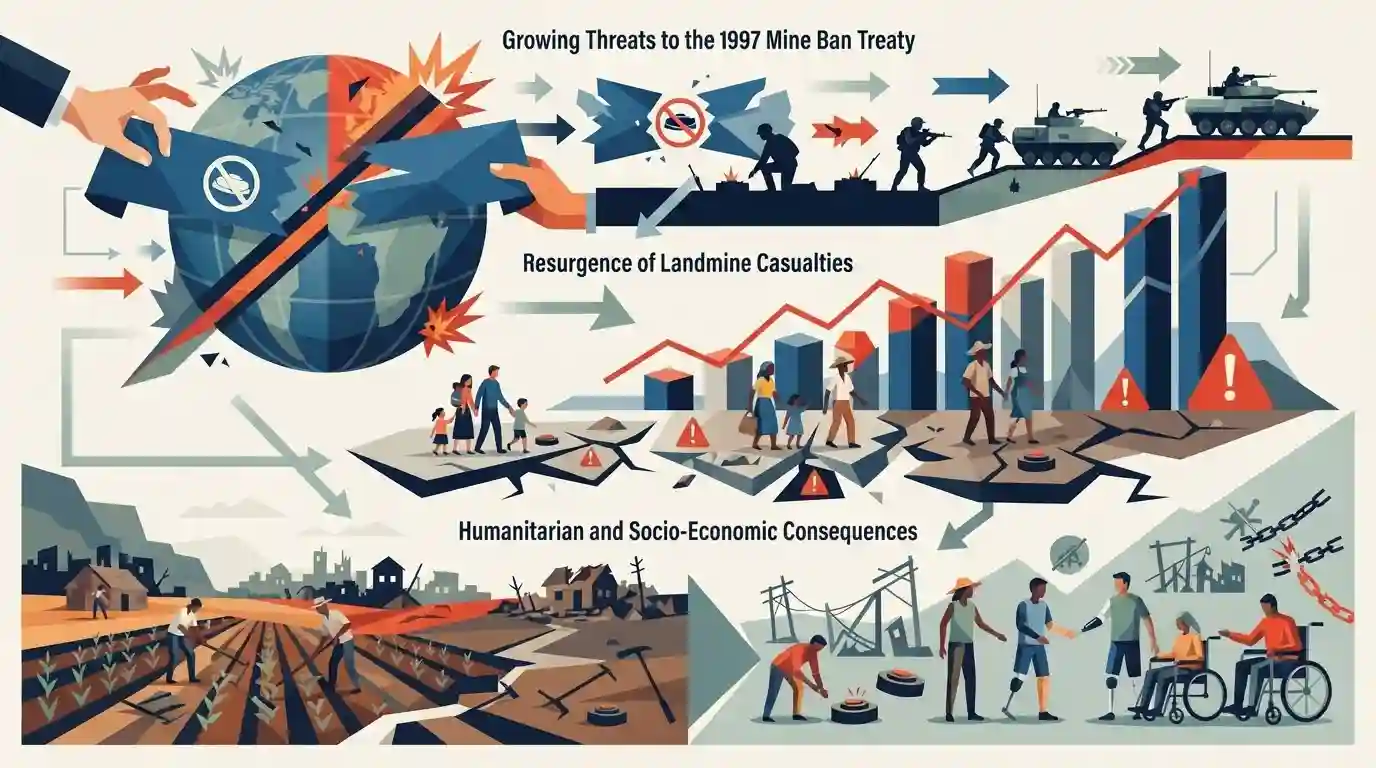
The article examines the alarming resurgence of landmine casualties globally amidst growing threats to the 1997 Mine Ban Treaty (Ottawa Convention). It explores how modern conflicts, non-state actors, and state breaches are reversing decades of disarmament progress, resulting in devastating humanitarian and socio-economic consequences for civilian populations long after conflicts cease.
Key Points
- Global landmine casualties are rising significantly, driven largely by ongoing armed conflicts like the war in Ukraine.
- The 1997 Mine Ban Treaty (Ottawa Convention) is facing severe threats from state non-compliance, new usage, and weakening international norms.
- Landmines pose long-term humanitarian, socio-economic, and developmental crises, disproportionately affecting civilians long after active hostilities end.
- De-mining efforts face severe funding shortfalls, technical hurdles, and high risks, stalling post-conflict rehabilitation.
Important Terms
Mine Ban Treaty

A landmark 1997 international treaty that bans the use, stockpiling, production, and transfer of anti-personnel landmines and mandates victim assistance and stockpile destruction.
UPSC context
GS Paper II (International Relations & Treaties) / GS Paper III (Internal Security); tests global disarmament norms, humanitarian law, and treaty compliance.
Ottawa Convention
Another name for the Mine Ban Treaty, referring to the convention opened for signature in Ottawa, Canada, in 1997 to eliminate anti-personnel mines.
UPSC context
GS Paper II (International Relations); tests understanding of multilateral disarmament treaties and international humanitarian conventions.
International Campaign to Ban Landmines
A global civil society network founded in 1992 that campaigned for the Mine Ban Treaty and shared the 1997 Nobel Peace Prize for its humanitarian advocacy.
UPSC context
GS Paper II (International Relations); tests the role of non-governmental organizations (NGOs) and civil society in global policymaking and disarmament.
Prelims Trap
India is a founding signatory to the 1997 Mine Ban Treaty (Ottawa Convention).
Aspirants often assume India is a signatory to the Ottawa Convention. India is NOT a party to the 1997 Mine Ban Treaty due to national security concerns along its borders.
Static Concepts Connected
What are the key international instruments regulating landmines and conventional weapons?
- Mine Ban Treaty: Ottawa Convention: Formally known as the Mine Ban Treaty (1997), it totally bans anti-personnel landmines. India, the US, China, and Russia are not signatories.
- CCW Protocol II: CCW Protocol II: The Convention on Certain Conventional Weapons regulates landmines, booby traps, and other devices, permitting their use under specific restrictions.
- Amended Protocol II: CCW Amended Protocol II: Strengthens restrictions on the use of mines and requires recording of minefield locations to protect civilians post-conflict.
Cross-Topic Patterns
Landmines and International Humanitarian Law Implementation
The Ottawa Convention and CCW illustrate how global disarmament regimes face enforcement gaps when major powers and non-state actors reject international humanitarian law.
Post-Conflict Reconstruction and Food Security Impact
Unexploded ordnance (UXO) and landmine contamination directly obstruct agricultural revival and rural development in post-conflict zones like Ukraine or Afghanistan.

Expect statement-based questions on the Ottawa Convention (binding vs non-signatories) and its distinction from the CCW protocols.
Linked PYQs · 3
Linked PYQs · 3
- 2026PrelimsGS1
Which of the following international conventions have not been ratified by India ? 1. Employment Policy Convention 2. Abolition of Forced Labour Convention 3. International Convention on the Protection of the Rights of All Migrant Workers and Members of Their Families 4. Geneva Convention Relative to the Protection of Civilian Persons in Time of War 5. Convention on Reduction of Statelessness Select the answer using the code given below :
- 2020PrelimsGS1
Consider the following pairs: International agreement/set-up Subject 1. Alma-Ata Declaration : Healthcare of the people 2. Hague Convention : Biological and chemical weapons 3. Talanoa Dialogue : Global climate change 4. Under2 Coalition : Child rights Which of the pairs given above is/are correctly matched?
- 2023MainsGS3
Winning of 'Hearts and Minds' in terrorism-affected areas is an essential step in restoring the trust of the population. Discuss the measures adopted by the Government in this respect as part of the conflict resolution in Jammu and Kashmir.
