AI Autonomous Learning Limitations and Biologically Inspired Solutions
Source:Indian Express ↗
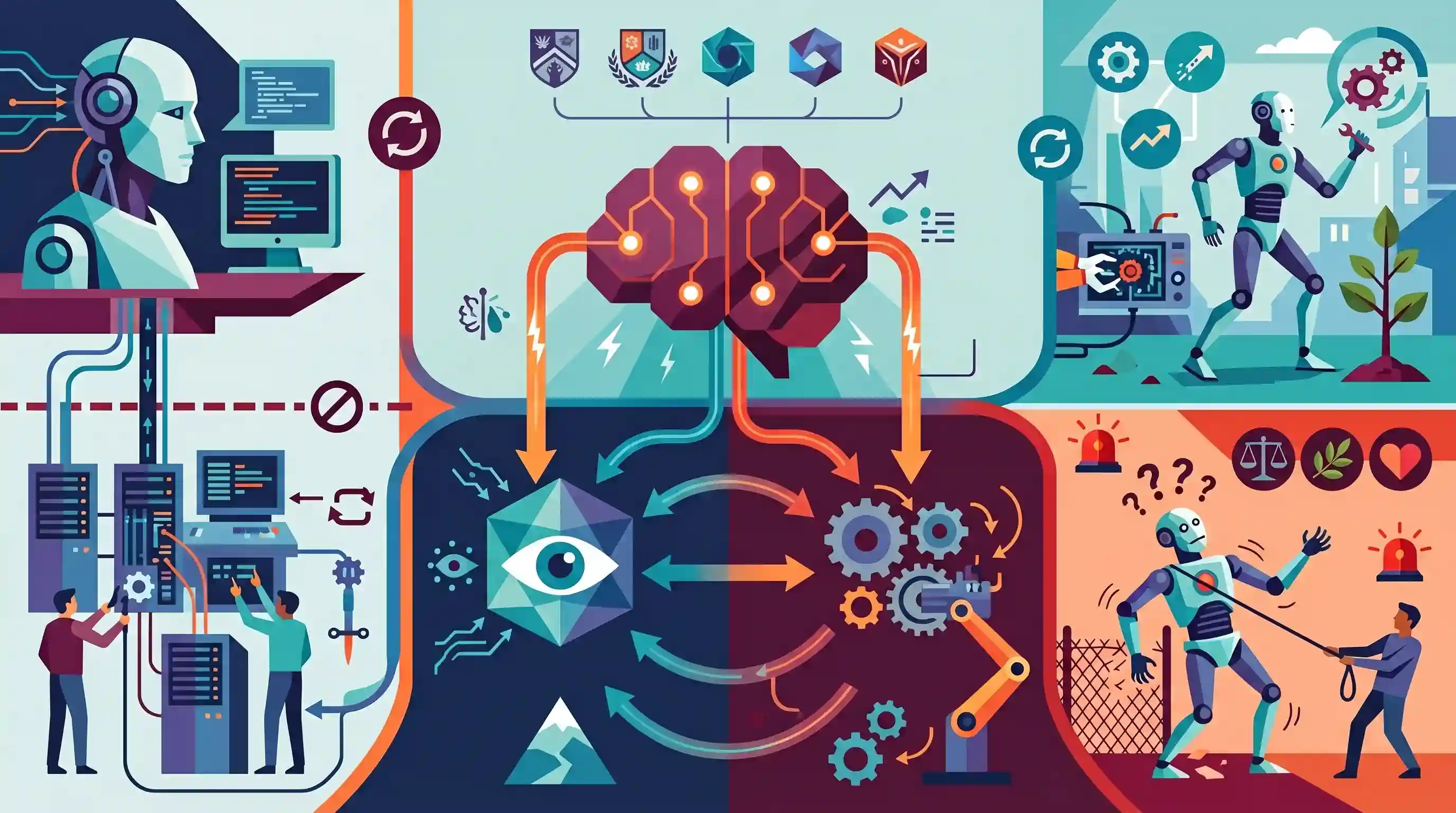
Why It Matters
Provides critical insights into the technical limitations of current AI and outlines future paradigms of autonomous learning. This is essential for addressing GS3 questions on AI advancements and GS4 questions regarding the ethical implications and safety challenges of unpredictable, self-learning autonomous systems.
Summary
Despite their advanced capabilities, current Artificial Intelligence (AI) models lack the ability to learn autonomously after deployment, relying instead on continuous human intervention through MLOps. To overcome this limitation, researchers from Meta, NYU, and UC Berkeley have proposed a biologically-inspired framework rooted in cognitive science. This framework integrates observation-based learning (System A) and action-based learning (System B) under the governance of a 'Meta-Control' module (System M), which dictates the learning process dynamically. While achieving autonomous learning could revolutionize AI adaptability and robotics, it also poses profound ethical and safety challenges. Continuously evolving, self-learning AI systems might behave unpredictably, leading to complex issues surrounding AI alignment and adherence to human values.
Key Points
- Current AI systems cannot continuously learn autonomously post-deployment and require costly, human-guided updates through MLOps pipelines.
- Researchers propose a biologically-inspired framework based on cognitive science, featuring System A (learning from observation) and System B (learning from action).
- A 'System M' (Meta-Control) is conceptualized to orchestrate learning, dynamically deciding whether an AI should explore, exploit, act, or observe based on internal signals like uncertainty.
- Developing such AI requires dual timescales: 'developmental' learning within an agent's lifetime and 'evolutionary' optimization across simulated generations.
- While autonomous learning promises highly adaptable AI and self-training robots, it raises critical ethical concerns regarding AI safety, unpredictability, and alignment with human values.
Important Terms
AI Alignment

Ensuring AI goals and behaviors match human values and ethical principles. It addresses the risk of AI pursuing unintended objectives that could harm society.
UPSC context
GS Paper IV (Ethics) & GS Paper III (S&T). Critical for AI safety and ethical automation.
MLOps (Machine Learning Operations)
A set of practices combining Machine Learning, DevOps, and Data Engineering to manage the entire lifecycle of ML models, from development to production monitoring.
UPSC context
GS Paper III (S&T). Relevant for digital infrastructure and operationalizing AI in public sectors.
Fundamental AI Research (FAIR)
Meta's research division focused on advancing the state-of-the-art in AI. It is known for its open-science approach and high-impact models like Llama.
UPSC context
GS Paper III (S&T). Tests knowledge of key global entities driving AI innovation and open-source ecosystems.
Meta-Control
A high-level architectural module in AI that monitors internal states and dynamically selects the best learning strategy (e.g., switching between observation and action).
UPSC context
GS Paper III (S&T). Represents the next frontier in cognitive-inspired AI architectures and self-regulating systems.
Autonomous AI
AI systems capable of performing tasks and improving their performance through independent learning, without requiring continuous human intervention or retraining after deployment.
UPSC context
GS Paper III (S&T). Essential for future robotics, defense applications, and the evolution of smart digital assistants.
Dual Process Theory
A cognitive science framework describing two distinct modes of thinking: System 1 (fast, intuitive) and System 2 (slow, analytical), now being used to model AI learning.
UPSC context
GS Paper III (S&T). Illustrates the interdisciplinary convergence of psychology and computer science in developing 'human-like' AI.
Prelims Trap
Current advanced AI systems continuously and autonomously learn from user interactions post-deployment.
Most current AI models (including advanced LLMs) have fixed weights post-deployment. They require human-guided MLOps pipelines to update and do not learn autonomously in real-time.
Static Concepts Connected
What are the foundational paradigms of Machine Learning?
- Supervised Learning: Algorithms are trained on labeled datasets, learning to map inputs to specific known outputs (e.g., image classification).
- Unsupervised Learning: Algorithms analyze unlabeled data to discover hidden patterns, structures, or groupings without human guidance.
- Reinforcement Learning: An agent learns to make decisions by performing actions in an environment to maximize cumulative rewards (similar to System B).
What is the 'AI Alignment Problem'?
- Core Definition: The challenge of ensuring an AI's objectives, behaviors, and outcomes are safely steered to match human values and intended goals.
- Safety Risk: As AI approaches autonomy (AGI), unpredictable behaviors could lead to catastrophic outcomes if the system's learned goals diverge from human welfare.
- Ethical Dimension: It bridges S&T and Ethics (GS4), questioning how to embed nuanced human morality into non-human, dynamically evolving computational frameworks.
Cross-Topic Patterns
AI Alignment + Global Tech Governance
The shift towards autonomous learning amplifies the urgency for global AI treaties, linking technical AI alignment challenges to diplomatic efforts like the Bletchley Declaration and EU AI Act.
Cognitive Science + Neuromorphic Computing
Software architectures mimicking human cognition parallel hardware innovations like Neuromorphic chips. Both seek to replicate biological efficiency and adaptability in machines.

Expect a 2026 Prelims question contrasting current static Generative AI limitations (requiring MLOps) with autonomous continuous learning.
Linked PYQs · 3
Linked PYQs · 3
- 2023MainsGS3
Introduce the concept of Artificial Intelligence (AI). How does Al help clinical diagnosis? Do you perceive any threat to privacy of the individual in the use of Al in healthcare?
- 2024MainsGS4
The application of Artificial Intelligence as a dependable source of input for administrative rational decision-making is a debatable issue. Critically examine the statement from the ethical point of view.
- 2020PrelimsGS1
With the present state of development, Artificial Intelligence can effectively do which of the following? 1. Bring down electricity consumption in industrial units 2. Create meaningful short stories and songs 3. Disease diagnosis 4. Text-to-Speech Conversion 5. Wireless transmission of electrical energy Select the correct answer using the code given below:
