Artificial Intelligence in Healthcare and Workflow Discipline
Source:The Hindu ↗
Why It Matters
UPSC frequently asks about the applications and challenges of emerging technologies like AI. This article provides a critical, practical perspective: moving beyond the hype of AI to understand the operational bottlenecks (workflow discipline, data structuring) that prevent its successful deployment in critical sectors like healthcare.
Summary
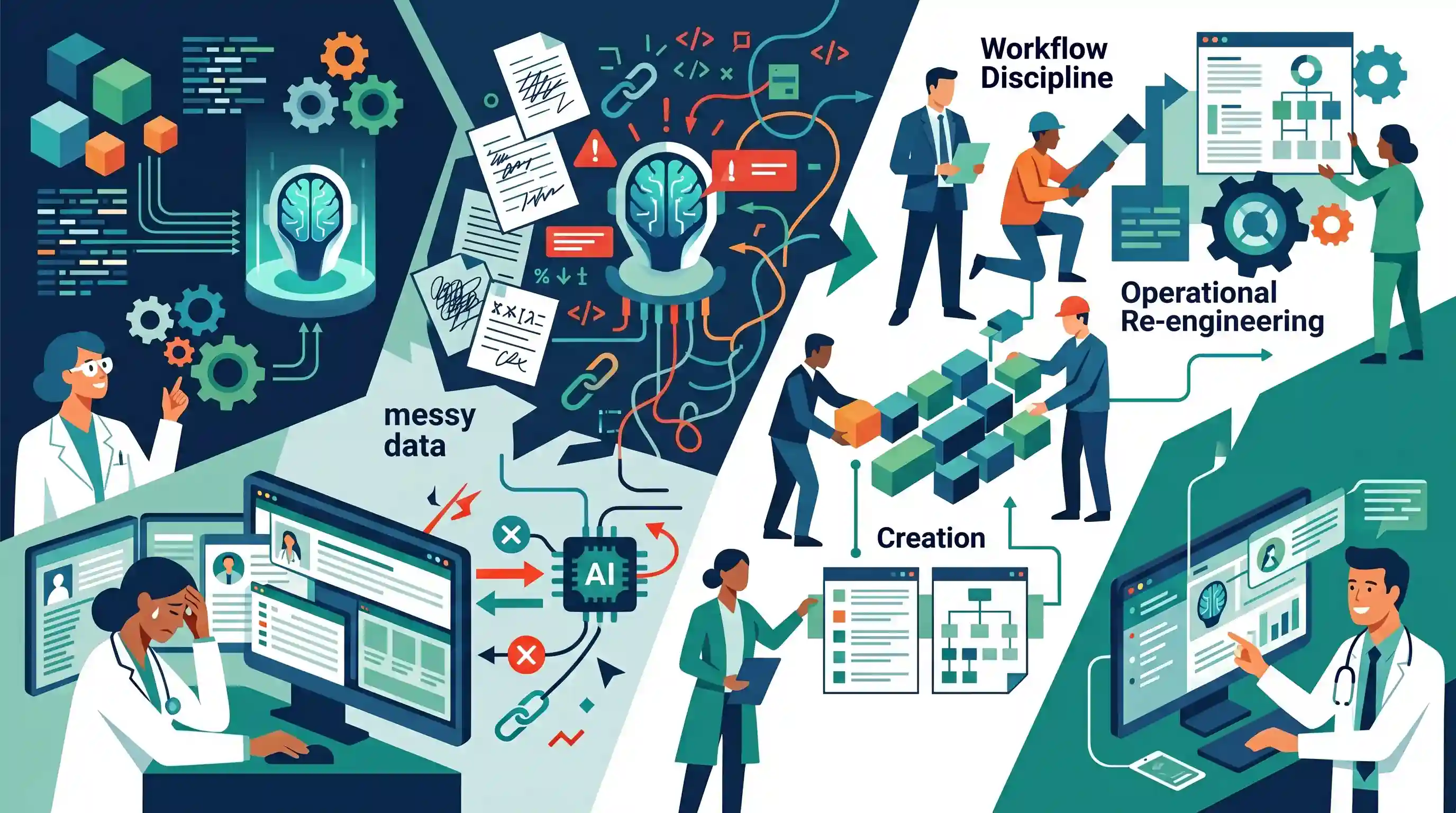
While Artificial Intelligence holds transformative potential for clinical diagnostics and patient care, its real-world implementation frequently falls short. The core issue is a lack of 'workflow discipline' within healthcare settings. AI models are typically trained on pristine, curated datasets, but real-world clinical data is often messy and unstructured due to inconsistent data entry practices. Furthermore, simply introducing an AI tool without integrating it seamlessly into a physician's daily routine and Electronic Health Record (EHR) system causes friction and low adoption. To harness AI effectively, healthcare institutions must first standardize their clinical workflows, improve data governance, and view AI not as a plug-and-play solution, but as a component requiring significant operational re-engineering.
Key Points
- AI models in healthcare frequently underperform in real-world clinical settings despite showing high accuracy in lab environments.
- The primary bottleneck is the lack of 'workflow discipline'—hospitals often lack standardized, structured processes for data entry and clinical decision-making.
- AI systems require clean, structured data; messy, unstructured real-world clinical data leads to poor AI predictions (garbage in, garbage out).
- Successful AI integration requires re-engineering clinical pathways, seamless interoperability with Electronic Health Records (EHRs), and continuous training for healthcare professionals.
- The failure highlights that technological innovation cannot bypass the need for robust operational and governance processes in healthcare delivery.
Prelims Trap
"Ayushman Bharat Digital Mission (ABDM) directly integrates AI models for automated clinical diagnostics in empanelled hospitals."
ABDM builds the data foundation (ABHA IDs, registries) for digital interoperability. It does not mandate, deploy, or run AI diagnostic models itself.
Static Concepts Connected
What are the foundational pillars of the Ayushman Bharat Digital Mission (ABDM)?
- ABHA Number: A 14-digit randomly generated health account number that links a patient's medical records digitally across different healthcare providers.
- Core Registries: The Healthcare Professionals Registry (HPR) and Health Facility Registry (HFR) act as verified, single sources of truth for medical infrastructure.
- Unified Health Interface: An open network designed to enable interoperable digital health services, functioning similarly to UPI for healthcare transactions.
What are the core operational barriers to implementing e-Governance in India?
- Process Re-engineering: Merely computerizing inefficient processes fails; underlying workflows must be redesigned and standardized to leverage digital tools effectively.
- Data Silos: A lack of interoperability and standardized data formats across departments prevents systems from communicating and sharing clean data.
- Capacity Building: End-users (like doctors or administrators) require training and continuous support to overcome resistance to adopting new technologies.
Cross-Topic Patterns
e-Governance: Digitization vs Re-engineering
The failure of "plug-and-play" AI mirrors early e-governance failures where manual processes were merely computerized without undergoing essential Business Process Re-engineering (BPR).
ABDM as Healthcare DPI
Structured Electronic Health Records (EHRs) form the base layer of healthcare Digital Public Infrastructure. Just as UPI structured payments, ABDM structures clinical data to enable AI.

Expect a GS3 Mains question linking the success of AI in Indian healthcare strictly to the rollout of ABDM and Electronic Health Records.
Linked PYQs · 3
Linked PYQs · 3
- 2023MainsGS3
Introduce the concept of Artificial Intelligence (AI). How does Al help clinical diagnosis? Do you perceive any threat to privacy of the individual in the use of Al in healthcare?
- 2020PrelimsGS1
With the present state of development, Artificial Intelligence can effectively do which of the following? 1. Bring down electricity consumption in industrial units 2. Create meaningful short stories and songs 3. Disease diagnosis 4. Text-to-Speech Conversion 5. Wireless transmission of electrical energy Select the correct answer using the code given below:
- 2024MainsGS2
e-governance is not just about the routine application of digital technology in service delivery process. It is as much about multifarious interactions for ensuring transparency and accountability. In this context evaluate the role of the 'Interactive Service Model' of e-governance.
