Lok Sabha Seat Delimitation Freeze and Federal Representation Balance
Source:The Hindu ↗
Why It Matters
The post-2026 delimitation is one of the most critical constitutional and political challenges facing modern India, with profound implications for democratic representation, national integration, and the North-South federal balance.
Summary
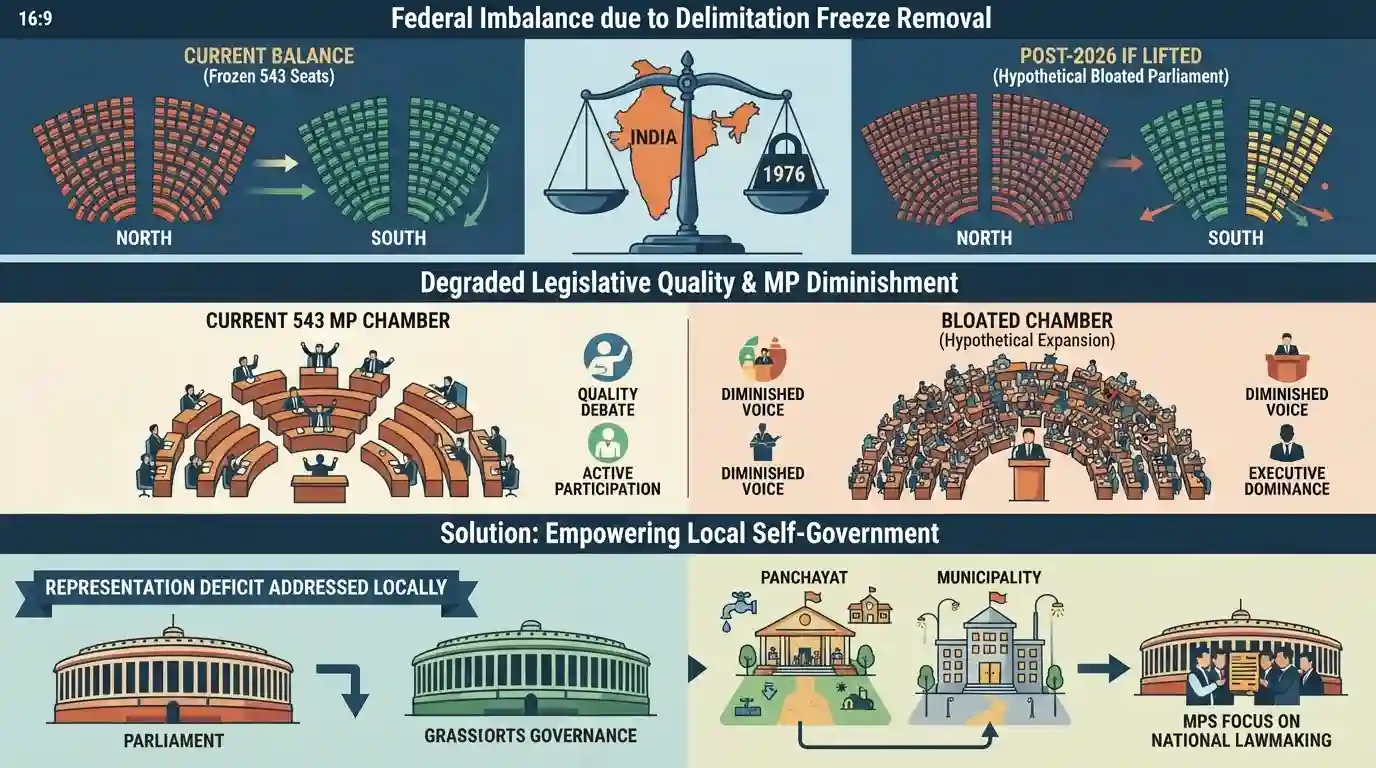
This article argues against expanding the number of Lok Sabha seats beyond the current 543. It explains that a frozen seat count has protected the political voice of Southern states that successfully managed population growth. Lifting this freeze post-2026 would lead to a massive federal imbalance, favoring Northern states. Furthermore, a bloated Parliament would degrade legislative quality, diminish individual MP participation, and empower executive dominance. The author suggests that the representation deficit should instead be addressed by empowering local self-governments (Panchayats and Municipalities) to handle local grievances, leaving MPs to focus on national-level lawmaking.
Key Points
- The allocation of Lok Sabha seats has been frozen at 543 since 1976 (based on the 1971 census) to prevent penalizing states that successfully implemented family planning and population control.
- The current freeze on seats is set to expire after the first census taken after 2026, triggering debates on whether the size of the Lok Sabha should be expanded to match India's massive population growth.
- Simply increasing the number of MPs to say 800 or more will make the Lok Sabha highly unwieldy, severely reduce the individual debating time available to MPs, and further consolidate power within the executive and party whips.
- Lifting the freeze and redistributing seats based on current population would reward states with high fertility rates (mostly in the North) and politically marginalize performing states (mostly in the South), threatening the delicate balance of Indian federalism.
- The primary constitutional role of an MP is national lawmaking and executive oversight, not local municipal work. Thus, the solution to the citizen-representative gap lies in empowering the third tier of government (Panchayats and Urban Local Bodies) through actual devolution of funds, functions, and functionaries, rather than bloating the national parliament.
Important Terms
42nd Constitutional Amendment Act, 1976

A landmark constitutional amendment that froze Lok Sabha and State Legislative Assembly seat allocations based on the 1971 Census to encourage states to control population growth without losing political power.
UPSC context
GS Paper II (Polity). Tests understanding of federal balance, demographic representation, and constitutional evolution.
84th Constitutional Amendment Act, 2001
This amendment extended the freeze on the total number of seats in the Lok Sabha and State Assemblies until the first census after 2026, maintaining inter-state political representation based on the 1971 Census.
UPSC context
GS Paper II (Polity). Tests understanding of Center-State relations, demographic representation, and 2026 delimitation challenges.
Delimitation Commission of India
A statutory, independent body appointed by the President of India to redraw the boundaries of parliamentary and assembly constituencies based on census data to ensure equal representation.
UPSC context
GS Paper II (Elections). Tests understanding of constituency division, the principle of 'one vote, one value', and legislative independence.
73rd Constitutional Amendment Act, 1992
A constitutional amendment that established rural local self-governance by granting constitutional status to Panchayati Raj Institutions, adding Part IX and the Eleventh Schedule to the Constitution.
UPSC context
GS Paper II (Local Governance). Tests knowledge of democratic decentralization, rural empowerment, and cooperative federalism.
74th Constitutional Amendment Act, 1992
A constitutional amendment that introduced urban local self-governance by granting constitutional status to Municipalities, adding Part IXA and the Twelfth Schedule to the Indian Constitution.
UPSC context
GS Paper II (Local Governance). Tests understanding of municipal governance, urban administration, and democratic decentralization.
MPLAD Scheme
A Central Sector Scheme enabling Members of Parliament to recommend developmental works creating durable community assets in their constituencies, funded up to five crore rupees annually.
UPSC context
GS Paper II (Government Schemes). Tests understanding of separation of powers, development administration, and MPs' role in local constituencies.
Prelims Trap
The 84th Amendment completely froze all delimitation exercises, halting any redrawing of constituency boundaries until after 2026.
The freeze only applied to inter-state seat allocation. Intra-state boundary readjustment was permitted and carried out based on the 2001 census via the 87th Amendment.
Static Concepts Connected
What is the constitutional status and power of a Delimitation Commission in India?
- Constitutional Basis: Setup under Article 82 (Parliament) and Article 170 (States) after every census, appointed by the President of India.
- Composition: Comprises a retired Supreme Court judge as chairperson, the Chief Election Commissioner, and respective State Election Commissioners.
- Judicial Immunity: Its orders have the force of law and cannot be challenged in any court to ensure election schedules are not delayed.
How does the Indian Constitution address demographic representation in legislative bodies?
- Article 81 Formula: Mandates a uniform ratio between allocated Lok Sabha seats and state population, creating structural conflict when regional growth rates diverge.
- Fourth Schedule Allocation: Allocates seats based on population, unlike equal representation in the US Senate, which accentuates asymmetric federal representation.
Cross-Topic Patterns
Demography + Fiscal Federalism
Post-2026 delimitation concerns mirror the 15th Finance Commission disputes, where performing Southern states feared penalty for population control under 2011 Census-based tax devolution.
Gender Quotas + Delimitation Deadlock
The 106th Amendment's implementation is legally tethered to the post-2026 census and delimitation, making women's legislative representation a hostage to federal seat-sharing disputes.
Decentralization + Legislative Efficiency
Empowering the third tier (73rd/74th Amendments) offloads constituency-level municipal grievances from MPs, reducing the justification for bloating Parliament's size.

Expect a multi-statement question on the constitutional history of delimitation freezes and their direct link to women's legislative quotas.
Linked PYQs · 3
Linked PYQs · 3
- 2024PrelimsGS1
How many Delimitation Commissions have been constituted by the Government of India till December 2023?
- 2022MainsGS2
“While the national political parties in India favour centralisation, the regional parties are in favour of State autonomy.” Comment.
- 2017MainsGS2
The local self-government system in India has not proved to be effective instrument of governance." Critically examine the statement and give your views to improve the situation.
