Wholesale Price Inflation Surges to Multi-Year High on Energy Costs
Source:The Hindu ↗
Why It Matters
The divergence between wholesale and retail inflation, the mechanics of the 'base effect,' and the way global geopolitical shocks (like the West Asia crisis) translate into domestic 'imported inflation' through crude oil prices are core macroeconomic concepts frequently tested in both UPSC Prelims and Mains.
Summary
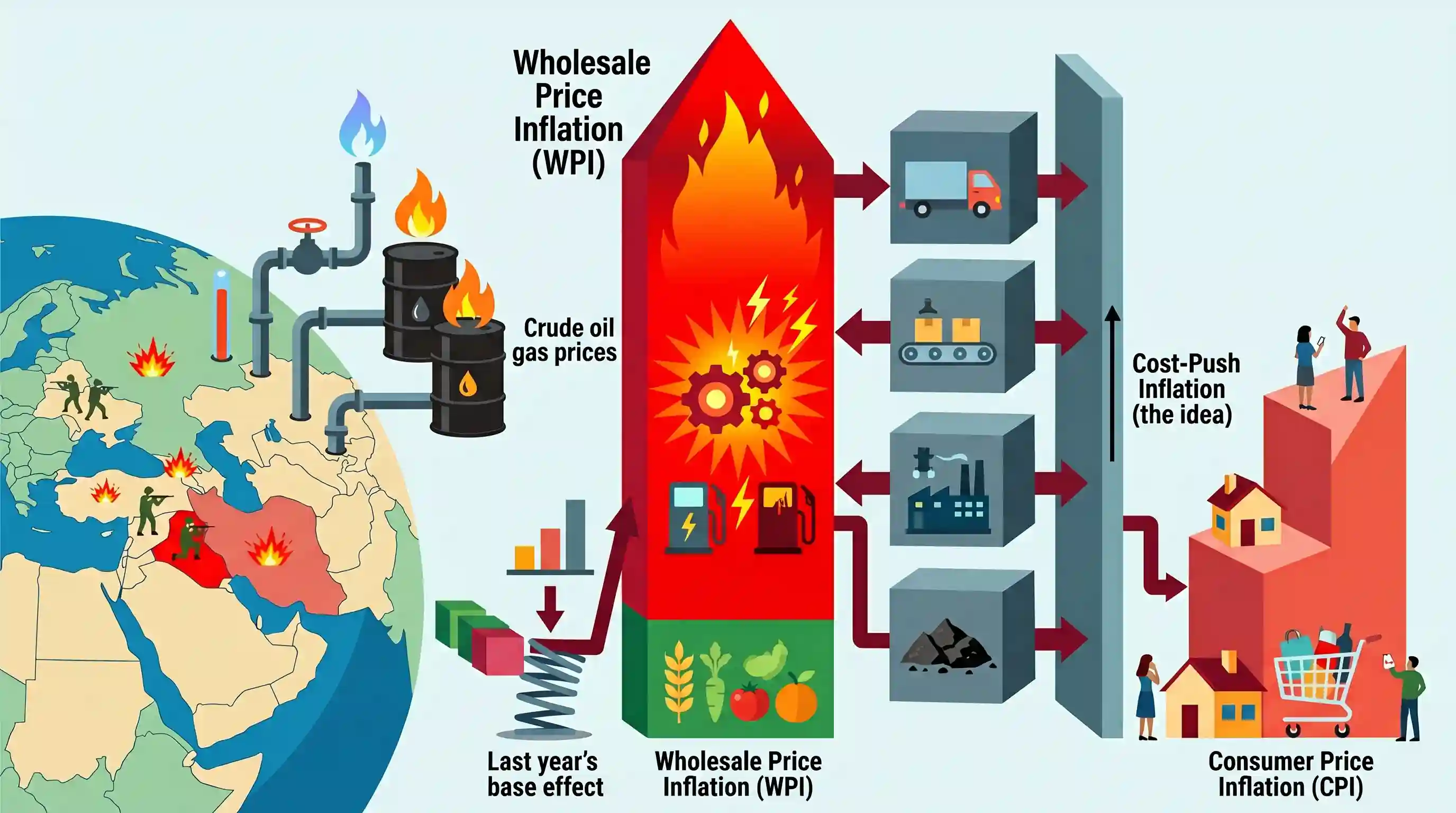
India's wholesale price inflation (WPI) escalated to a 3.5-year high of 8.3% in April 2026, largely propelled by escalating global crude oil and natural gas prices stemming from geopolitical tensions in West Asia. While primary food inflation remained low, the energy and non-food sectors experienced dramatic spikes, which were further amplified by a statistical base effect from the previous year's deflation. Financial experts warn that these elevated wholesale logistics and commodity costs will likely result in cost-push inflation, eventually trickling down to consumers and impacting overall retail inflation (CPI).
Key Points
- India's Wholesale Price Index (WPI) inflation surged to an 8.3% high in April 2026, marking the highest level in three and a half years.
- The primary driver of this inflation spike was the crude oil and natural gas segment, which saw a 67.2% inflation rate fueled by the ongoing West Asia crisis.
- A favorable 'base effect' exaggerated the current figures, as these energy commodities had experienced significant deflation during the corresponding months of the previous year.
- While energy and non-food articles witnessed sharp price increases, primary food inflation remained relatively subdued at 1.98%.
- Economists caution that elevated wholesale prices in logistics, freight, and commodities represent 'cost-push' inflation that will likely eventually pass through to consumer retail inflation (CPI) and squeeze corporate profit margins.
Important Terms
Wholesale Price Index (WPI)

Measures average price changes of goods at the wholesale or producer level. In India, it is published monthly by the Office of the Economic Adviser (OEA).
UPSC context
GS Paper 3 (Economy). Essential for understanding producer-level inflation and its role as a GDP deflator.
Consumer Price Index (CPI)
Measures price changes from the retail buyer's perspective, including services. It is the primary anchor used by the RBI for its inflation-targeting framework.
UPSC context
GS Paper 3 (Economy). Crucial for monetary policy analysis and understanding the cost of living.
Cost-Push Inflation
Inflation driven by rising costs of production inputs, such as raw materials and energy, which forces firms to increase prices to maintain margins.
UPSC context
GS Paper 3 (Economy). Tests the ability to identify supply-side vs. demand-side inflation drivers.
Base Effect
The distortion in current inflation figures caused by unusually low or high price levels in the same period of the previous year.
UPSC context
GS Paper 3 (Economy). Critical for accurate statistical interpretation of year-on-year economic data and growth trends.
Imported Inflation
Domestic price increases triggered by the rising cost of essential imported commodities, particularly crude oil, often due to global supply shocks or currency depreciation.
UPSC context
GS Paper 3 (Economy). Relevant for external sector stability and India's vulnerability to global geopolitical crises.
Ministry of Commerce and Industry
The central ministry responsible for trade, industrial development, and WPI compilation via its Office of the Economic Adviser.
UPSC context
GS Paper 2 & 3. Identifies the nodal agency for industrial data, trade policy, and wholesale inflation monitoring.
Prelims Trap
"Food articles hold a higher weightage in WPI than CPI, and WPI captures wholesale price changes in both goods and services."
WPI completely excludes services (unlike CPI) and gives the highest weightage to Manufactured Products (~64%). Food items hold a significantly higher weightage in CPI (~45%) than in WPI.
Static Concepts Connected
What are the core structural differences between WPI and CPI?
- Goods vs Services: WPI tracks wholesale goods and completely excludes services. CPI tracks retail-level prices for a basket of both goods and services.
- Component Weightages: Manufactured products dominate WPI (approx. 64.2%), whereas Food and Beverages hold the highest weightage in CPI (approx. 45.8%).
- Publishing Agencies: WPI is published by the Office of Economic Adviser (MoCI); CPI is published by the National Statistical Office (MoSPI).
How do Cost-Push and Imported Inflation differ from Demand-Pull?
- Cost-Push Inflation: Driven by a decrease in aggregate supply due to increased costs of production, raw materials, or supply chain disruptions, regardless of consumer demand.
- Imported Inflation: A specific subset of cost-push inflation where domestic prices rise due to costlier imported inputs (e.g., global crude oil spikes) or domestic currency depreciation.
- Demand-Pull Inflation: Occurs when aggregate demand outpaces aggregate supply, often fueled by rising incomes, expansionary fiscal policies, or lower interest rates.
Cross-Topic Patterns
West Asia geopolitics & twin deficits
Geopolitical disruptions in the Middle East directly inflate India's WPI via crude oil spikes, simultaneously widening the Current Account Deficit (CAD) and stressing the Rupee's exchange rate.
WPI-CPI divergence & RBI monetary policy
The RBI targets CPI for its monetary policy, meaning a WPI spike only triggers repo rate hikes if this 'cost-push' wholesale inflation successfully passes through to retail consumers.

Expect a 2026 prelims statement contrasting WPI/CPI weightages, specifically linking imported fuel costs to WPI spikes vs food in CPI.
Linked PYQs · 4
Linked PYQs · 4
- 2020PrelimsGS1
Consider the following statements: 1. The weightage of food in Consumer Price Index (CPI) is higher than that in Wholesale Price Index (WPI). 2. The WPI does not capture changes in the prices of services, which CPI does. 3. Reserve Bank of India has now adopted WPI as its key measure of inflation and to decide on changing the key policy rates. Which of the statements given above is/are correct?
- 2010PrelimsGS1
With reference to India, consider the following statements : 1. The Wholesale Price Index (WPI) in India is available on a monthly basis only. 2. As compared to Consumer Price Index for Industrial Workers (CPI(IW)), the WPI gives less weight to food articles. Which of the statements given above is/are correct ?
- 2021PrelimsGS1
With reference to Indian economy, demand-pull inflation can be caused/ increased by which of the following? 1. Expansionary policies 2. Fiscal stimulus 3. Inflation-indexing wages 4. Higher purchasing power 5. Rising interest rates Select the correct answer using the code given below.
- 2018MainsGS3
How would the recent phenomena of protectionism and currency manipulations in world trade affect macroeconomic stability of India?
