India Wholesale Price Inflation Accelerates to 1.81 Percent in January
Source:The Hindu ↗
Why It Matters
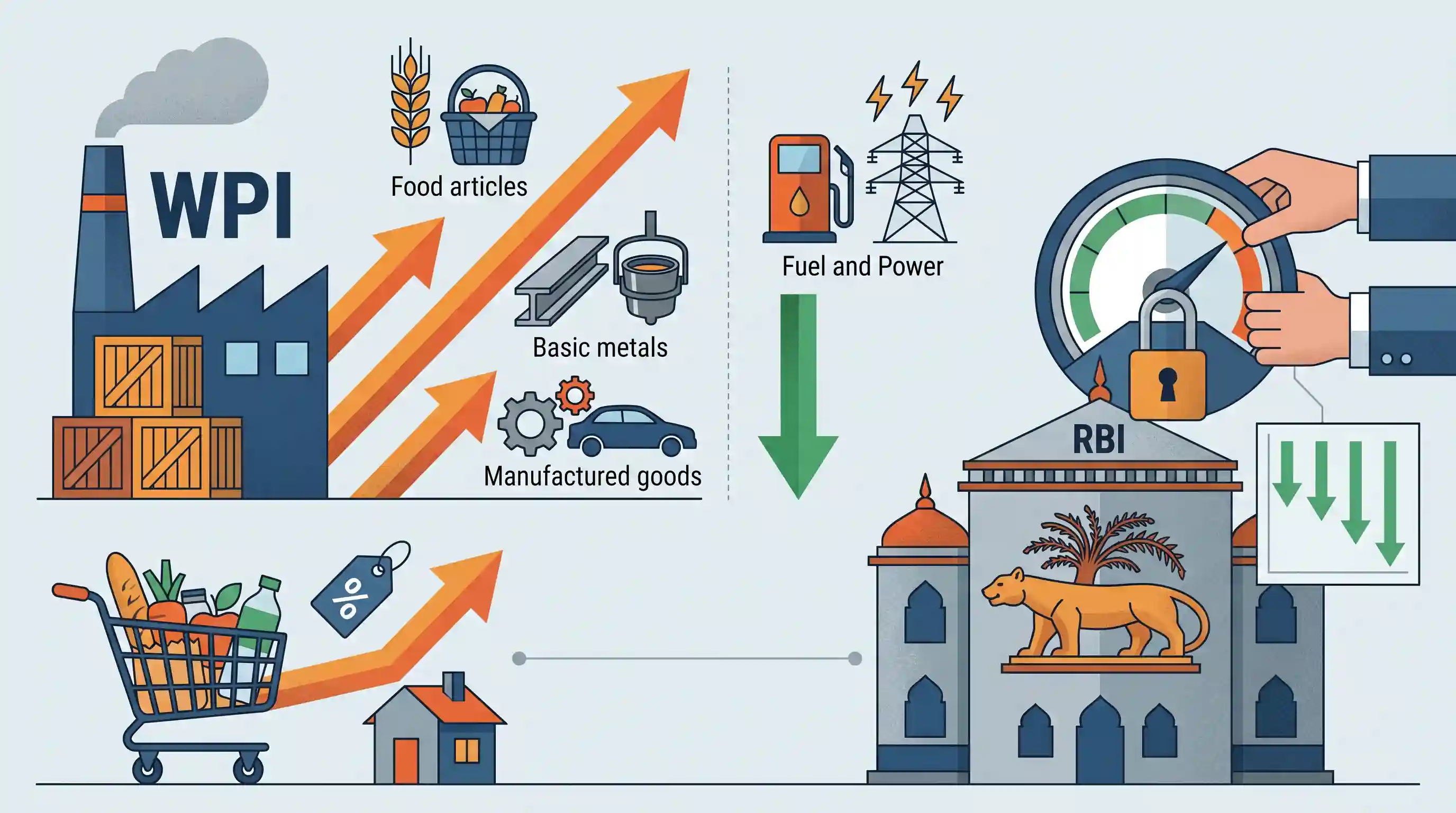
Understanding the composition and divergence of inflation indices like WPI and CPI is foundational for macroeconomic analysis. It highlights how sectoral price movements (e.g., deflation in fuel vs. inflation in food) impact the broader economy and dictate the RBI's monetary policy stance, particularly its interest rate decisions under the inflation-targeting framework.
Summary
India's Wholesale Price Index (WPI) inflation accelerated to 1.81% in January 2026, marking an upward trend driven primarily by price increases in food articles, basic metals, and manufactured goods. Conversely, the fuel and power segment continued to register deflation at -4.01%. In tandem, retail inflation (CPI) inched up to 2.75%. The Reserve Bank of India (RBI), which relies on CPI as its nominal anchor for inflation targeting, held its benchmark interest rate steady at 5.25%, having already implemented 1.25 percentage points in rate cuts during the current fiscal year amidst broadly benign inflation metrics.
Key Points
- India's Wholesale Price Index (WPI) inflation rose to 1.81% in January 2026, up from 0.83% in December 2025.
- The increase in WPI was driven by higher prices for primary articles (including food and non-food items), basic metals, textiles, and manufactured products.
- The fuel and power sector continued to experience deflation, recording negative inflation of 4.01% in January.
- Retail inflation, measured by the Consumer Price Index (CPI), stood at 2.75% for the same month.
- The Reserve Bank of India (RBI), which targets CPI for its monetary policy, maintained its benchmark interest rate at 5.25% after reducing it by 1.25 percentage points earlier in the fiscal year.
Important Terms
Consumer Price Index (CPI)

An index measuring price changes of a basket of goods and services purchased by households. Compiled by the NSO, it reflects retail inflation and cost of living.
UPSC context
GS Paper 3 (Economy); crucial for understanding RBI's mandate and inflation targeting framework.
Wholesale Price Index (WPI)
An index measuring the average change in prices of goods at the wholesale level. Compiled by the Office of Economic Adviser, it tracks producer-level inflation trends.
UPSC context
GS Paper 3 (Economy); tested for its components, base year, and differences with CPI.
Inflation Targeting
A monetary policy framework where the RBI aims to maintain a specific CPI inflation rate, currently 4% with a tolerance band of ±2%.
UPSC context
GS Paper 3 (Economy); significant for policy-related questions on price stability and growth.
Nominal Anchor
A variable, such as the CPI inflation rate, used by the central bank to stabilize price expectations and guide its monetary policy decisions.
UPSC context
GS Paper 3 (Economy); tests knowledge of the theoretical foundation behind modern monetary policy.
Monetary Policy Committee (MPC)
A six-member statutory body chaired by the RBI Governor, mandated to determine the benchmark repo rate to achieve the government-set inflation target.
UPSC context
GS Paper 3 (Economy) and Prelims; essential for understanding institutional decision-making in India.
Deflation
A sustained decrease in the general price level of goods and services, resulting in a negative inflation rate.
UPSC context
GS Paper 3 (Economy); important for analyzing sector-specific economic trends and price volatility.
Prelims Trap
"Both WPI and CPI track changes in the prices of goods and services in the economy."
While CPI includes both goods and services (like housing, health, education), WPI exclusively tracks the wholesale prices of goods and completely ignores services.
Static Concepts Connected
What are the structural differences between the WPI and CPI baskets?
- Services excluded: WPI tracks only goods at the wholesale level. CPI includes both goods and consumer services (like education and health).
- Food weightage: Food commands a significantly higher weight in retail CPI (approx. 46%) compared to wholesale WPI (approx. 24%).
- Manufacturing dominance: 'Manufactured Products' dominate the WPI basket (approx. 64%), making it highly sensitive to industrial input costs.
What is the RBI's statutory framework for inflation targeting?
- Nominal anchor: Following the Urjit Patel Committee's recommendations, the RBI shifted from WPI to CPI-Combined as its primary metric for anchoring inflation.
- Target band: The Monetary Policy Committee (MPC) is mandated under the RBI Act to keep CPI inflation at 4%, with a tolerance band of +/- 2%.
- Policy tool: The RBI primarily adjusts the repo rate to influence systemic liquidity, borrowing costs, and aggregate demand to meet this target.
Cross-Topic Patterns
WPI-CPI Divergence Dynamics
UPSC often tests scenarios where these indices diverge. Global crude deflation heavily pulls down WPI, while domestic food supply shocks simultaneously push up CPI, showcasing differing index sensitivities.
Imported Inflation & WPI Pass-through
WPI's heavy reliance on basic metals and fuel makes it highly sensitive to global commodity cycles and currency depreciation, making it a leading indicator for "imported inflation" into the economy.

Expect a 2026 multi-statement Prelims question testing why global fuel deflation pulls down WPI drastically while CPI remains sticky.
Linked PYQs · 4
Linked PYQs · 4
- 2020PrelimsGS1
Consider the following statements: 1. The weightage of food in Consumer Price Index (CPI) is higher than that in Wholesale Price Index (WPI). 2. The WPI does not capture changes in the prices of services, which CPI does. 3. Reserve Bank of India has now adopted WPI as its key measure of inflation and to decide on changing the key policy rates. Which of the statements given above is/are correct?
- 2010PrelimsGS1
With reference to India, consider the following statements : 1. The Wholesale Price Index (WPI) in India is available on a monthly basis only. 2. As compared to Consumer Price Index for Industrial Workers (CPI(IW)), the WPI gives less weight to food articles. Which of the statements given above is/are correct ?
- 1997PrelimsGS1
In India, inflation is measured by the
- 2017PrelimsGS1
Which of the following statements is/are correct regarding the Monetary Policy Committee (MPC)? 1. It decides the RBI's benchmark interest rates. 2. It is a 12-member body including the Governor of RBI and is reconstituted every year. 3. It functions under the chairmanship of the Union Finance Minister. Select the correct answer using the code given below:
