Wholesale Price Inflation Returns to Positive Territory in December
Source:The Hindu ↗
Why It Matters
Understanding the divergence between wholesale and retail inflation indices (WPI vs. CPI) and the RBI's reliance on CPI as a monetary policy anchor are crucial for comprehending macroeconomic stability and interest rate decisions in India.
Summary
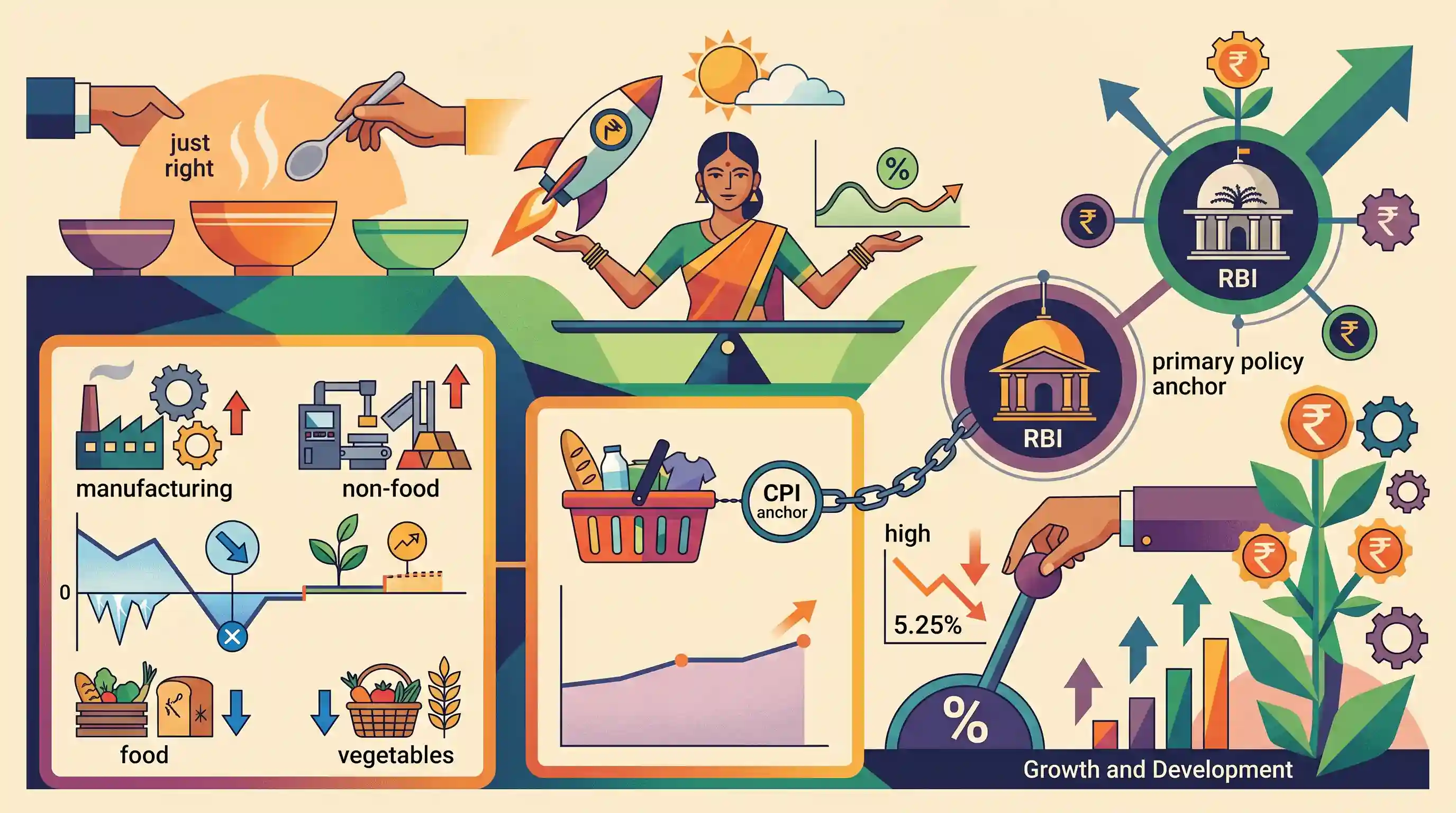
India's Wholesale Price Index (WPI) inflation registered a marginal increase to 0.83% in December 2025, breaking a two-month deflationary streak. The rise was driven by increased prices in manufacturing and non-food sectors, despite continuing deflation in food and vegetable prices. Concurrently, retail inflation (CPI) saw a slight uptick to 1.33%. With retail inflation serving as its primary policy anchor, the Reserve Bank of India (RBI) recently reduced the benchmark interest rate to 5.25%. The central bank has characterized the current macroeconomic environment as a "rare Goldilocks period" marked by high GDP growth and sustained low inflation.
Key Points
- India's Wholesale Price Index (WPI) based inflation returned to positive territory, recording a marginal rise to 0.83% in December 2025 after two months of deflation.
- The WPI increase was primarily driven by price upticks in manufactured products and non-food articles, while food articles continued to see a deflationary trend.
- Retail inflation (CPI), the primary metric tracked by the RBI for setting benchmark interest rates, also saw a slight increase to 1.33% in December.
- Citing rapid disinflation, the RBI cut key policy interest rates by 25 basis points to 5.25%, describing the economy as being in a 'rare Goldilocks period' of high growth and low inflation.
Important Terms
Wholesale Price Index (WPI)

Measures the average change in prices of goods traded in bulk by businesses. It is released monthly by the Office of Economic Adviser, Ministry of Commerce and Industry.
UPSC context
GS Paper III (Economy). Tests understanding of inflation measurement at the producer level versus retail level.
Consumer Price Index (CPI)
Tracks price changes of a basket of goods and services purchased by households. It serves as the primary inflation anchor for India's monetary policy.
UPSC context
GS Paper III (Economy). Vital for understanding inflation targeting and the cost of living for consumers.
Goldilocks Period
An ideal economic state characterized by robust GDP growth and low, stable inflation, being "neither too hot nor too cold."
UPSC context
Current Affairs/GS III. Tests knowledge of macroeconomic stability and conditions favorable for interest rate cuts.
Repo Rate
The benchmark interest rate at which the Reserve Bank of India (RBI) lends money to commercial banks to manage liquidity and control inflation.
UPSC context
GS Paper III (Monetary Policy). Key tool for implementing expansionary or contractionary economic policies.
Monetary Policy Committee (MPC)
A statutory six-member body led by the RBI Governor, mandated to fix the repo rate to maintain an inflation target of 4% (+/- 2%).
UPSC context
GS Paper III. Critical for understanding the institutional framework of India's inflation management.
Deflation
A general decline in the prices of goods and services, often occurring when the inflation rate falls below 0%.
UPSC context
GS Paper III (Economy). Tests conceptual clarity on price stability and its impact on production and demand.
Prelims Trap
The RBI uses the Wholesale Price Index (WPI) as its primary macroeconomic anchor for setting key policy rates.
The RBI formally shifted its policy anchor from WPI to CPI (Combined) in 2014, a move later cemented by the 2016 Flexible Inflation Targeting (FIT) framework.
Static Concepts Connected
What are the core differences between WPI and CPI?
- Basket coverage: WPI tracks only goods at the producer/wholesale level, whereas CPI tracks both goods and services at the retail level.
- Food weightage: Food carries a much higher weightage in CPI (approx 46%) compared to its weightage in the WPI basket (approx 24%).
- Publishing agencies: The Office of Economic Adviser (Ministry of Commerce and Industry) publishes WPI, while the National Statistical Office (NSO) publishes CPI.
What constitutes a Goldilocks Economy?
- Definition: A macroeconomic state that is 'just right'—not expanding too fast (which triggers inflation) and not growing too slow (which causes recession).
- Key indicators: Characterized by steady GDP growth, low unemployment, and stable retail inflation.
- Policy impact: It provides central banks the headroom to maintain lower interest rates, thereby sustaining economic expansion without overheating risks.
Cross-Topic Patterns
Low CPI + FIT framework debate
CPI dropping well below the 4% target (to 1.33%) often triggers debates on whether the Monetary Policy Committee (MPC) should permanently shift focus to growth metrics.
WPI trends + MSME pricing power
Prolonged deflation or marginal inflation in WPI manufactured products signals weak pricing power, squeezing corporate margins and impacting MSME debt servicing capacity.

Expect a 2026 prelims question pairing the 'Goldilocks economy' concept with the structural weightages of food and services in CPI vs WPI.
Linked PYQs · 3
Linked PYQs · 3
- 2020PrelimsGS1
Consider the following statements: 1. The weightage of food in Consumer Price Index (CPI) is higher than that in Wholesale Price Index (WPI). 2. The WPI does not capture changes in the prices of services, which CPI does. 3. Reserve Bank of India has now adopted WPI as its key measure of inflation and to decide on changing the key policy rates. Which of the statements given above is/are correct?
- 2010PrelimsGS1
With reference to India, consider the following statements : 1. The Wholesale Price Index (WPI) in India is available on a monthly basis only. 2. As compared to Consumer Price Index for Industrial Workers (CPI(IW)), the WPI gives less weight to food articles. Which of the statements given above is/are correct ?
- 2022PrelimsGS1
With reference to the Indian economy, consider the following statements: 1. If the inflation is too high, Reserve Bank of India (RBI) is likely to buy government securities. 2. If the rupee is rapidly depreciating, RBI is likely to sell dollars in the market. 3. If interest rates in the USA or European Union were to fall, that is likely to induce RBI to buy dollars. Which of the statements given above are correct?
