थोक मूल्य मुद्रास्फीति और RBI नीतिगत दर कटौती
स्रोत:द हिंदू ↗
क्यों मायने रखता है
Understanding the differences between WPI and CPI, as well as their respective components, is a recurring theme in UPSC Prelims. Additionally, the RBI's use of CPI for inflation targeting and benchmark rate decisions (Monetary Policy) is critical for GS Paper 3. The concept of a 'Goldilocks economy' is also an important macroeconomic term for Mains answers and essays.
सारांश
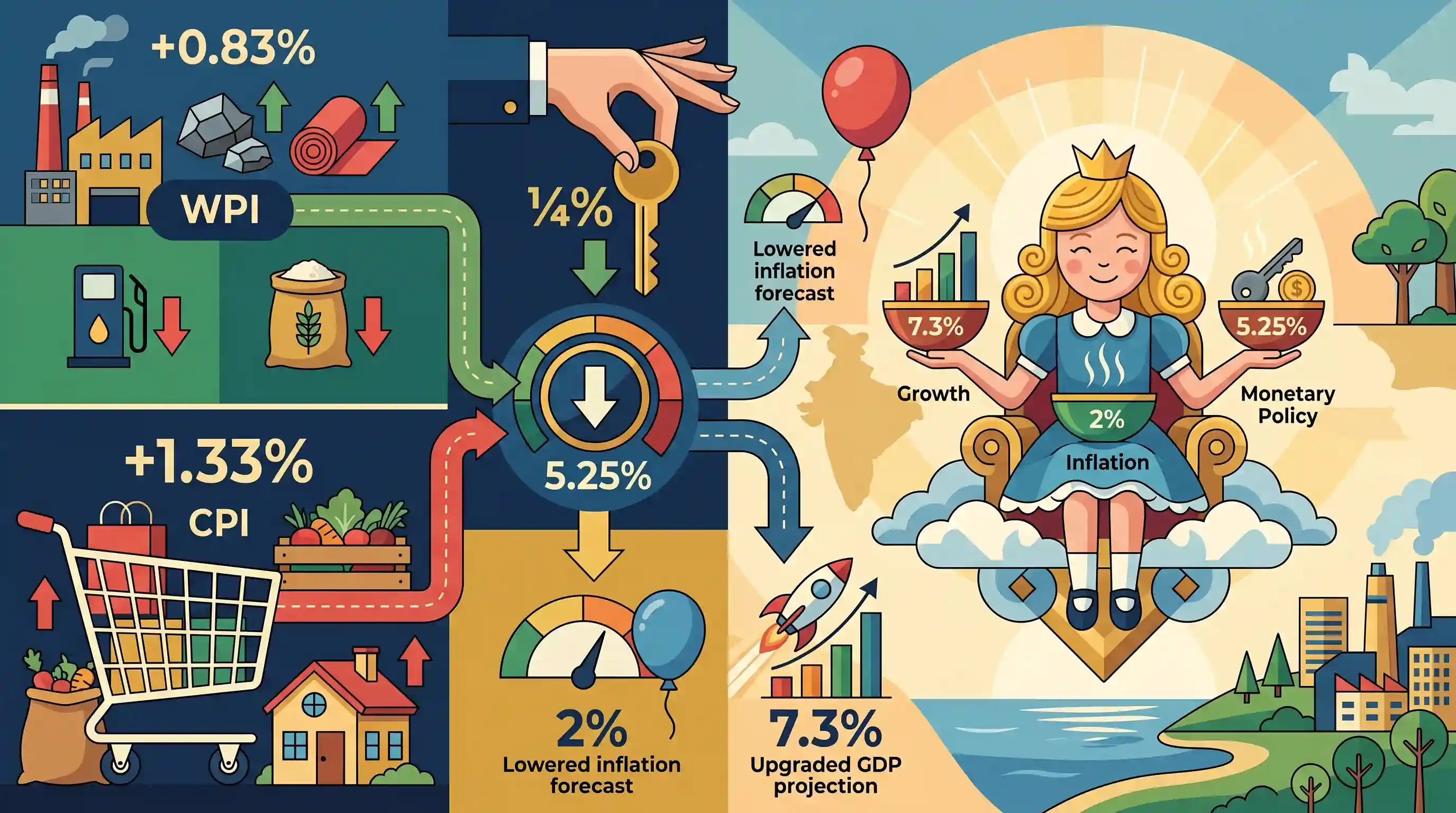
Wholesale Price Index (WPI) inflation in India rebounded to a positive 0.83% in December 2025, ending a two-month deflationary spell. The rise was driven by increased prices in manufacturing, minerals, and textiles, despite continued wholesale deflation in food articles and fuel. Conversely, retail inflation (CPI) climbed to 1.33% due to higher retail food prices. Acknowledging the overall low inflation and robust economic performance, the Reserve Bank of India (RBI) reduced its benchmark interest rate by 25 basis points to 5.25%, lowered its annual inflation forecast to 2%, and upgraded its GDP growth projection to 7.3%. This combination of high growth and low inflation has led economists to describe the current state of the Indian economy as a 'Goldilocks period.'
मुख्य बिंदु
- थोक मूल्य सूचकांक (WPI) आधारित मुद्रास्फीति दो महीने की अपस्फीति (deflation) के बाद दिसंबर में मामूली बढ़कर 0.83% पर पहुँचते हुए सकारात्मक हो गई है।
- खुदरा मुद्रास्फीति (उपभोक्ता मूल्य सूचकांक या CPI), जिसे RBI मौद्रिक नीति निर्णयों के लिए ट्रैक करता है, मुख्य रूप से खुदरा खाद्य कीमतों के कारण नवंबर के 0.71% से बढ़कर दिसंबर में 1.33% हो गई।
- While retail food prices rose, the wholesale segment witnessed deflation in food articles, vegetables, and the fuel and power sectors.
- अनुकूल मुद्रास्फीति के माहौल को देखते हुए, RBI ने अपनी बेंचमार्क ब्याज दर में 25 बेसिस पॉइंट्स की कटौती कर इसे 5.25% कर दिया।
- The RBI lowered its inflation projection for the current fiscal year to 2% while raising its FY26 GDP growth forecast to 7.3%.
- Economists characterize the current Indian macroeconomic scenario—marked by high growth and low inflation—as a rare 'Goldilocks period.'
महत्वपूर्ण शब्द
Wholesale Price Index (WPI)

An index measuring average price changes of goods at the wholesale level. Released monthly by the Office of Economic Adviser, it tracks inflation before it reaches the retail stage.
UPSC context
GS-III (अर्थव्यवस्था); मुद्रास्फीति के मापकों (inflation metrics), उनके घटकों (विनिर्मित उत्पाद, ईंधन) और उत्पादकों पर उनके प्रभाव के ज्ञान का परीक्षण करता है।
उपभोक्ता मूल्य सूचकांक (CPI)
An index measuring price changes of a basket of goods and services at the retail level. It is India's primary anchor for inflation targeting by the RBI.
UPSC context
GS-III (Economy); essential for understanding cost of living, purchasing power, and the RBI's monetary policy stance.
Goldilocks Period
An ideal economic phase featuring robust growth and low inflation. The economy is described as being "just right"—neither overheating (inflationary) nor stalling (recessionary).
UPSC context
GS-III (समष्टि आर्थिक स्थिरता); अनुकूलतम व्यापार चक्र स्थितियों और सतत आर्थिक विकास की वैचारिक समझ का परीक्षण करता है।
Reserve Bank of India (RBI)
India’s central bank, responsible for regulating the banking system and managing monetary policy to ensure price stability while supporting economic growth.
UPSC context
GS-III (Banking/Economy); a core institution for topics like financial regulation, monetary tools, and forex management.
Basis Points (bps)
A financial unit of measure equal to 1/100th of 1% (0.01%). It is the standard unit for expressing precise changes in interest rates.
UPSC context
GS-III (Economy); vital for interpreting RBI policy rate changes (e.g., Repo Rate) and financial market movements.
Monetary Policy
वह ढांचा जिसके माध्यम से केंद्रीय बैंक मुद्रा आपूर्ति और ब्याज दरों को नियंत्रित करता है ताकि मुद्रास्फीति नियंत्रण और मूल्य स्थिरता जैसे समष्टि आर्थिक उद्देश्यों को प्राप्त किया जा सके।
UPSC context
GS-III (Economic Development); key area for questions on the Monetary Policy Committee (MPC) and liquidity tools.
प्रारंभिक ट्रैप
WPI includes services, and rising food prices impact WPI more severely than CPI due to its higher food weightage.
WPI केवल वस्तुओं की कीमतों को मापता है। CPI वस्तुओं और सेवाओं दोनों को मापता है। इसके अतिरिक्त, WPI की तुलना में CPI में खाद्य वस्तुओं का भारांश (weightage) काफी अधिक होता है।
संबंधित अवधारणाएँ
What are the core structural differences between WPI and CPI in India?
- Item Coverage: CPI covers both goods and services, whereas WPI measures changes in the prices of goods only.
- Food Weightage: Food accounts for nearly 46% of the CPI basket, compared to roughly 15% in the WPI basket.
- Monetary Policy Anchor: CPI serves as the RBI's nominal anchor for flexible inflation targeting, not the WPI.
What defines a 'Goldilocks Economy' in macroeconomic terms?
- Ideal Balance: It represents an ideal state where the economy is "not too hot, not too cold," avoiding both high inflation and recession.
- Growth and Inflation: मजबूत GDP वृद्धि के साथ-साथ कम और प्रबंधनीय मुद्रास्फीति दरों द्वारा चिह्नित।
- मौद्रिक पैंतरेबाज़ी: Allows central banks to implement or maintain lower interest rates without the risk of overheating the economy.
अंतर-विषय पैटर्न
WPI-CPI विचलन की गतिशीलता
A persistent gap between retail and wholesale inflation usually stems from global crude prices or domestic food supply shocks. UPSC frequently tests the structural reasons behind this divergence.
Monetary Policy Framework & Growth
The RBI's statutory mandate is price stability while keeping in mind the objective of growth. Cutting rates during a 'Goldilocks' phase perfectly exemplifies balancing this dual mandate.

2026 Prelims में WPI/CPI बास्केट के विचलन (विशेष रूप से खाद्य बनाम विनिर्माण) को Goldilocks economy की परिभाषा से जोड़ने वाले एक प्रश्न की अपेक्षा करें।
संबद्ध PYQ · 3
संबद्ध PYQ · 3
- 2020PrelimsGS1
Consider the following statements: 1. The weightage of food in Consumer Price Index (CPI) is higher than that in Wholesale Price Index (WPI). 2. The WPI does not capture changes in the prices of services, which CPI does. 3. Reserve Bank of India has now adopted WPI as its key measure of inflation and to decide on changing the key policy rates. Which of the statements given above is/are correct?
- 1997PrelimsGS1
In India, inflation is measured by the
- 2011PrelimsGS1
Economic growth is usually coupled with
