Wholesale price inflation trends and primary article price contraction
Source:The Hindu ↗
Why It Matters
Inflation trends directly influence the Reserve Bank of India's (RBI) monetary policy decisions, agricultural dynamics, and overall macroeconomic stability. Understanding the components and weightages of the WPI (e.g., primary articles, fuel and power, manufactured products) versus the CPI is a high-yield conceptual area for both Prelims and Mains.
Summary
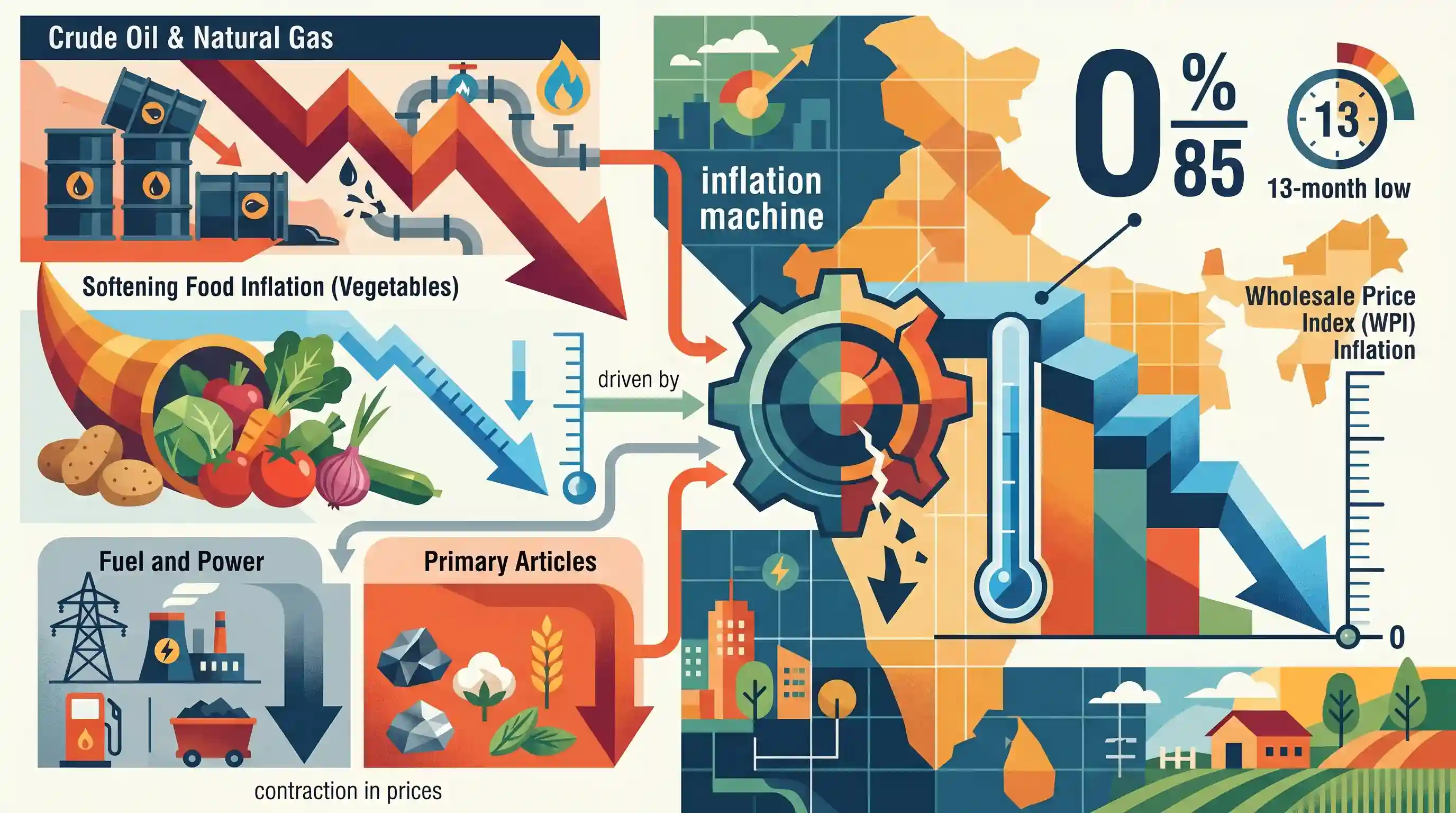
Wholesale inflation in India, measured by the Wholesale Price Index (WPI), eased to a 13-month low of 0.85% in April 2025. This deceleration was largely driven by a sharp contraction in crude oil and natural gas prices, alongside softening food inflation, particularly in vegetables. Both the primary articles and fuel and power categories recorded a contraction in prices.
Key Points
- Wholesale inflation (WPI) in India eased to 0.85% in April 2025, a 13-month low, as per data released by the Ministry of Commerce and Industry.
- The primary articles category contracted by 1.44% (its first contraction in nearly two years), driven primarily by falling crude oil and natural gas prices.
- Food inflation softened significantly, with vegetable prices contracting by 18.26% and the overall food group easing to a 22-month low of 2.55%.
- The fuel and power category also witnessed a price contraction of 2.18%, reflecting cheaper LPG, petrol, and diesel.
Important Terms
Wholesale Price Index (WPI)

An index measuring changes in the price of goods sold and traded in bulk by wholesale businesses to other businesses at the production level.
UPSC context
GS Paper 3: Indian Economy. Tests understanding of inflation types (producer vs. consumer) and their impact on the monetary policy framework.
Manufactured Products
The largest component of the WPI (64.23% weight), covering processed items like textiles, chemicals, basic metals, and food products derived from processing.
UPSC context
GS Paper 3: Macroeconomics. Vital for analyzing industrial health and the supply-side impact on headline inflation.
Primary Articles
A WPI category (22.62% weight) consisting of raw materials like food articles (cereals, vegetables), non-food articles (oilseeds), and minerals/crude petroleum.
UPSC context
GS Paper 3: Agriculture/Economy. Highlights the volatility of raw material prices and their transmission to final goods.
Fuel and Power
A WPI category (13.15% weight) tracking price movements in energy-related commodities including electricity, coal, and mineral oils (petrol, diesel, LPG).
UPSC context
GS Paper 3: Infrastructure/Energy. Essential for understanding imported inflation and cost-push factors in the Indian economy.
Office of the Economic Adviser (OEA)
The specific nodal office under the Department for Promotion of Industry and Internal Trade (DPIIT) responsible for compiling and releasing WPI data monthly.
UPSC context
Prelims: Governance/Institutions. Frequently tested as the designated authority for official economic indices.
WPI Food Index
A sub-index of the WPI representing the price movement of food items from both the 'Primary Articles' and 'Manufactured Products' groups.
UPSC context
GS Paper 3: Food Security/Inflation. Distinguishes between raw food costs and processed food inflation.
Base Year
The specific year (currently 2011-12 for WPI) used as a benchmark for comparing price changes over time, assigned an index value of 100.
UPSC context
Prelims/Mains: Macroeconomics. Tests knowledge of 'Base Effect' and index revision cycles (e.g., proposed shift to 2022-23).
Prelims Trap
WPI tracks the wholesale prices of both bulk goods and essential business services.
WPI exclusively tracks bulk goods traded between businesses and completely excludes services. CPI is the index that factors in services like health, education, and transport.
Static Concepts Connected
What are the key structural differences between WPI and CPI?
- Target Audience: WPI tracks prices at the producer or wholesale level, while CPI measures the prices paid by end consumers at the retail level.
- Services Inclusion: CPI includes services like housing, healthcare, and education, whereas WPI completely excludes all service sector pricing.
- Weightage Allocation: Manufactured products dominate WPI (~64.2%), whereas food and beverages carry the highest weight in CPI (~45.9%).
How does Headline Inflation differ from Core Inflation?
- Headline Inflation: This is the total inflation rate in the economy, encompassing all basket items, including highly volatile components like food and fuel.
- Core Inflation: Calculated by stripping out volatile food and energy prices from the headline figure to reveal the underlying, long-term price trends in the economy.
Cross-Topic Patterns
Monetary policy vs supply shocks
The easing of WPI through falling vegetable and crude prices demonstrates how headline inflation is often driven by supply-side shocks, limiting the effectiveness of RBI's demand-curbing repo rate tools.
Imported inflation and geopolitics
WPI's reliance on the 'Fuel and Power' category makes India's wholesale inflation highly sensitive to external geopolitical shocks affecting global crude oil and natural gas supply chains.

Expect a multi-statement Prelims 2026 question contrasting WPI/CPI weightages, specifically the treatment of imported crude and services.
Linked PYQs · 3
Linked PYQs · 3
- 2020PrelimsGS1
Consider the following statements: 1. The weightage of food in Consumer Price Index (CPI) is higher than that in Wholesale Price Index (WPI). 2. The WPI does not capture changes in the prices of services, which CPI does. 3. Reserve Bank of India has now adopted WPI as its key measure of inflation and to decide on changing the key policy rates. Which of the statements given above is/are correct?
- 2010PrelimsGS1
With reference to India, consider the following statements : 1. The Wholesale Price Index (WPI) in India is available on a monthly basis only. 2. As compared to Consumer Price Index for Industrial Workers (CPI(IW)), the WPI gives less weight to food articles. Which of the statements given above is/are correct ?
- 2024MainsGS3
What are the causes of persistent high food inflation in India? Comment on the effectiveness of the monetary policy of the RBI to control this type of inflation.
