Bhojpur Encounter Protests Prompt Judicial Inquiry into Police Action
Source:opindia ↗
Why It Matters
This event is highly relevant for BPSC Prelims as it touches upon several crucial dimensions: the administrative mechanism of judicial inquiries in Bihar, the police accountability framework under the CrPC/BNSS, the geographical significance of NH-922 (Patna-Buxar route), and the historical connection of Jagdishpur, which is a recurrent BPSC theme owing to Babu Kunwar Singh's role in the 1857 Revolt.
Summary
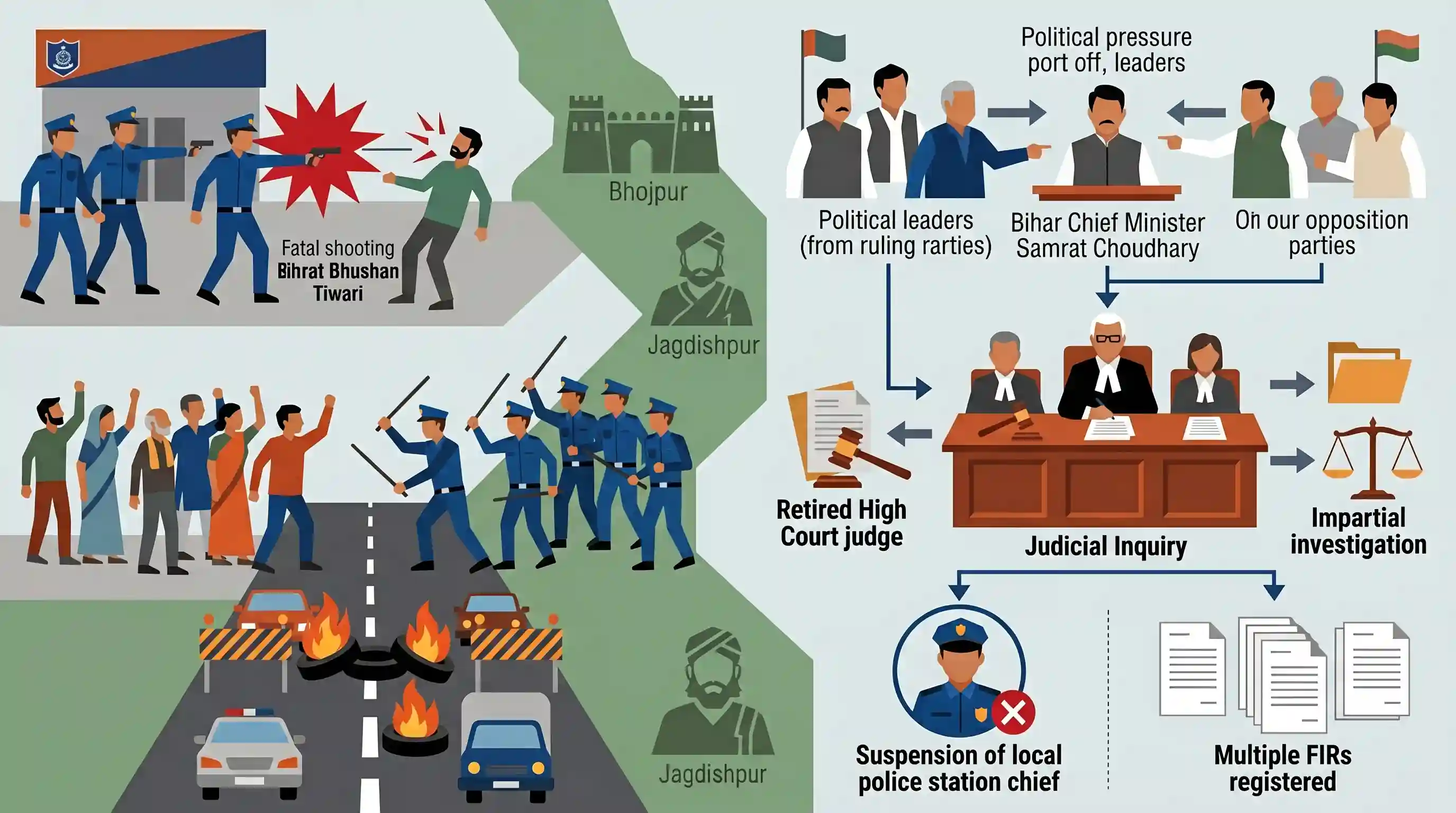
The article reports on the controversial encounter of Bharat Bhushan Tiwari in the Bhojpur district of Bihar on June 17, 2026. After Tiwari was shot dead by the Bihar Police in the Shahpur police station area, his family and local villagers disputed the police's self-defense narrative, claiming the encounter was fake. Massive protests erupted, leading to a blockade of National Highway 922 (NH-922) and subsequent police lathi-charge. Facing intense political pressure from both ruling and opposition parties, Bihar Chief Minister Samrat Choudhary ordered a judicial inquiry led by a retired High Court judge on June 20, 2026, to ensure an impartial investigation. The local police station chief was suspended, and multiple FIRs have been registered.
Key Points
- On June 17, 2026, Bharat Bhushan Tiwari was killed in a police encounter near Bilauti village in the Shahpur police station area of Bhojpur district, Bihar, sparking political and public outrage.
- The police alleged that Tiwari fired at them during a live Facebook stream and refused to surrender, while his family and eyewitnesses claimed he threw away his weapon and surrendered before being shot.
- In response to the public anger and road blockades on National Highway 922 (NH-922), Bihar Chief Minister Samrat Choudhary ordered an independent judicial inquiry headed by a retired High Court judge on June 20, 2026.
- Tiwari had previously posted multiple Facebook live videos in which he brandished weapons and issued direct death threats to local administrative officials, including the Sub-Divisional Magistrate (SDM) of Jagdishpur.
- Following the incident, Shahpur police station in-charge Rajesh Kumar Malakar was suspended, and two FIRs were registered—one against the victim's family for weapon possession and another against the protesters for highway blockades and violence.
- The opposition leader Tejashwi Yadav and ruling alliance leaders (from JDU and BJP) raised demands for a transparent investigation, turning the law-and-order incident into a major state-level controversy.
Important Terms
Commissions of Inquiry Act 1952

A central legislation empowering both Central and State governments to appoint ad hoc commissions of inquiry to investigate matters of public importance, granting them civil court powers.
UPSC context
GS Paper II: Polity & Governance; tests executive accountability, federal power distribution, and ad hoc investigative tribunals.
Bharatiya Nagarik Suraksha Sanhita (BNSS)
The primary procedural law enacted to replace the Code of Criminal Procedure (CrPC), 1973, modernizing India's criminal justice system with digital processes and time-bound investigations.
UPSC context
GS Paper II: Criminal Justice Reforms; tests reforms in procedural laws and technology integration in the judiciary.
Code of Criminal Procedure (CrPC) Section 176
A statutory provision (now replaced by Section 196 of the BNSS) mandating a magisterial inquiry into cases of death, disappearance, or rape occurring in police or custodial custody.
UPSC context
GS Paper II: Human Rights & Police Reforms; tests checks against custodial torture and extrajudicial killings.
PUCL v. State of Maharashtra (2014)
A landmark Supreme Court judgment establishing a mandatory 16-point protocol to govern thorough, independent, and transparent investigations into all police encounter deaths under Article 141.
UPSC context
GS Paper II: Judiciary & Human Rights; tests constitutional safeguards and guidelines preventing fake police encounters.
Veer Kunwar Singh
A prominent leader of the 1857 Revolt from Jagdishpur, Bhojpur district, Bihar, who successfully organized and led rebel forces against British rule using guerrilla warfare tactics.
UPSC context
GS Paper I: Modern Indian History; tests key personalities and regional leadership during the 1857 Revolt.
Patna High Court
The highest judicial institution in Bihar, established in 1916 under Letters Patent, exercising original, appellate, and writ jurisdiction (under Article 226) over the state.
UPSC context
GS Paper II: State Judiciary; tests evolution of high court jurisdiction and enforcement of fundamental rights.
Prelims Trap
Reports and recommendations of a Commission of Inquiry appointed under the 1952 Act are legally binding on the establishing government.
The recommendations of a Commission of Inquiry are purely advisory. The government is only required to table the report with an Action Taken Report.
Static Concepts Connected
What is the constitutional and legal framework of a Commission of Inquiry in India?
- Statutory Basis: Established under the Commissions of Inquiry Act, 1952, by either Central or State governments for matters of public importance.
- Advisory Nature: The commission's findings are purely recommendatory and cannot be enforced as a court decree or binding judgment.
- Civil Court Powers: Equipped with powers of a civil court to summon witnesses, requisition public records, and receive evidence.
What are the Supreme Court's PUCL v. State of Maharashtra (2014) guidelines on police encounters?
- Mandatory FIR: Immediate registration of an FIR is required post-encounter, followed by rapid submission to the jurisdictional court.
- Independent Probe: Investigation must be led by an independent team from an outside station or the state CID.
- Magisterial Inquiry: A mandatory magisterial inquiry under CrPC (now BNSS) must be conducted in every case of encounter-related death.
Cross-Topic Patterns
Police accountability + Human rights
Interlinks Supreme Court guidelines on extrajudicial deaths with state police reform directives and human rights commission mandates.
1857 Revolt + Jagdishpur history
Connects Bhojpur's current administrative setup with Babu Kunwar Singh's historic 1857 rebellion base at Jagdishpur, a frequent UPSC history theme.

UPSC may contrast the advisory status of judicial commissions with mandatory magisterial probes under investigative guidelines in 2026.
Linked PYQs · 3
Linked PYQs · 3
- 2022BPSC_PRELIMSGS1
One of the leaders of the Revolt of 1857 AD, Kunwar Singh was related to which place?
- 2008BPSC_PRELIMSGS1
Which person of Jagdishpur took the lead of revolutionaries during the revolt of 1857 A.D.?
- 2019BPSC_PRELIMSGS1
Who led the 1857 Revolt in Bihar?
