Strategic Autonomy And India-US Bilateral Relations Dynamics
Source:Indian Express ↗
Why It Matters
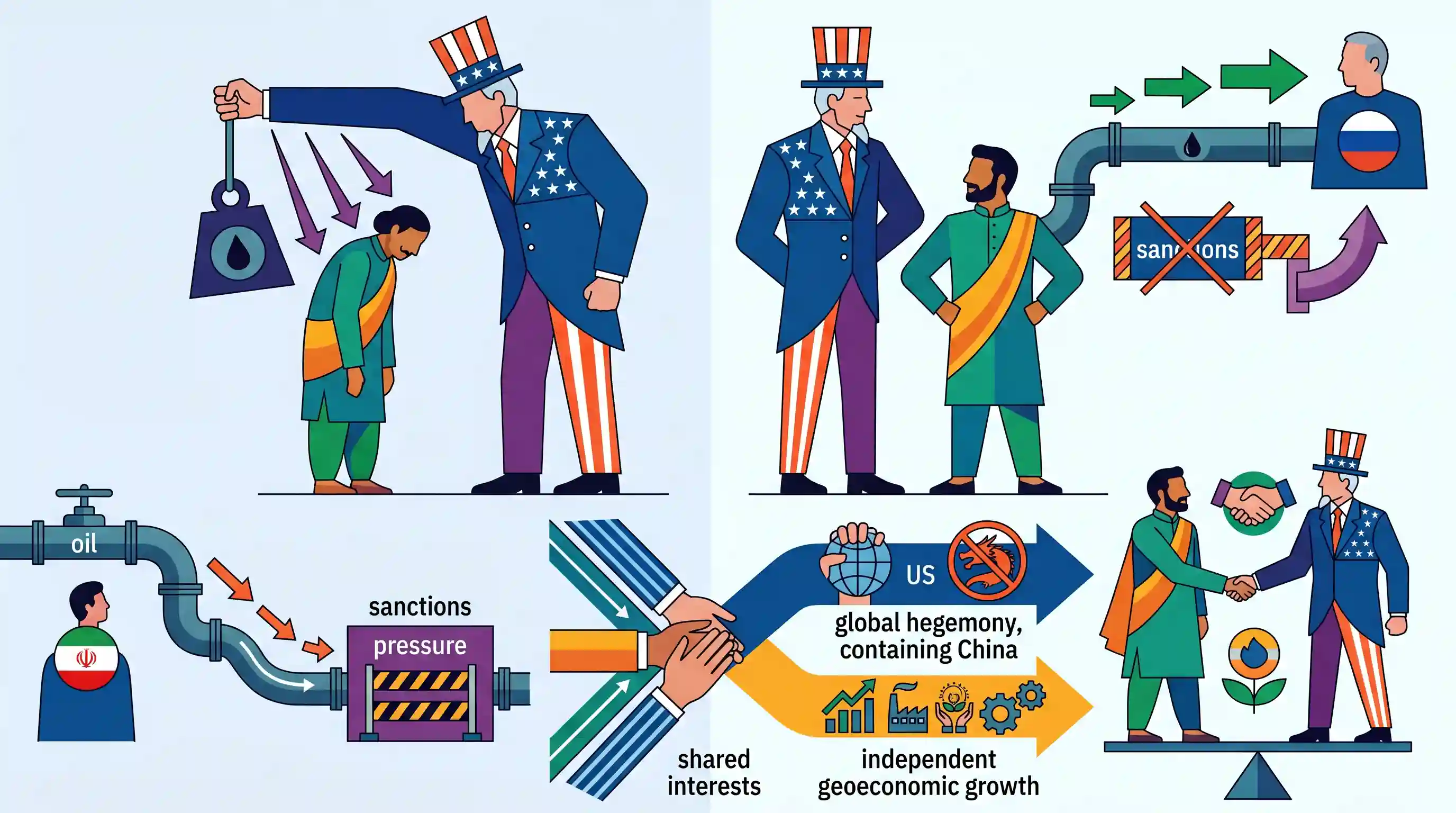
It provides a clear contrast between India's past vulnerability to US secondary sanctions (Iran) and its current assertion of strategic autonomy (Russia), offering crucial examples for GS2 questions on India-US relations, foreign policy shifts, and energy security.
Summary
The article dismisses the political narrative that India has 'surrendered' to the United States, arguing instead that current India-US ties are anchored in strategic autonomy and mutual respect. The author contrasts the UPA era—when India bowed to US pressure by drastically reducing Iranian oil imports under NDAA sanctions—with the current government's approach of significantly increasing Russian oil imports despite Western sanctions to ensure national energy security. While acknowledging shared interests, the author emphasizes that the US's focus on global hegemony and containing China differs from India's goal of independent geoeconomic growth, making a case for a partnership based on mutual sensitivity rather than subservience.
Key Points
- The assertion that India is submitting to US dictates is historically inaccurate; during the UPA era, India yielded to US pressure by cutting Iranian oil imports under the 2012 NDAA sanctions.
- Conversely, the current government has aggressively prioritized national energy security by increasing Russian oil imports to 30% of its total demand, explicitly defying Western pressure.
- The US and India have divergent strategic priorities: the US seeks to contain China and maintain global hegemony, whereas India pursues 'strategic autonomy' and regional growth without formal alliance entanglements.
- A successful India-US partnership relies on three mutuals—mutual respect, mutual sensitivity, and mutual interest—rather than subordinate alignment.
- Friction points such as the H-1B visa regime, tariff disputes, and India's refusal to be a subordinate ally highlight the need for Washington to accommodate India's independent foreign policy choices.
Important Terms
Strategic Autonomy

A state's ability to make independent foreign policy and defense decisions without being constrained by external pressures or formal alliances, prioritizing sovereign national interests in a multipolar world.
UPSC context
GS Paper II (IR). Tests understanding of India’s sovereign decision-making and its transition from non-alignment to issue-based multi-alignment.
National Defense Authorization Act (NDAA)
An annual U.S. federal law specifying the Department of Defense budget. It often contains significant policy mandates, including sanctions and the designation of security partners like India.
UPSC context
GS Paper II (Bilateral Relations). Tests knowledge of U.S. legislative frameworks that govern defense trade, technology transfer, and international sanctions.
Geoeconomics
The use of economic instruments, such as trade, investment, and resource management, to achieve geopolitical objectives and enhance a nation's international power and influence.
UPSC context
GS Paper II (IR). Tests the ability to analyze how economic dependencies and global trade shifts influence regional security and foreign policy.
United Progressive Alliance (UPA)
A center-left coalition of Indian political parties, led by the Indian National Congress (INC), which formed the central government in India from 2004 to 2014.
UPSC context
GS Paper II. Provides historical context for comparing foreign policy shifts and economic decisions between different political leaderships in India.
National Democratic Alliance (NDA)
A center-right coalition of Indian political parties, led by the Bharatiya Janata Party (BJP), which has governed India at the center since 2014.
UPSC context
GS Paper II. Relevant for discussing the current government's approach to strategic autonomy, energy security, and major bilateral partnerships.
H-1B Visa
A U.S. non-immigrant visa allowing American companies to employ foreign workers in specialty occupations. It is a vital link for the Indian IT sector and diaspora.
UPSC context
GS Paper II (Indian Diaspora). Tests understanding of how labor mobility policies in developed nations impact the Indian economy and bilateral ties.
Prelims Trap
India is legally bound by international law to enforce US-mandated sanctions on oil imports.
India officially recognizes only UN Security Council sanctions, not unilateral ones (like US/EU). Past compliance (e.g., Iran oil cuts) was a strategic choice to avoid secondary sanctions, not a legal mandate.
Static Concepts Connected
How does 'Strategic Autonomy' differ from traditional 'Non-Alignment'?
- Non-Alignment Context: Focused on avoiding entanglement in Cold War blocs (US vs. USSR) and maintaining a defensive distance from superpowers.
- Strategic Autonomy: Involves proactive, issue-based partnerships. Actively engaging with multiple major powers simultaneously based on national interest.
- Operational Flexibility: Allows India to purchase discounted Russian oil while simultaneously conducting the Malabar naval exercise with the US Quad partners.
What are US 'secondary sanctions' and how do they impact India?
- Extraterritorial Reach: Laws (like CAATSA or NDAA) that penalize third-party countries or entities for conducting business with a sanctioned nation (e.g., Russia, Iran).
- Enforcement Mechanism: Threatens to cut off violating entities from the US financial system, restricting access to dollar-denominated global trade.
- Impact on India: Creates persistent diplomatic friction over India's legacy defense procurements (S-400) and critical crude oil imports.
Cross-Topic Patterns
Visa frictions and WTO GATS Mode 4
US visa restrictions (like H-1B fee hikes) clash directly with India's longstanding diplomatic push for easier movement of skilled professionals under WTO GATS Mode 4.
Unilateral sanctions driving Rupee internationalization
Western sanctions on major oil suppliers (Russia, Iran) act as a catalyst for India's push toward Rupee-Ruble trade mechanisms and the broader internationalization of the Rupee.

Expect a Mains question on how India balances its 'Strategic Autonomy' in energy security with Indo-Pacific commitments alongside the US.
Linked PYQs · 3
Linked PYQs · 3
- 2019MainsGS2
‘What introduces friction into the ties between India and the United States is that Washington is still unable to find for India a position in its global strategy, which would satisfy India's national self-esteem and ambitions.’ Explain with suitable examples.
- 2025MainsGS2
"Energy security constitutes the dominant kingpin of India's foreign policy, and is linked with India's overarching influence in Middle Eastern countries.” How would you integrate energy security with India's foreign policy trajectories in the coming years?
- 2023MainsGS2
Indian diaspora has scaled new heights in the West. Describe its economic and political benefits for India.
