WHO Global Antimicrobial Resistance Health Threat Alert
Source:The Hindu ↗
Why It Matters
Antimicrobial resistance is a persistent core topic in GS Paper 3 (Health/Science & Technology), frequently tested through both direct descriptive questions on drug resistance drivers and analytical evaluations of mitigation mechanisms.
Summary
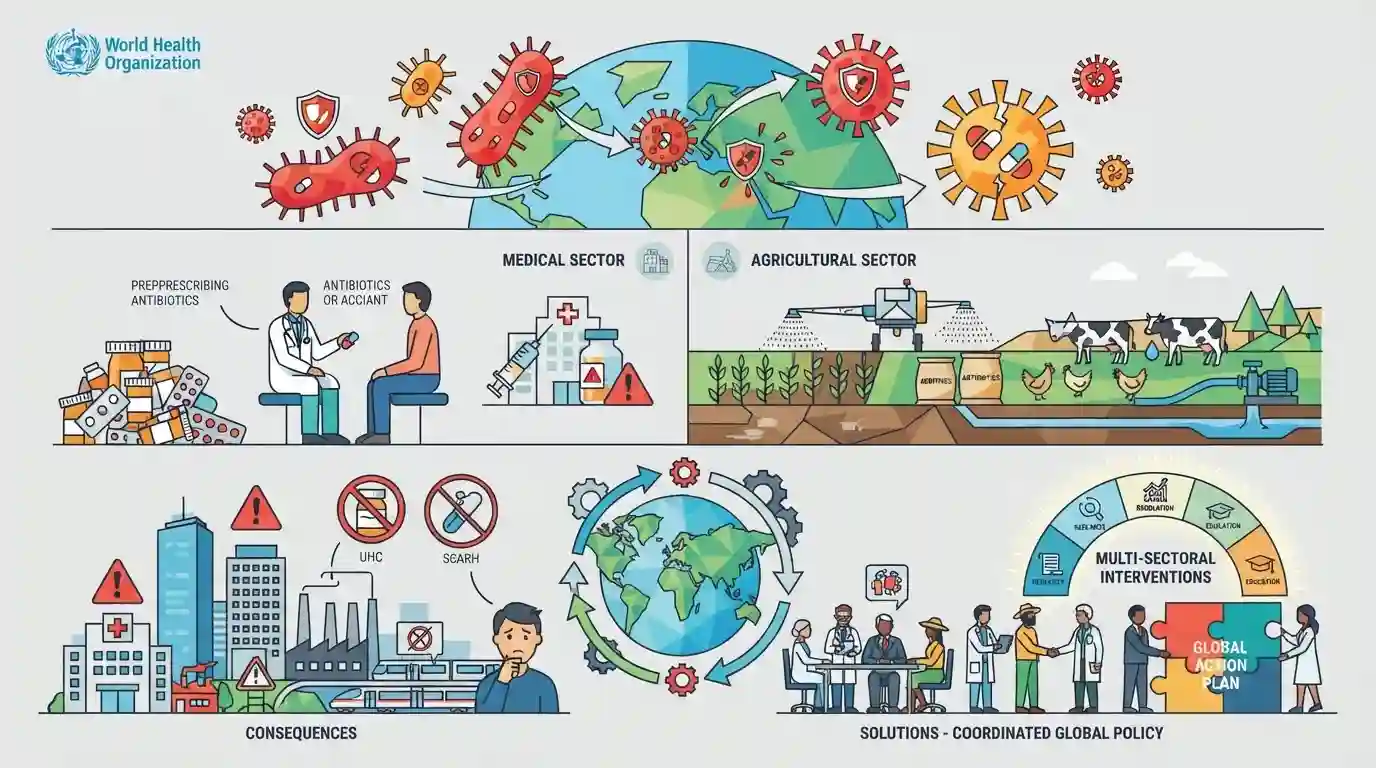
The World Health Organization has raised urgent concerns over the growing global crisis of antimicrobial resistance (AMR), highlighting how drug-resistant pathogens threaten public health, universal health coverage, and global health security. The crisis is fueled by overuse and misuse of antimicrobials across medical and agricultural sectors, demanding coordinated global policy and multi-sectoral interventions.
Key Points
- The World Health Organization (WHO) has issued severe warnings regarding the escalating global threat of Antimicrobial Resistance (AMR).
- AMR poses a critical danger to modern medicine, rendering routine treatments, surgeries, and infectious disease management increasingly ineffective.
- Overuse and misuse of antibiotics in humans, livestock, and agriculture are primary drivers accelerating drug resistance.
- Global health frameworks emphasize multi-sectoral 'One Health' approaches integrating human, animal, and environmental health monitoring.
Important Terms
World Health Organization

A specialized agency of the United Nations responsible for international public health, setting global norms, tracking disease outbreaks, and responding to health emergencies worldwide.
UPSC context
UPSC GS Paper 2 (International Organizations, Health Governance); tests role of global bodies in coordinating responses to trans-national issues like pandemics and AMR.
Antimicrobial Resistance (AMR)
The phenomenon where pathogens like bacteria, viruses, fungi, and parasites evolve to become resistant to antimicrobial drugs, rendering standard treatments ineffective.
UPSC context
UPSC GS Paper 2 (Health, Governance) and GS Paper 3 (Science & Tech); tests understanding of public health threats, drug misuse, and One Health frameworks.
One Health Approach
An integrated, unifying approach that aims to sustainably balance and optimize the health of people, animals, and ecosystems by recognizing their interconnectedness.
UPSC context
UPSC GS Paper 2 & 3 (Health and Environment); tests policy frameworks for managing cross-sectoral crises like zoonotic diseases, environmental pollution, and AMR.
Prelims Trap
Antimicrobial resistance is primarily driven by the overuse of antibiotics in human clinical medicine.
Aspirants often assume AMR is solely a human healthcare problem caused by doctors over-prescribing, ignoring the massive contribution of agriculture, livestock growth promoters, and environmental runoff.
Static Concepts Connected
What is the Quadripartite alliance and the One Health framework in global health governance?
- Four Agencies: Quadripartite composition comprises WHO, FAO, UNEP, and WOAH (formerly OIE) working jointly on human, animal, plant, and environmental health threats.
- Core Principle: One Health approach recognizes that human health is inextricably linked to animal health and the shared environment, demanding coordinated policy responses.
- Policy Blueprint: Global Action Plan (GAP) on AMR is the blueprint steered by these agencies to preserve antimicrobial efficacy and promote stewardship.
Cross-Topic Patterns
AMR + WTO SPS Measures
AMR in poultry and fisheries intersects with WTO sanitary and phytosanitary (SPS) measures, as importing nations ban shipments with high antibiotic residue or resistant strains.
One Health + Fiscal Federalism
The One Health framework requires integrating animal husbandry budgets with human health allocations under the National Health Mission and central veterinary schemes.

AMR + One Health framework (WHO, FAO, UNEP, WOAH Quadripartite) is a high-yield matching or statement-based question area for Prelims.
Linked PYQs · 3
Linked PYQs · 3
- 2014MainsGS3
Can overuse and free availability of antibiotics without Doctor's prescription, be contributors to the emergence of drug-resistant diseases in India? What are the available mechanisms for monitoring and control? Critically discuss the various issues involved.
- 2019PrelimsGS1
Which of the following are the reasons for the occurrence of multi-drug resistance in microbial pathogens in India? 1. Genetic predisposition of some people 2. Taking incorrect doses of antibiotics to cure diseases 3. Using antibiotics in livestock farming 4. Multiple chronic diseases in some people Select the correct answer using the code given below.
- 2022PrelimsGS1
Consider the following statements: 1. Biofilms can form on medical implants within human tissues. 2. Biofilms can form on food and food processing surfaces. 3. Biofilms can exhibit antibiotic resistance. Which of the statements given above are correct?
