WHO warns of disease outbreaks after major Venezuelan earthquakes
Source:The Hindu ↗
Why It Matters
The crisis serves as a critical case study for GS2 (Public Health and International Organizations) and GS3 (Disaster Management). It highlights the compound risks of natural disasters—specifically how infrastructural collapse and pre-existing vulnerabilities (like low vaccination rates) can trigger secondary public health emergencies, requiring coordinated global humanitarian intervention.
Summary
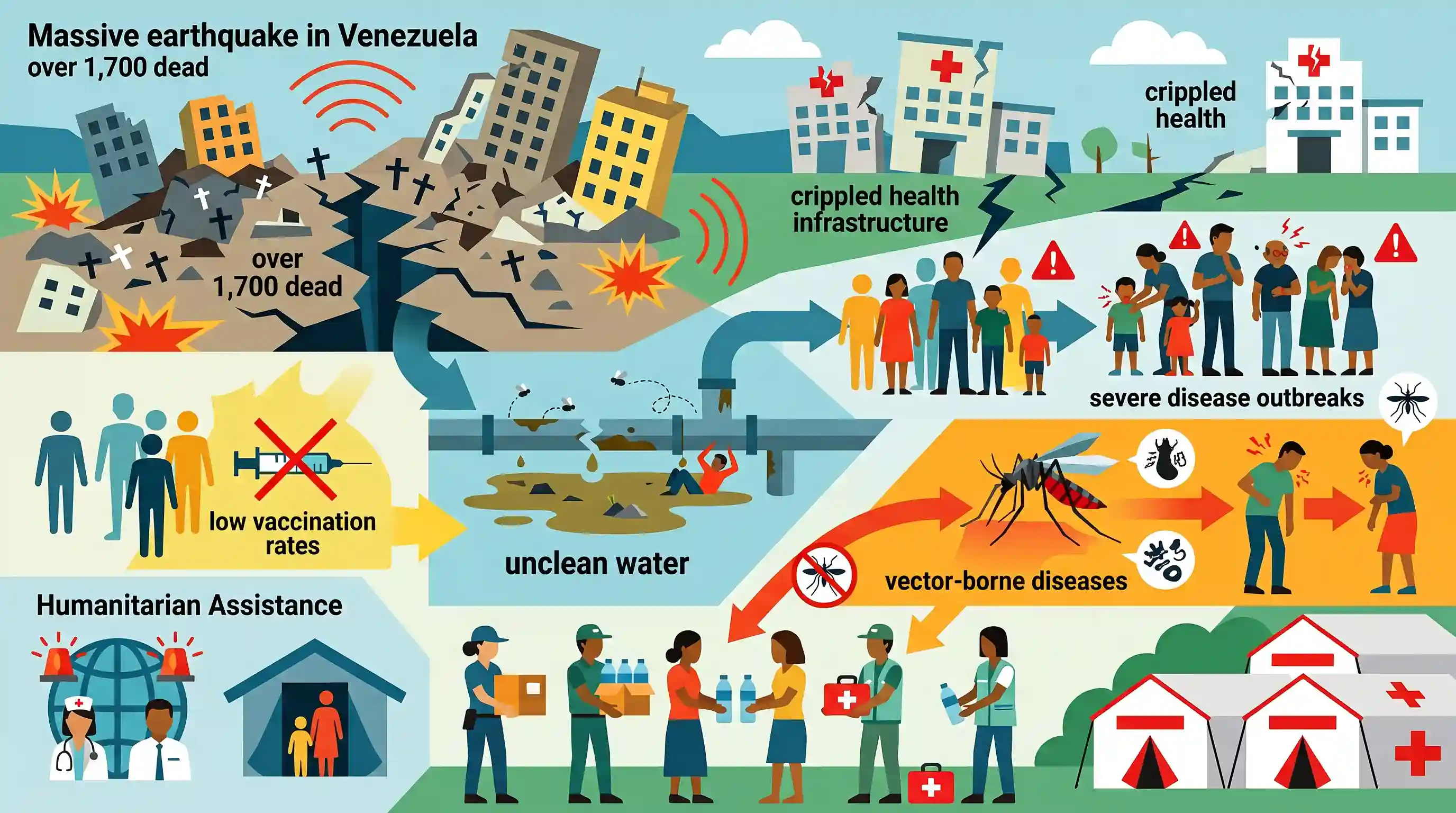
The World Health Organization (WHO) has issued an urgent warning regarding the risk of severe disease outbreaks in Venezuela following massive 7.5 and 7.2 magnitude earthquakes. The seismic events caused widespread destruction, leaving over 1,700 dead and crippling health infrastructure across multiple states. The WHO emphasized that pre-existing low vaccination rates and disrupted water/sanitation systems drastically increase the threat of vaccine-preventable diseases (like measles and diphtheria) and vector-borne illnesses (such as dengue, malaria, and Zika). International agencies like UNHCR and MSF are currently on the ground assisting in the humanitarian response to mitigate this secondary public health disaster.
Key Points
- Devastating 7.5 and 7.2 magnitude earthquakes in Venezuela resulted in over 1,700 deaths and severe damage to at least 38 hospitals, crippling local health infrastructure.
- The WHO warned of a high risk of post-disaster disease outbreaks, compounded by Venezuela's pre-existing low vaccination coverage.
- There is heightened vulnerability to vaccine-preventable diseases (measles, diphtheria) and vector/water-borne diseases (malaria, dengue, Zika, yellow fever) due to disrupted sanitation systems.
- International humanitarian organizations, including UNHCR and MSF, are actively providing critical medical aid and logistical support to manage the unfolding public health crisis.
Important Terms
World Health Organization (WHO)

A specialized United Nations agency established in 1948, headquartered in Geneva, responsible for international public health, norm-setting, and coordinating responses to global health emergencies.
UPSC context
GS Paper 2: International Institutions; GS Paper 3: Health. Focuses on global health governance and outbreak management.
UNHCR
The UN Refugee Agency, established in 1950, mandated to protect and support refugees, internally displaced persons (IDPs), and stateless people under the 1951 Refugee Convention.
UPSC context
GS Paper 2: International Organizations; Social Justice. Tests knowledge of humanitarian mandates and the rights of displaced populations.
Doctors Without Borders (MSF)
An independent, international medical humanitarian organization (NGO) providing emergency aid to people affected by conflict, epidemics, or disasters regardless of political or religious affiliations.
UPSC context
GS Paper 2: Role of NGOs; GS Paper 3: Disaster Management. Highlights non-state actors in international humanitarian response.
Vector-borne Diseases
Human illnesses caused by parasites, viruses, and bacteria that are transmitted by living organisms (vectors) such as mosquitoes, ticks, and fleas.
UPSC context
GS Paper 3: Science and Technology; Health. Vital for understanding public health challenges exacerbated by environmental changes and disasters.
Disaster Management
The organization and management of resources and responsibilities for dealing with all humanitarian aspects of emergencies, specifically preparedness, response, and recovery to lessen impact.
UPSC context
GS Paper 3: Disaster and Disaster Management. Evaluates strategies to mitigate secondary hazards like post-disaster disease outbreaks.
Prelims Trap
"Malaria and Dengue are water-borne diseases that spread directly through contaminated drinking water after earthquakes."
They are vector-borne, not water-borne. Earthquakes create stagnant water which acts as breeding grounds for mosquitoes, but the diseases are not ingested via drinking water like cholera.
Static Concepts Connected
What characterises seismic activity along transform plate boundaries?
- Horizontal Motion: Plates slide horizontally past one another, meaning crust is neither created nor destroyed (conservative boundary).
- Shallow Focus: Earthquakes are typically shallow-focus, which often leads to more destructive surface shaking and infrastructure damage.
- Absence of Volcanism: Unlike convergent or divergent boundaries, transform faults (like the Caribbean-South American plate boundary) generally lack volcanic activity.
How do epidemics emerge as secondary disasters following earthquakes?
- Vector Proliferation: Disrupted drainage and surface depressions create stagnant water pools, serving as ideal breeding grounds for Aedes (Dengue, Zika) and Anopheles (Malaria) mosquitoes.
- WASH Collapse: Damage to Water, Sanitation, and Hygiene (WASH) infrastructure leads to the rapid spread of water-borne pathogens like cholera.
- Crowding & Immunity: Displacement into crowded relief camps combined with halted immunization networks accelerates the transmission of vaccine-preventable diseases like measles.
Cross-Topic Patterns
Sendai Framework + Health Infrastructure
The collapse of 38 hospitals highlights Sendai Target D: substantially reducing disaster damage to critical infrastructure and basic services, particularly health and educational facilities.
Economic crisis + Disaster vulnerability
Venezuela's pre-existing economic instability caused low vaccination rates, demonstrating how economic fragility acts as a threat multiplier for biological disasters following natural hazards.

Expect a 2026 multi-statement question combining post-disaster epidemiological risks with Sendai Framework healthcare resilience goals.
Linked PYQs · 5
Linked PYQs · 5
- 2019MainsGS3
Disaster preparedness is the first step in any disaster management process. Explain how hazard zonation mapping will help disaster mitigation in the case of landslides.
- 2020MainsGS3
Discuss the recent measures initiated in disaster management by the Government of India departing from the earlier reactive approach.
- 2013MainsGS3
How important are vulnerability and risk assessment for pre-disaster management ? As an administrator, what are key areas that you would focus on in a Disaster Management System.
- 2020MainsGS2
Critically examine the role of WHO in providing global health security during the Covid-19 pandemic.
- 2017PrelimsGS1
Consider the following statements: 1. In tropical regions, Zika virus disease is transmitted by the same mosquito that transmits dengue. 2. Sexual transmission of Zika virus disease is possible. Which of the statements given above is/are correct?
