World Health Organization assessment on Nipah virus spread
Source:The Hindu ↗
Why It Matters
Understanding viral outbreaks and the epidemiological characteristics of zoonotic diseases like Nipah is crucial for GS-2 (Health) and GS-3 (Science and Technology). It highlights the role of international bodies like the WHO in managing global health security, disease surveillance, and issuing travel advisories.
Summary
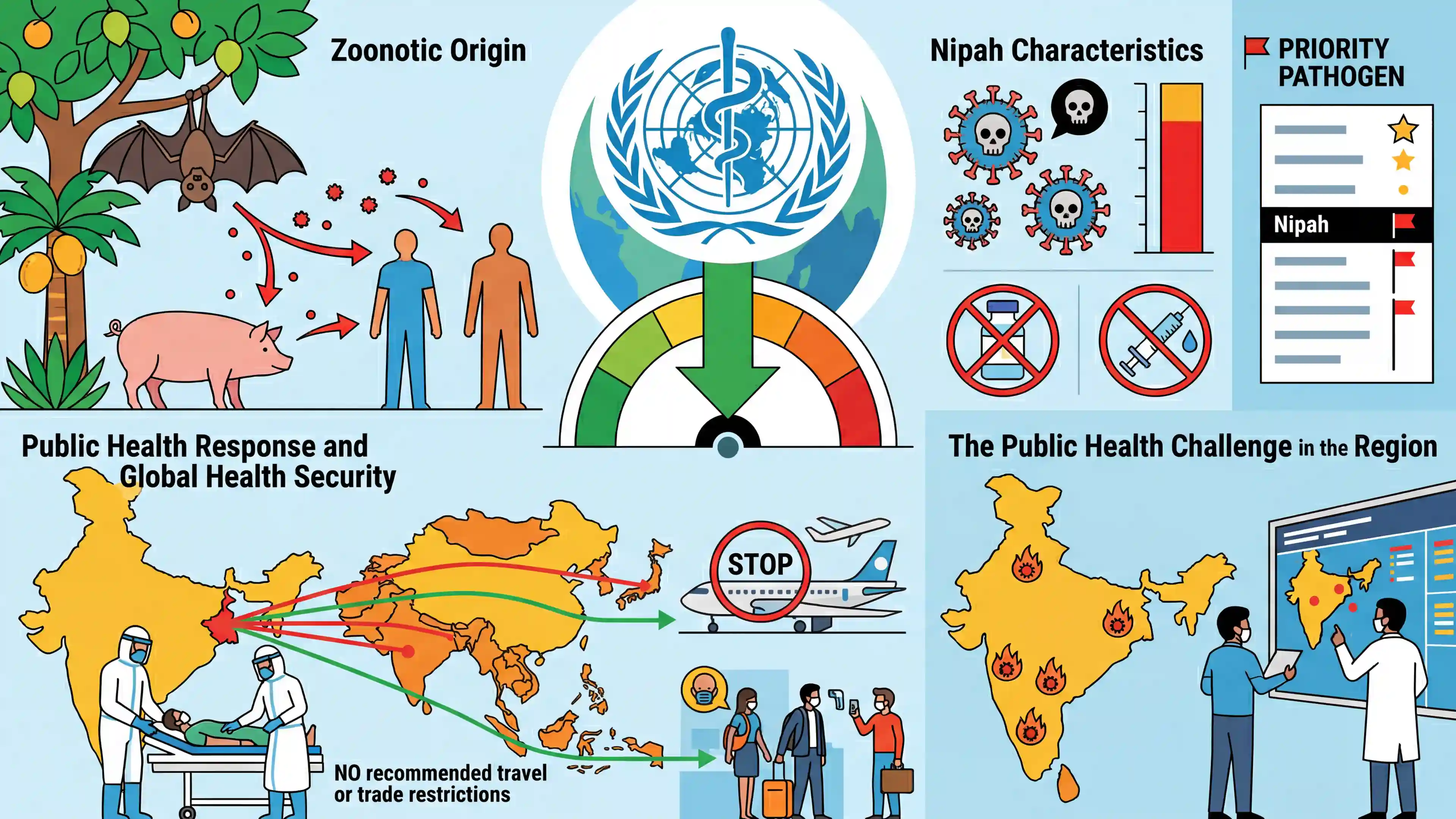
The World Health Organization (WHO) has stated that the risk of the Nipah virus spreading globally from India remains low, following a recent outbreak in West Bengal that infected two health workers. Despite some Asian countries tightening airport screenings, the WHO has not recommended any travel or trade restrictions. Nipah is a deadly zoonotic disease transmitted by fruit bats and pigs, with a fatality rate of 40% to 75% and no known cure or vaccine. Because of its severity, lack of treatments, and potential to mutate, the WHO designates Nipah as a 'priority pathogen'. Although human-to-human transmission is difficult and requires prolonged contact, regular sporadic outbreaks in India highlight the ongoing public health challenge in the region.
Key Points
- The World Health Organization (WHO) has assessed the international risk of the Nipah virus spreading from India as low and advised against travel or trade restrictions.
- This assessment follows a recent outbreak in West Bengal infecting two health workers, marking the seventh documented Nipah outbreak in India.
- Nipah is a zoonotic virus primarily carried by fruit bats and pigs, which can cause severe brain inflammation and has a high fatality rate of 40% to 75%.
- The WHO classifies Nipah as a 'priority pathogen' because there are no licensed vaccines or treatments, and there is a high risk of the virus mutating into a more transmissible variant.
- While human-to-human transmission is possible, it typically requires prolonged contact; nonetheless, several Asian nations have increased airport screening out of caution.
Important Terms
World Health Organization (WHO)

The United Nations' specialized agency for international public health, responsible for setting global health standards, monitoring outbreaks, and coordinating international responses to health emergencies.
UPSC context
GS Paper 2 (International Relations; Health); tests knowledge of global governance and international health security mechanisms.
Ministry of Health and Family Welfare (MoHFW)
The apex Indian government body responsible for formulating health policy, managing national health programs, and coordinating the response to disease outbreaks via agencies like the NCDC.
UPSC context
GS Paper 2 (Governance; Health); tests understanding of the executive role in public health management.
Nipah Virus (NiV)
A highly fatal (40–75% CFR) bat-borne henipavirus causing severe encephalitis and respiratory illness; designated by WHO as a priority pathogen due to its epidemic potential.
UPSC context
GS Paper 3 (Science & Tech; Health); relevant for questions on infectious diseases and pandemic preparedness.
Zoonotic Disease
An infectious disease that has jumped from a non-human animal to humans, such as Nipah, Ebola, or COVID-19, often linked to environmental and habitat changes.
UPSC context
GS Paper 3 (Science & Tech; Environment); tests understanding of the link between wildlife, environment, and human health.
Priority Pathogen
Pathogens on WHO's R&D Blueprint list considered to pose the greatest public health risk because of their epidemic potential and lack of sufficient countermeasures.
UPSC context
GS Paper 3 (Science & Tech); tests awareness of global medical research priorities and biosecurity threats.
One Health
An integrated approach that recognizes the health of people is closely connected to the health of animals and our shared environment.
UPSC context
GS Paper 2 & 3 (Health Governance; Ecology); tests knowledge of multidisciplinary strategies for managing zoonotic risks.
Prelims Trap
Human-to-human transmission of the Nipah virus is not possible as it is strictly a zoonotic disease.
Human-to-human transmission is absolutely possible and well-documented (especially among healthcare workers and families), though it typically requires close or prolonged contact.
Static Concepts Connected
What is the WHO Priority Pathogens list?
- R&D Blueprint: A watchlist of diseases with high epidemic/pandemic potential that currently lack sufficient medical countermeasures (vaccines/treatments).
- Key Pathogens: It includes Nipah, Ebola, Zika, COVID-19, Marburg, and the placeholder 'Disease X'.
- Core Purpose: Guides global funding and fast-tracks collaborative research for diagnostics, vaccines, and therapeutics.
What constitutes the 'One Health' approach?
- Integration: An integrated, unifying approach that aims to sustainably balance and optimize the health of people, animals, and ecosystems.
- Core Rationale: Recognizes that human health is intrinsically linked to animal health and the environment, critical since 60%+ of infectious diseases are zoonotic.
- Global Agencies: Spearheaded globally by the Quadripartite: WHO, FAO, UNEP, and WOAH (World Organisation for Animal Health).
Cross-Topic Patterns
Ecological disruption driving zoonosis
Deforestation and changing land-use patterns force bat populations into agricultural zones, acting as a bridge for zoonotic spillovers like Nipah. Connects environment syllabus directly to epidemiology.
Health security and biosurveillance
Recurrent outbreaks in states like West Bengal test India's Integrated Disease Surveillance Programme (IDSP) and state-capacity for pandemic preparedness, framing public health infrastructure as a national security imperative.

Expect a 2026 prelims question pairing viral diseases (Nipah/Zika) with their reservoirs, transmission modes, and the One Health mission.
Linked PYQs · 3
Linked PYQs · 3
- 2024PrelimsGS1
With reference to monoclonal antibodies, often mentioned in news, consider the following statements : I. They are man-made proteins. II. They stimulate immunological function due to their ability to bind to specific antigens. III. They are used in treating viral infections like that of Nipah virus. Which of the statements given above are correct?
- 2025PrelimsGS1
With reference to monoclonal antibodies, often mentioned in news, consider the following statements : I. They are man-made proteins. II. They stimulate immunological function due to their ability to bind to specific antigens. III. They are used in treating viral infections like that of Nipah virus. Which of the statements given above are correct?
- 2020MainsGS2
Critically examine the role of WHO in providing global health security during the Covid-19 pandemic.
