Climate change adaptation and cooperative fiscal federalism in India
Source:The Hindu ↗
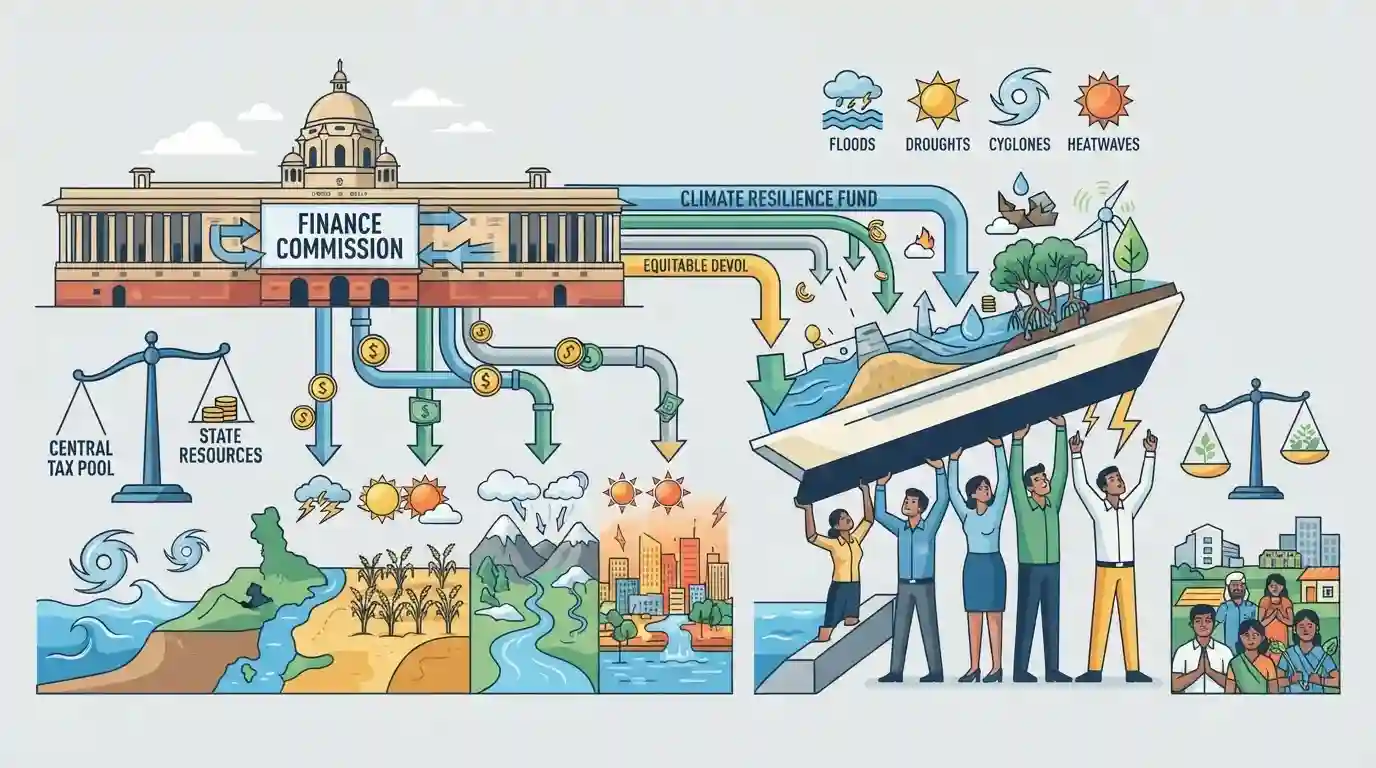
Why It Matters
It bridges environmental economics and constitutional governance, offering vital perspectives on how Indian federal architecture must evolve to finance climate adaptation and manage localized climate disasters.
Summary
The article examines how the costs of climate change adaptation, mitigation, and disaster response intersect with India's fiscal federalism. It argues that subnational governments bear an asymmetric burden of climate impacts, necessitating a structural overhaul of resource devolution through bodies like the Finance Commission to ensure equitable climate justice and federal resilience.
Key Points
- Climate change impacts pose acute fiscal challenges to subnational governments (States), highlighting the intersection of climate adaptation and fiscal federalism.
- Traditional resource allocation models under Finance Commissions often fail to account for escalating climate-induced disaster adaptation and mitigation costs borne by States.
- A cooperative federal framework is necessary to balance national climate commitments with subnational fiscal autonomy and targeted funding mechanisms.
- The burden of loss and damage and adaptation financing requires structural integration into India's fiscal devolution architecture.
Important Terms
Finance Commission

A constitutional body under Article 280 that recommends the vertical and horizontal distribution of tax revenues between the Centre and states, increasingly looked upon to integrate climate risks into fiscal devolution.
UPSC context
UPSC GS Paper II (Polity and Governance - Constitutional Bodies, Fiscal Federalism). Tested for its role in resource sharing and cooperative federalism.
Inter-State Council
A constitutional body under Article 263 designed to promote coordination and discuss policies between the Union and states, seen as a vital forum for addressing cooperative climate governance.
UPSC context
UPSC GS Paper II (Indian Polity - Centre-State Relations, Cooperative Federalism). Crucial for questions on federal friction and institutional mechanisms.
Supreme Court of India
Apex judicial body that recently read the right against adverse effects of climate change into fundamental rights under Articles 21 and 14, driving constitutional climate litigation in India.
UPSC context
UPSC GS Paper II (Judiciary, Constitutional Law, Environment). Tested for judicial activism, fundamental rights expansion, and environmental jurisprudence.
National Action Plan on Climate Change
Comprehensive domestic policy framework comprising multiple national missions aimed at enhancing adaptation, mitigation, energy efficiency, and sustainable agriculture across India.
UPSC context
UPSC GS Paper III (Environment and Climate Change). Frequently tested for India's domestic institutional architecture and mitigation-adaptation strategies.
Paris Agreement
A landmark international treaty under the UNFCCC adopted in 2015 to limit global temperature rise well below 2 degrees Celsius, anchoring global climate commitments.
UPSC context
UPSC GS Paper III (Environment, International Relations). Tested for Nationally Determined Contributions (NDCs), global climate governance, and equity.
Prelims Trap
The Finance Commission allocates direct untied climate adaptation grants through its primary tax devolution formula.
The 15th Finance Commission did not create a separate climate adaptation grant pool of tax devolution; it used forest cover and ecology parameters in the horizontal devolution formula itself.
Static Concepts Connected
What are the constitutional provisions and mechanisms governing Centre-State disaster management financing in India?
- Constitutional basis: Constitutional division under Seventh Schedule places public health, sanitation, and agriculture primarily in the State List, while disaster management cuts across concurrent domains.
- Statutory framework: Disaster Management Act 2005 statutorily established the National Disaster Response Fund (NDRF) and State Disaster Response Fund (SDRF) for immediate relief.
- Finance Commission: Finance Commission role includes recommending horizontal and vertical tax devolution formulas and specific grants-in-aid for disaster relief and mitigation.
Cross-Topic Patterns
Fiscal federalism meets ecological devolution
The 15th FC's 10% weightage for forest cover links traditional tax devolution to environmental public goods, testing how fiscal instruments drive subnational climate action.
Disaster management architecture vs. climate realities
Exclusion of heatwaves from official disaster lists restricts SDRF access, highlighting how central guidelines impact subnational adaptation capacity.

Expect a statement-based question linking Finance Commission criteria (forest/ecology weights) to subnational fiscal distress in climate adaptation.
Linked PYQs · 3
Linked PYQs · 3
- 2025MainsGS2
Examine the evolving pattern of Centre-State financial relations in the context of planned development in India. How far have the recent reforms impacted the fiscal federalism in India?
- 2024MainsGS3
Flooding in urban areas is an emerging climate-induced disaster. Discuss the causes of this disaster. Mention the features of two such major floods in the last two decades in India. Describe the policies and frameworks in India that aim at tackling such floods.
- 2025MainsGS3
Explain how the Fiscal Health Index (FHI) can be used as a tool for assessing the fiscal performance of states in India. In what way would it encourage the states to adopt prudent and sustainable fiscal policies?
