Scientific Publishing and Intellectual Property in AI Era
Source:The Hindu ↗
Why It Matters
The intersection of traditional copyright regimes and modern AI data-harvesting raises unprecedented ethical and legal challenges for IPR. This is crucial for GS3 (IPR and emerging technologies) and GS2 (Government policies for higher education and knowledge democratization), particularly regarding India's strategic push towards self-reliance in R&D.
Summary
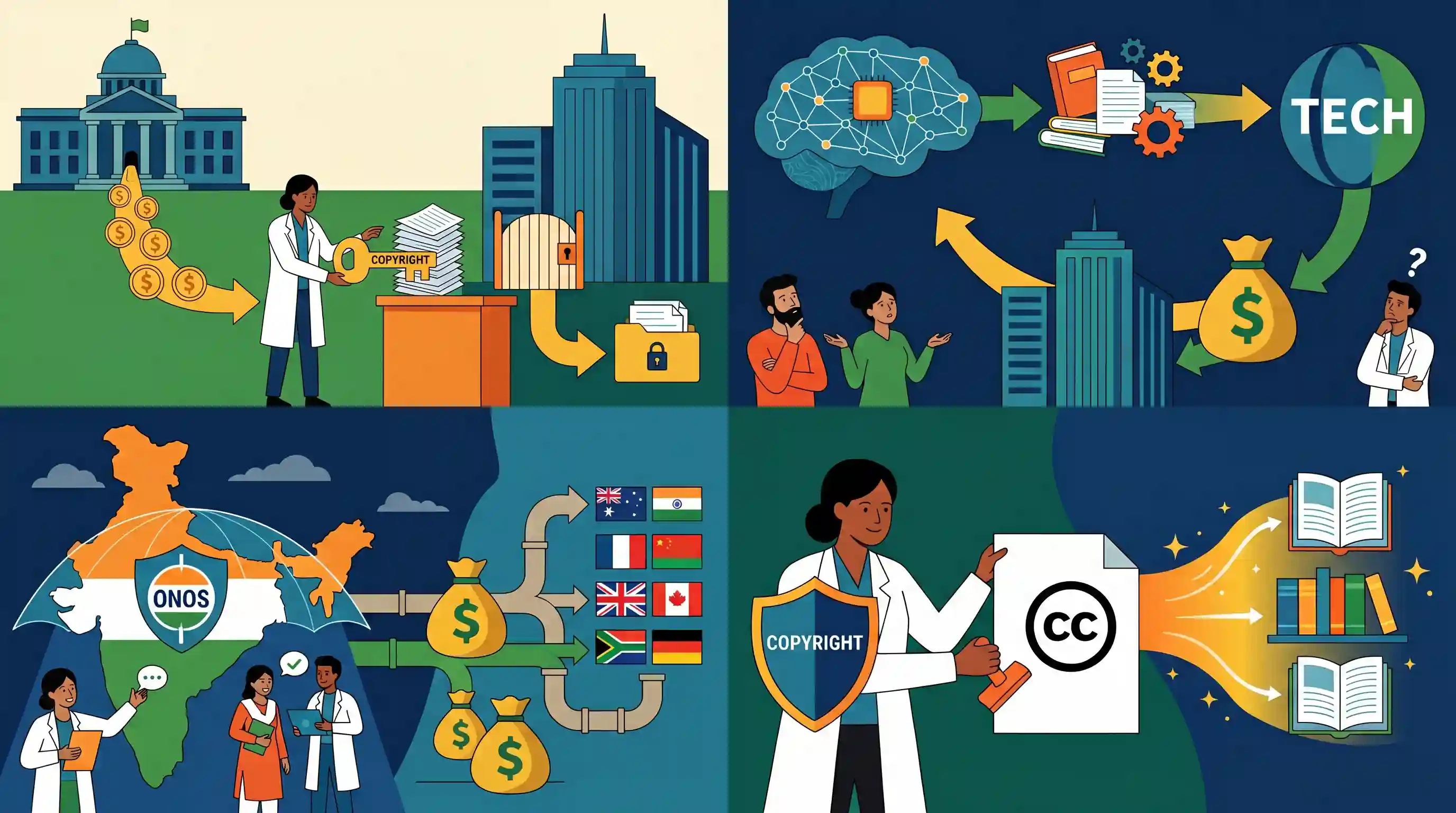
The article critiques the traditional scientific publishing model where publicly funded research is privatized by commercial publishers demanding complete copyright transfers. With the advent of artificial intelligence, publishers are now monetizing this knowledge a second time by licensing vast scholarly datasets to Big Tech to train AI models (LLMs) without authors' explicit consent or compensation. The piece highlights India’s "One Nation, One Subscription" (ONOS) initiative as a step towards democratization but argues it still heavily relies on paying foreign publishers. It advocates for researchers to embrace open-access alternatives, retain their copyrights, and use open Creative Commons licenses to ensure scientific knowledge remains a global public good.
Key Points
- Publicly funded research is being monetized multiple times by commercial publishers—first via exorbitant subscription fees or Article Processing Charges (APCs), and now through lucrative AI training data licensing deals.
- India introduced the "One Nation, One Subscription" (ONOS) initiative starting in 2025 to give publicly funded institutions access to 30 major global publishers, though this still enriches foreign commercial entities.
- Publishers frequently compel researchers to sign copyright transfer agreements, stripping authors of legal control over their own work and enabling publishers to restrict data mining and adaptation (e.g., via CC-BY-NC-ND licenses).
- Global initiatives like "Plan S" and the Budapest Open Access Declaration advocate for researchers to retain copyrights over their scholarly output.
- Authors are advised to self-archive their manuscripts, append rights-retention addendums to contracts, and use permissive licenses (like CC-BY) to ensure broad access and prevent unauthorized commercial exploitation.
Important Terms
One Nation, One Subscription (ONOS)

A Government of India central sector scheme (approved 2024) providing nationwide, centralized access to 13,000+ international journals for researchers in over 6,300 government-run institutions starting January 2025.
UPSC context
GS Paper 2/3: Science & Technology and Education Policy. Tests knowledge of digital infrastructure and democratizing academic research in India.
Plan S
An international open-access initiative launched in 2018 requiring that research funded by public or private grants from participating agencies be published in compliant open-access journals or platforms without delay.
UPSC context
GS Paper 3: Science & Technology. Significant for understanding global trends in knowledge governance and the transition away from subscription-based models.
Budapest Open Access Declaration
The foundational 2002 declaration that defined "Open Access" and launched the global movement to make peer-reviewed research freely available online without financial or legal barriers.
UPSC context
GS Paper 3: Science & Technology. Tests historical context of IPR reforms and the "Global Public Good" aspect of scientific knowledge.
Creative Commons (CC) licenses
Standardized public copyright licenses that allow creators to retain copyright while granting others permission to use, distribute, and build upon their work under specified conditions like attribution.
UPSC context
GS Paper 3: Intellectual Property Rights (IPR). Essential for discussing flexible copyright frameworks in the digital and AI age.
Atmanirbhar Bharat
A comprehensive policy framework for a "Self-Reliant India" focusing on domestic manufacturing, innovation, and reducing dependency on foreign imports in key sectors including technology and research.
UPSC context
GS Paper 3: Economy and S&T. Central theme in Indian governance regarding strategic autonomy and domestic capability building.
US Copyright Act 1976
The primary law governing copyright in the United States, frequently cited in global debates regarding "Fair Use" and the legality of using datasets to train AI models.
UPSC context
GS Paper 3: IPR/AI. Relevant for comparative legal analysis of how major jurisdictions handle data mining and AI-driven knowledge monetization.
Prelims Trap
ONOS eliminates global commercial publishers by launching an indigenous Indian open-access journal platform.
ONOS centralizes government payments to provide nationwide access to 30 major global commercial publishers; it does not eliminate them or replace them with an indigenous open-access platform.
Static Concepts Connected
What are Creative Commons (CC) licenses in the context of Intellectual Property Rights?
- Some Rights Reserved: They operate alongside traditional copyright, changing 'All rights reserved' to allow free distribution, sharing, and building upon the creator's work.
- CC-BY: The most permissive license, allowing broad reuse (including commercial use and AI data mining) provided original credit is given to the author.
- Restrictive variants: Publishers often use CC-BY-NC-ND (Non-Commercial, No-Derivatives) to prevent data mining and adaptation, restricting how the research can be used.
What is the role of INFLIBNET in India's higher education infrastructure?
- Autonomous Body: An Inter-University Centre of the UGC (Ministry of Education) promoting the automation and networking of university libraries across India.
- Shodhganga: Maintains a massive national digital repository of Indian electronic theses and dissertations to promote open access and prevent duplication of research.
- ONOS Management: Entrusted with centrally managing subscriptions and nationwide digital access to global e-journals under the One Nation, One Subscription (ONOS) initiative.
Cross-Topic Patterns
Generative AI + Copyright Fair Use
AI companies training LLMs on copyrighted research papers tests the limits of India's Copyright Act, which currently lacks explicit 'Text and Data Mining' (TDM) exceptions for commercial AI development.
Knowledge Economy + Forex Drain
India's struggle with double-monetization highlights a neo-colonial knowledge dynamic: the Global South publicly funds research, but pays Western entities exorbitant Article Processing Charges (APCs) and subscriptions to access it.

Expect a multi-statement 2026 Prelims question merging ONOS, Plan S, and Creative Commons under the Open Science and IPR umbrella.
Linked PYQs · 3
Linked PYQs · 3
- 2014MainsGS3
In a globalized world, Intellectual Property Rights assume significance and are a source of litigation. Broadly distinguish between the terms-Copyrights, Patents and Trade Secrets.
- 2002PrelimsGS1
Consider the following statements: 1. The World Intellectual Property Organisation (WIPO) is a specialised agency of United Nations System of Organisations 2. WIPO has its headquarters at Rome 3. The Trade Related Aspects of Intellectual Property Rights (TRIPS) Agreement is binding on all WTO members 4. Least developed country members of WTO are not required to apply the provisions of TRIPS Agreements for a period of 20 years from the general date of application of the Agreement Which of these statements are correct?
- 2023MainsGS3
Introduce the concept of Artificial Intelligence (AI). How does Al help clinical diagnosis? Do you perceive any threat to privacy of the individual in the use of Al in healthcare?
