WHO Financial Crisis and Global Health Governance Vulnerability
Source:Indian Express ↗
Why It Matters
Understanding the structural and financial vulnerabilities of critical multilateral institutions like the WHO is essential. It highlights the impact of geopolitical shifts (such as the US withdrawal) on global health security, conflict zone responses, and the broader debate on reforming international organizations to make them resilient against the domestic political volatility of donor nations.
Summary
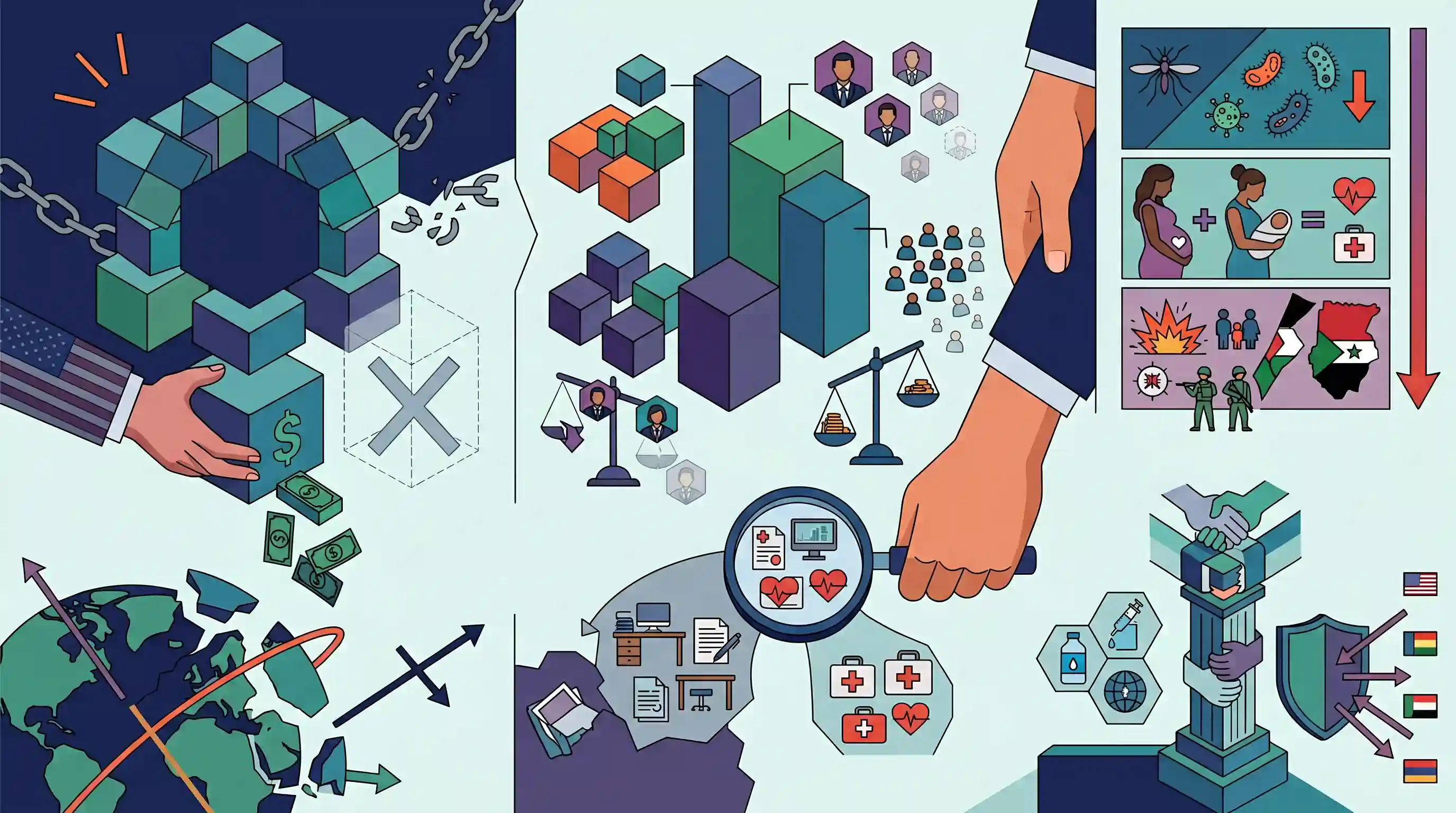
The World Health Organization (WHO) is confronting a severe financial crisis following the withdrawal of the US, its largest benefactor. The withdrawal has triggered a $4 billion budget shortfall for the 2026-27 period, forcing the global health agency to implement a drastic restructuring. This overhaul includes merging departments, halving the number of directors, and potentially shrinking its workforce by over 7,000. To cope with the limited resources, the WHO is scaling back "lower impact services" to prioritize life-saving operations. This capacity crunch threatens critical programs, including infectious disease management, maternal mortality interventions, and health responses in conflict zones such as Gaza and Sudan. The situation exposes the inherent weakness of global health governance, underscoring the urgent need for a new financial paradigm that treats health as a global public good, insulated from the political volatility and shifting geopolitical priorities of individual donor nations.
Key Points
- The withdrawal of the United States from the WHO has resulted in a $4 billion budget cut for 2026-27, creating a severe 15% funding shortfall.
- In response to the funding crunch, WHO is undertaking a major structural reset—including halving the number of directors and potentially downsizing its workforce by over 7,000.
- The agency is forced to scale back on 'lower impact services' to prioritize emergency and 'life-saving services', threatening its technical expertise in maternal mortality, infectious diseases, and crisis responses in conflict zones like Gaza and Sudan.
- The crisis highlights the vulnerability of global public health systems to the political volatility of key donors, necessitating a more resilient, public-goods-based financial model.
Important Terms
World Health Organization (WHO)

A specialized United Nations agency established in 1948, responsible for directing international public health, setting global norms, and coordinating responses to health emergencies.
UPSC context
GS Paper 2: Important International Institutions. Relevant for analyzing global health leadership and the impact of funding crises on institutional effectiveness.
World Health Assembly (WHA)
The supreme decision-making body of the WHO, composed of 194 member states, which meets annually to set policies, approve budgets, and appoint the Director-General.
UPSC context
GS Paper 2: International Institutions. Tests knowledge of the democratic governance, policy-setting, and financial oversight mechanisms of global health bodies.
Global Health Governance
The framework of rules, norms, and institutions—primarily led by the WHO—that coordinates collective international action to manage health threats and improve population well-being.
UPSC context
GS Paper 2: International Relations and Social Justice. Crucial for discussing the efficacy of multilateral cooperation in managing pandemics and health security.
Global Public Good
A concept treating health services (like pandemic preparedness) as non-excludable and non-rivalrous, requiring collective international investment rather than being treated as a national or private commodity.
UPSC context
GS Paper 2 (Health) & GS Paper 4 (Ethics). Evaluates the moral and practical shift toward shared global responsibility for health security.
WHO Investment Round
A 2024 WHO initiative designed to mobilize predictable, flexible, and sustainable funding for its 2025–2028 strategy, aiming to reduce dependence on volatile individual donor priorities.
UPSC context
GS Paper 2: International Institutions. Significant for understanding recent multilateral reforms intended to insulate global health from geopolitical instability.
Assessed Contributions (ACs)
The set dues paid by WHO member states based on their wealth and population; currently, these cover less than 20% of the WHO’s total budget.
UPSC context
GS Paper 2: Effect of policies of developed countries. Tests awareness of the WHO's financial vulnerability due to reliance on voluntary funding.
Prelims Trap
Assessed contributions constitute the majority of WHO's funding.
Voluntary contributions historically form ~80% of WHO's budget. Assessed (mandatory) contributions make up <20%, causing extreme financial volatility when major donors exit.
Static Concepts Connected
How is the World Health Organization (WHO) primarily funded?
- Assessed Contributions (AC): Mandatory membership dues calculated by a country's wealth and population. These historically account for less than 20% of the total budget.
- Voluntary Contributions (VC): Extra funds given by member states, private organizations, and philanthropies (like the Gates Foundation). These make up roughly 80% of the budget.
- Core Voluntary Contributions: A subset of voluntary funds that are not earmarked, allowing WHO the flexibility to allocate resources to the most pressing emergencies.
What defines 'Global Public Goods' in economics and governance?
- Non-rivalrous: One country's consumption of the good does not reduce its availability to others (e.g., eradicated diseases or global health security).
- Non-excludable: No individual or country can be prevented from benefiting from it, such as an early warning system for a pandemic.
- Free-rider problem: Because benefits are shared globally, individual nations often under-invest, hoping others will bear the cost—requiring multilateral institutions to step in.
Cross-Topic Patterns
Weaponization of multilateral funding
The US exit mirrors its past defunding of UNESCO and blocking of WTO Appellate Body judges, reflecting a trend of hegemon nations using financial leverage to paralyze global governance.
Global health geopolitics and Indian targets
WHO's capacity crunch threatens technical aid for the Global South. This directly links US geopolitical isolationism to India’s domestic goals like TB elimination and combating Neglected Tropical Diseases.

Expect a 2026 GS-2 Mains question linking WHO's structural funding vulnerability to the broader paralysis of multilateral institutions.
Linked PYQs · 2
Linked PYQs · 2
- 2020MainsGS2
Critically examine the role of WHO in providing global health security during the Covid-19 pandemic.
- 2019MainsGS2
‘Too little cash, too much politics, leaves UNESCO fighting for life.’ Discuss the statement in the light of US' withdrawal and its accusation of the cultural body as being 'anti-Israel bias'.
