WHO Science and Policy Summaries on Air Quality and Health
Source:The Hindu ↗
Why It Matters
WHO guidelines and international initiatives on air pollution are frequently tested in UPSC Prelims and Mains. The transition from general guidelines to sector-specific policy summaries represents a key shift in global environmental governance and directly informs National Clean Air Programme (NCAP) implementation strategies in India.
Summary
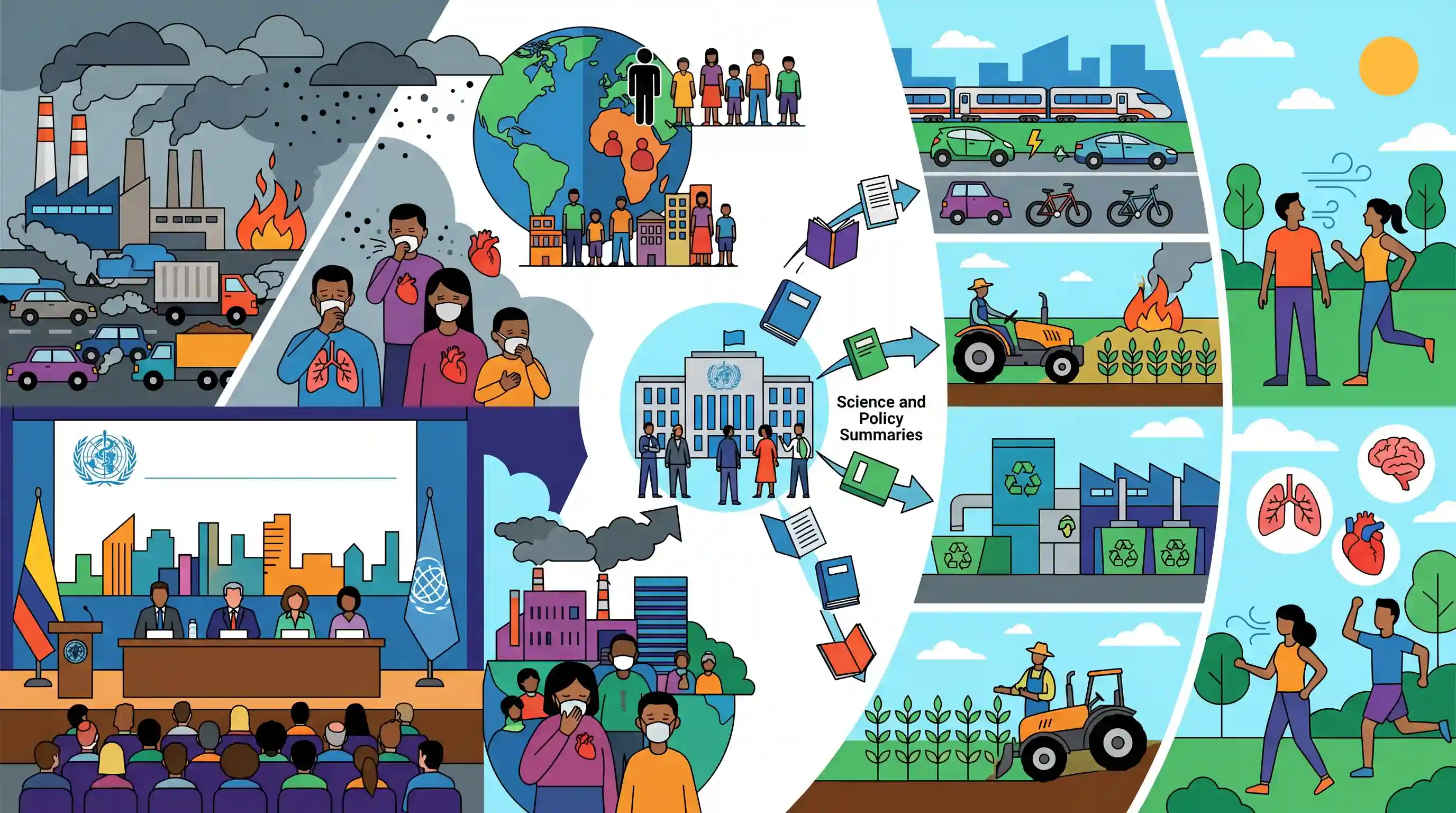
Following the Second WHO Global Conference on Air Pollution and Health in Cartagena, Colombia, the World Health Organization (WHO) has launched a new series of Science and Policy Summaries (SPS). The initiative aims to support countries in reducing air pollution, which was linked to 6.4 million deaths globally in 2021 from particulate matter exposure, predominantly in low- and middle-income countries. The summaries offer practical, sector-specific solutions in areas like transport, agriculture, and waste management, emphasizing the need to tackle air pollution as a major risk factor for noncommunicable diseases.
Key Points
- The WHO has launched the Science and Policy Summaries (SPS) series to drive sector-specific action on air quality and health.
- The launch follows the Second WHO Global Conference on Air Pollution and Health held in Cartagena, Colombia.
- Air pollution is a leading global risk factor for noncommunicable diseases, linked to 6.4 million deaths in 2021 from particulate matter exposure.
- Low- and middle-income countries (LMICs) disproportionately bear the burden, accounting for 93% of these deaths.
- The SPS series provides actionable solutions across sectors such as transport, agriculture, waste management, and energy, addressing cross-cutting issues like climate change and legislation.
Important Terms
World Health Organization (WHO)

A specialized United Nations agency responsible for international public health, setting global standards, and monitoring health trends.
UPSC context
GS Paper II (International Institutions) and GS Paper III (Health); tests knowledge of global health governance and policy leadership.
Particulate Matter (PM)
Microscopic solids or liquid droplets suspended in air (e.g., PM2.5), capable of penetrating lungs and bloodstreams to cause severe health damage.
UPSC context
GS Paper III (Environment/Pollution); essential for understanding air quality indices and the National Clean Air Programme (NCAP).
Noncommunicable Diseases (NCDs)
Chronic, non-infectious conditions like heart disease, stroke, and lung cancer, which air pollution significantly exacerbates as a major environmental risk factor.
UPSC context
GS Paper II (Issues relating to Health); tests awareness of the rising public health burden and India's epidemiological transition.
Ambient Air Pollution
Pollution in the outdoor environment, primarily from transport, industry, and waste burning, which was linked to millions of premature deaths globally.
UPSC context
GS Paper III (Environmental Degradation); relevant for urban planning, sustainable transport, and disaster management (smog events).
WHO Global Air Quality Guidelines (AQG)
WHO-established science-based thresholds for air pollutants meant to protect human health from the harmful effects of long- and short-term exposure.
UPSC context
GS Paper III (Pollution); frequently compared with India's National Ambient Air Quality Standards (NAAQS) in mains and prelims.
Prelims Trap
The WHO's Science and Policy Summaries establish legally binding emission and PM reduction targets for member countries.
WHO air quality guidelines and the new SPS series are purely advisory frameworks to guide domestic policymaking, not legally binding treaties with penal provisions.
Static Concepts Connected
What are the pollutant limits under the 2021 WHO Air Quality Guidelines (AQGs)?
- PM2.5 limits: The annual mean limit is strictly set at 5 µg/m³, and the 24-hour mean is 15 µg/m³.
- PM10 limits: The annual mean limit is set at 15 µg/m³, and the 24-hour mean is 45 µg/m³.
- Covered Pollutants: The guidelines provide specific exposure limits for PM2.5, PM10, Ozone (O3), Nitrogen dioxide (NO2), Sulfur dioxide (SO2), and Carbon monoxide (CO).
How does particulate matter (PM2.5) directly cause Noncommunicable Diseases (NCDs)?
- Systemic inflammation: Ultrafine PM2.5 particles bypass respiratory defenses, crossing the alveolar-capillary barrier into the bloodstream to cause systemic oxidative stress.
- Cardiovascular impact: Circulating pollutants trigger endothelial dysfunction and arterial plaque buildup, drastically increasing the risk of ischemic heart disease and stroke.
- Respiratory damage: Chronic irritation and inflammation of the airways lead to permanent lung tissue damage, manifesting primarily as Chronic Obstructive Pulmonary Disease (COPD).
Cross-Topic Patterns
Global health targets vs domestic realities (NAAQS)
India's National Ambient Air Quality Standards (NAAQS) for PM2.5 (annual 40 µg/m³) remain vastly more relaxed than WHO's stringent 5 µg/m³ target, highlighting the developmental challenges LMICs face in adopting global norms.
Air pollution as an economic health tax
With LMICs bearing 93% of the PM-mortality burden, air pollution acts as a regressive health tax, directly eroding India's demographic dividend through lost productivity and strained public healthcare budgets.

Expect a multi-statement Prelims question comparing the strict WHO AQG limits (PM2.5 at 5 µg/m³) against India's NAAQS limits.
Linked PYQs · 2
Linked PYQs · 2
- 2021MainsGS3
Describe the key points of the revised Global Air Quality Guidelines (AQGs) recently released by the World Health Organisation (WHO). How are these different from its last update in 2005? What changes in India's National Clean Air Programme are required to achieve these revised standards?
- 2022PrelimsGS1
In the context of WHO Air Quality Guidelines, consider the following statements: 1. The 24-hour mean of PM2.5 should not exceed 15 µg/m³ and annual mean of PM2.5 should not exceed 5 µg/m³. 2. In a year, the highest levels of ozone pollution occur during the periods of inclement weather. 3. PM10 can penetrate the lung barrier and enter the bloodstream. 4. Excessive ozone in the air can trigger asthma. Which of the statements given above are correct?
