Human Spaceflight and International Space Station Access
Source:The Hindu ↗
Why It Matters
India's increasing presence in human spaceflight is a crucial theme for UPSC Science & Technology (GS3), representing a leap from unmanned missions to manned space exploration. It intersects with themes of the commercialization of the space sector, strategic international partnerships (NASA-ISRO), and the much-anticipated Gaganyaan mission. Questions on micro-gravity experiments and private space players like SpaceX/Axiom frequently appear in Prelims, while Mains often focuses on the challenges and logistics of human spaceflight.
Summary
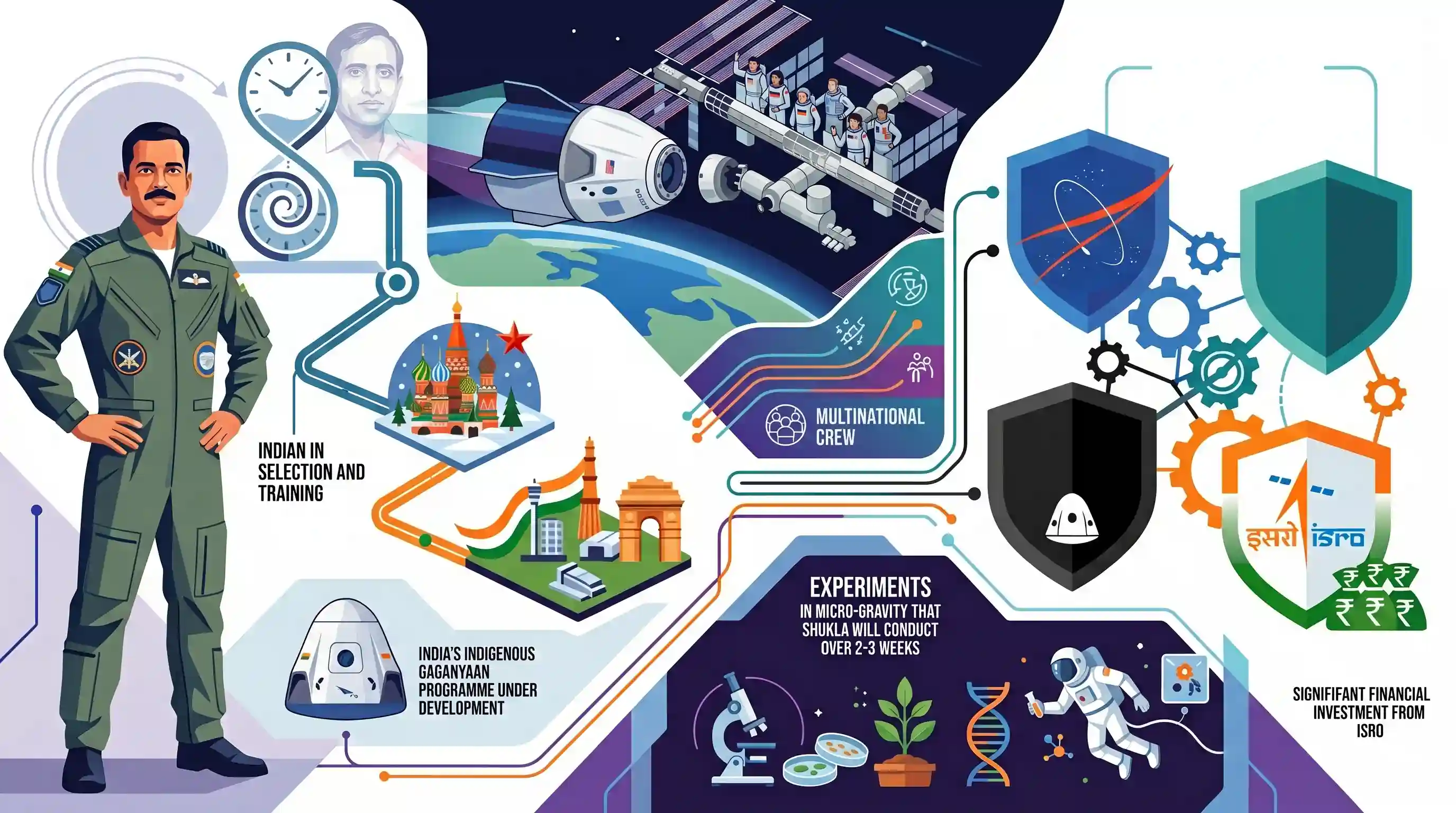
Indian Air Force Group Captain Shubhanshu Shukla has made history as the first Indian to travel to space in over four decades, launching to the International Space Station (ISS) as the pilot of the Axiom-4 (Ax-4) mission. A joint commercial effort involving NASA, Axiom Space, SpaceX, and ISRO (which invested ₹550 crore), the mission carries a multinational crew. Shukla, previously selected for India's indigenous Gaganyaan programme and trained in Russia and India, will spend two to three weeks on the ISS conducting numerous micro-gravity experiments. The mission reflects India's deepening collaboration in international and commercial spaceflight ahead of its own human spaceflight milestones.
Key Points
- Group Captain Shubhanshu Shukla launched to the International Space Station (ISS) aboard the commercial Axiom-4 mission, becoming the first Indian in space since Rakesh Sharma in 1984.
- The Axiom-4 mission, launched via a SpaceX Crew Dragon spacecraft from NASA's Kennedy Space Center, includes astronauts from the US, Poland, and Hungary.
- Shukla serves as the mission pilot, marking significant international collaboration; ISRO invested Rs 550 crore ($60 million) to secure this seat.
- Selected for India's Gaganyaan human spaceflight programme in 2019, Shukla has undergone extensive training in Russia and at ISRO's Bengaluru facilities.
- The crew will spend 14-21 days on the ISS conducting approximately 60 scientific experiments, particularly in micro-gravity research.
Important Terms
Gaganyaan

India's maiden human spaceflight mission aiming to send a 2-3 member crew to Low Earth Orbit (400 km) for 3-7 days using the LVM3 rocket.
UPSC context
GS Paper 3 (Space Tech): Tests indigenization, life support systems, and technological sovereignty in human spaceflight.
Axiom-4 mission
A private-led commercial mission to the International Space Station (ISS), involving ISRO, NASA, and Axiom Space, where Group Captain Shubhanshu Shukla served as mission pilot.
UPSC context
GS Paper 3 (Space Tech): Signifies India's shift toward international commercial collaboration and private sector engagement in space.
ISRO
India's national space agency responsible for the design, launch, and management of the Gaganyaan mission and international collaborations like Axiom-4.
UPSC context
GS Paper 3 (Space Tech): Core institutional body for space research, satellite communication, and planetary exploration.
Axiom Space
A private American company building the world's first commercial space station and organizing private astronaut missions to the International Space Station.
UPSC context
GS Paper 3 (Space Tech): Represents the global trend of commercialization of space and private infrastructure in orbit.
SpaceX
A private American aerospace manufacturer providing the Falcon 9 rocket and Crew Dragon spacecraft for missions like Axiom-4 and international crew transport.
UPSC context
GS Paper 3 (Space Tech): Impact of reusable launch technology on space accessibility and cost reduction.
Gagarin Cosmonaut Training Centre
A premier Russian facility in Star City where Indian astronauts (Gaganyatris) underwent initial basic spaceflight training from 2020-2021.
UPSC context
GS Paper 3 (Space Tech): Highlights bilateral cooperation (India-Russia) in astronaut training and human resource development.
Indian Air Force (IAF)
The primary source for India's astronaut selection; its pilots, including Shubhanshu Shukla, are trained for mission-critical roles in the Gaganyaan programme.
UPSC context
GS Paper 3 (Security/Space): Role of defense personnel in pioneering civilian space exploration and inter-agency coordination.
Prelims Trap
Shubhanshu Shukla travelled to the ISS aboard India's indigenous Gaganyaan spacecraft.
Shukla is part of the Gaganyaan crew, but this specific ISS trip is aboard a commercial SpaceX Crew Dragon under the collaborative Axiom-4 mission.
Static Concepts Connected
What are the core technological elements of ISRO's Gaganyaan human spaceflight programme?
- Human-rated LVM3 (HLVM3): India's heavy-lift launch vehicle reconfigured with advanced safety parameters to reliably carry the human-rated orbital module.
- Orbital Module: Consists of a pressurized Earth-like Crew Module for astronauts and an unpressurized Service Module for power and propulsion.
- Crew Escape System: An autonomous, fast-acting safety mechanism designed to quickly abort the launch and pull the crew module to safety.
What are the unique scientific conditions of Low Earth Orbit (LEO) utilized by the ISS?
- Microgravity environment: Creates a state of continuous free-fall, allowing unique research on fluid dynamics, cyanobacteria, and muscle atrophy without gravity's interference.
- Extreme space vacuum: Provides an ultra-high vacuum environment to test material durability, space microalgae, and advanced technologies outside Earth's protective atmosphere.
Cross-Topic Patterns
Axiom-4 + iCET space cooperation
This joint ISRO-NASA-Axiom mission directly materializes the human spaceflight commitments made under the US-India initiative on Critical and Emerging Technology (iCET).
Commercial space logistics + IN-SPACe
Axiom-4 using SpaceX showcases the shift of LEO logistics to commercial providers, mirroring India's push to privatize its space sector via IN-SPACe and NSIL.

Expect a 2026 question contrasting ISRO's indigenous Gaganyaan parameters with its commercial Axiom-4 and iCET space collaborations.
Linked PYQs · 2
Linked PYQs · 2
- 2025PrelimsGS1
Consider the following space missions : I. Axiom-4 II. SpaDeX III. Gaganyaan How many of the space missions given above encourage and support micro-gravity research?
- 2017MainsGS3
India has achieved remarkable successes in unmanned space missions including the Chandrayaan and Mars Orbitter Mission, but has not ventured into manned space missions. What are the main obstacles to launching a manned space mission, both in terms of technology and logistics? Examine critically.
