Leadership Transition and Soft Power of the Vatican
Source:Indian Express ↗
Why It Matters
As the spiritual leader of the global Catholic Church and head of the Vatican State, the Pope exercises substantial soft power in international diplomacy, conflict mediation, and global socio-economic debates. Understanding the Vatican's influence is relevant for UPSC aspirants studying international relations and the contemporary role of religion in global governance.
Summary
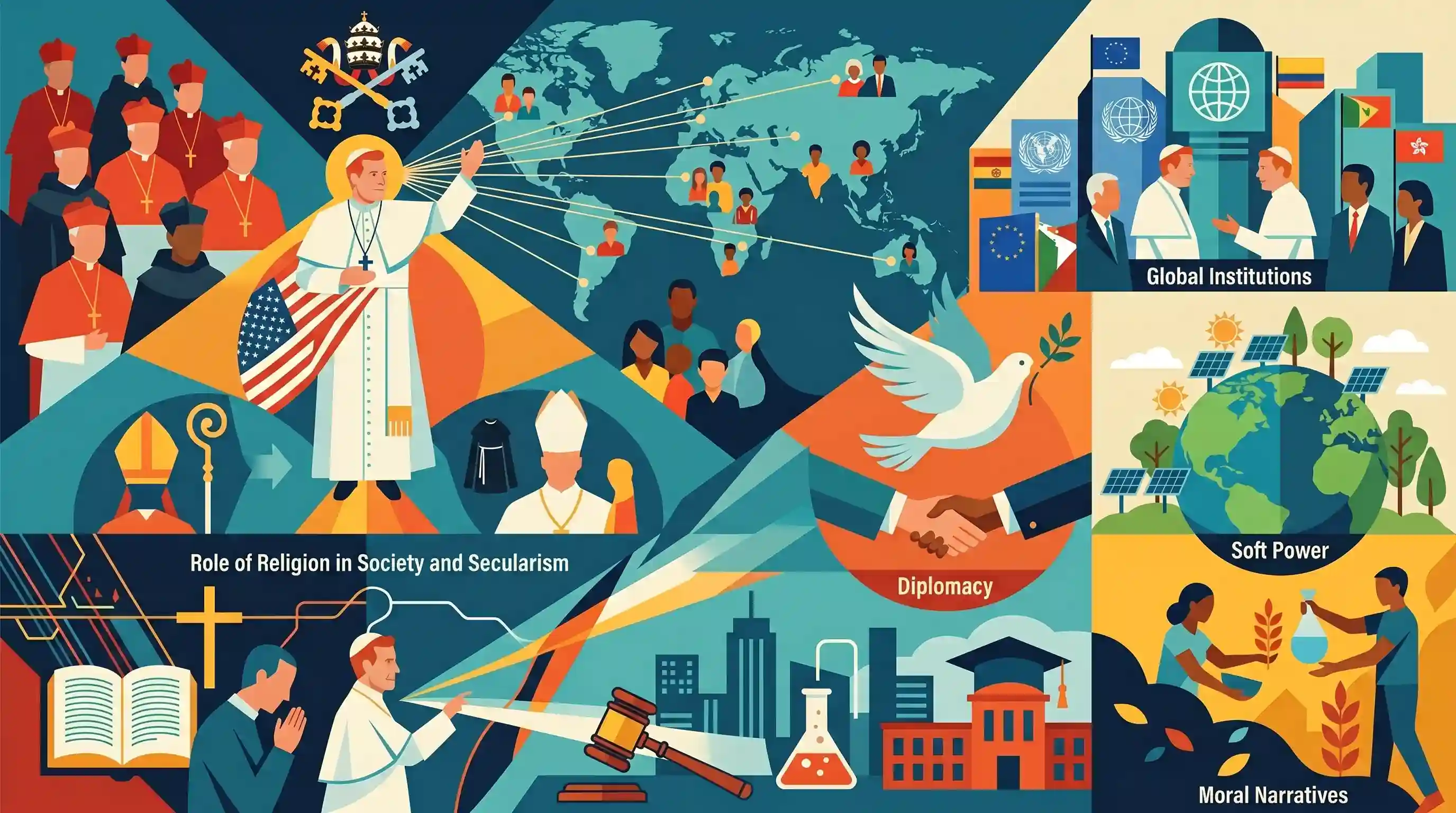
The article details the election of Robert Prevost as the new Pope of the Catholic Church. An American prelate and an Augustinian friar, Prevost previously served as the Prefect of the Dicastery for Bishops, a highly influential role in the Vatican. His elevation via the Papal Conclave underscores a significant moment in the Catholic Church's history, placing an American at the helm of an institution with over a billion followers. Beyond religious leadership, the Papacy wields immense global soft power, shaping international diplomacy, peace efforts, and moral narratives on issues such as climate change and poverty. The transition highlights the enduring intersection of religion, global governance, and international relations.
Key Points
- Robert Prevost, an American prelate and former Prefect of the Dicastery for Bishops, has been elected as the new Pope.
- He is a member of the Augustinian Order and brings significant administrative and pastoral experience from his time in Rome and the US.
- The election process, known as the Papal Conclave, involves the College of Cardinals voting in secrecy within the Sistine Chapel.
- The election of an American Pope signals potential shifts in the Catholic Church's approach to global diplomacy, social issues, and internal administration.
- The papacy holds immense soft power, influencing global debates on peace negotiations, poverty alleviation, and climate change.
Important Terms
Holy See

The central governing body of the Catholic Church and a sovereign entity under international law. It maintains diplomatic relations, signs treaties, and holds Permanent Observer status at the UN.
UPSC context
GS Paper 2: International Relations. Tests understanding of non-state sovereign actors and their role in global diplomacy.
Vatican City
The world's smallest independent city-state, enclaved within Rome. Established by the 1929 Lateran Treaty, it provides the territorial base and political independence for the Holy See.
UPSC context
GS Paper 2: International Relations/Political Science. Relevant for topics on sovereignty, theocracy, and microstates.
College of Cardinals
The senior ecclesiastical body of the Catholic Church. Its members advise the Pope and, most importantly, assemble in a conclave to elect a new Pope upon a vacancy.
UPSC context
GS Paper 2: Role of global institutions. Tests knowledge of specialized governance structures with significant international influence.
Papal Conclave
The private meeting of the College of Cardinals to elect a new Pope. It is one of the oldest ongoing methods for choosing a head of state.
UPSC context
GS Paper 1: World History/Culture. Illustrates historical continuity and religious administrative traditions influencing global leadership.
Soft Power (Papal)
The Vatican’s ability to shape international narratives on climate change, poverty, and peace through moral authority and diplomatic mediation rather than military or economic force.
UPSC context
GS Paper 2: International Relations. Tests the application of Joseph Nye’s soft power theory to religious institutions.
Augustinian Order
A Catholic religious order founded in 1244 based on the Rule of Saint Augustine. They focus on community life, education, and missionary work across the globe.
UPSC context
GS Paper 1: History/Culture. Relevant for the role of religious missions in global history and social development.
Prelims Trap
"Vatican City is a full member state of the United Nations General Assembly."
The Holy See is a Permanent Observer State, not a full member. Furthermore, it is the 'Holy See' (the governing body), not 'Vatican City' (the physical state), that holds this UN status.
Static Concepts Connected
What distinguishes the Holy See from Vatican City in International Law?
- Holy See: The supreme governing body of the global Catholic Church, recognized universally as a sovereign juridical entity in international law.
- Vatican City: The physical, independent microstate created in 1929 by the Lateran Treaty to guarantee the Holy See's absolute temporal independence from Italy.
- Diplomatic Status: It is the Holy See, not Vatican City, that maintains diplomatic relations with other nations and holds Permanent Observer status at the UN.
How is 'Soft Power' utilized in modern diplomacy?
- Core Definition: The ability to co-opt and influence others through culture, political values, and moral authority rather than coercion or payment (hard power).
- Papal Influence: The Papacy uses encyclicals and moral appeals to drive global consensus on poverty, climate change, and conflict resolution (e.g., mediating US-Cuba relations).
Cross-Topic Patterns
Non-member Observer States at the UN
The Holy See shares its rare UN Permanent Observer State status with the State of Palestine, making it a recurring comparative pivot in prelims questions regarding UN General Assembly membership.
Religious Soft Power in Diplomacy
Similar to India leveraging Buddhism in its 'Act East' policy, the Papacy utilizes religious soft power to shape global climate and peace agendas without military coercion.

Expect a multi-statement Prelims question contrasting the UN statuses of the Holy See and Palestine, focusing on Permanent Observer rights.
Linked PYQs · 5
Linked PYQs · 5
- 2015MainsGS2
Terrorist activities and mutual distrust have clouded India-Pakistan relations. To what extent the use of soft power like sports and cultural exchanges could help generate goodwill between the two countries? Discuss with suitable examples.
- 2018MainsGS1
How the Indian concept of secularism is different from the western model of secularism? Discuss.
- 2019MainsGS1
What are the challenges to our cultural practices in the name of secularism?
- 2022MainsGS1
Are tolerance, assimilation and pluralism the key elements in the making of an Indian form of secularism? Justify your answer.
- 2025MainsGS2
"With the waning of globalization, post-Cold War world is becoming a site of sovereign nationalism.” Elucidate.
