Rangarajan Poverty Estimation Framework in India
Source:Indian Express ↗
Why It Matters
Poverty estimation forms the backbone of India's welfare architecture and inclusive growth policies. Understanding committee methodologies (like Tendulkar and Rangarajan) is essential for GS3 questions on poverty, deprivation, and social sector schemes.
Summary
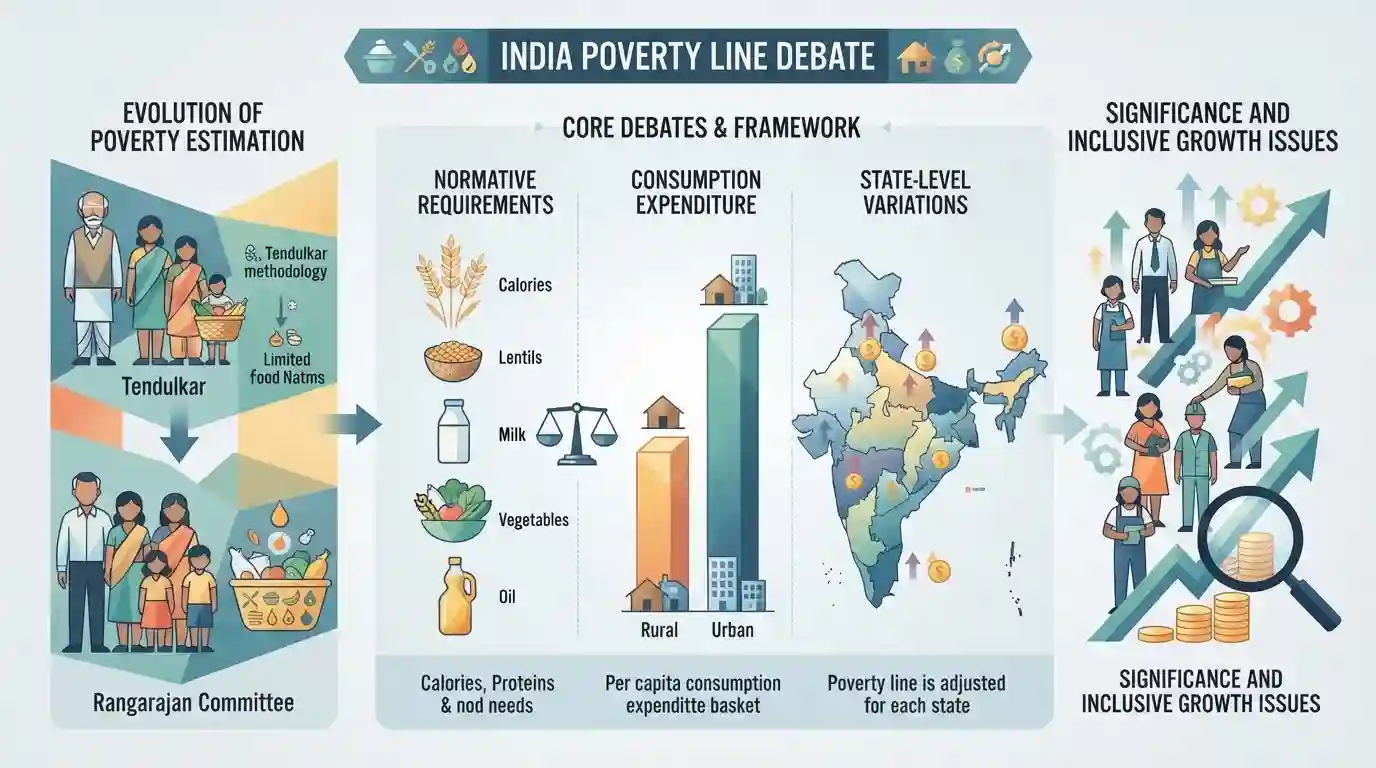
The article examines the evolution, updates, and significance of the Rangarajan poverty line framework for estimating poverty in India, highlighting the core debates surrounding consumption expenditure, normative calorie/protein/fat intake requirements, and state-level price variations.
Key Points
- The article discusses the updated Rangarajan poverty line framework and methodologies for measuring poverty in India.
- Poverty estimation in India has historically transitioned through multiple expert groups, including the Tendulkar Committee and the Rangarajan Committee, each proposing different consumption expenditure thresholds and normative requirements for calories, proteins, and fats.
- The debate centers on how poverty lines are indexed to inflation, consumption baskets, and regional price variations across states.
- Accurate poverty lines are crucial for inclusive growth, social welfare targeting, and evaluating the impact of developmental schemes.
Important Terms
Rangarajan Committee

An expert committee formed in 2012 by the Planning Commission under Dr. C. Rangarajan to re-evaluate poverty measurement methodology, recommending a higher poverty line and recognizing normative calorie, protein, and fat requirements along with non-food expenses.
UPSC context
UPSC CSE Prelims & Mains (GS Paper III: Inclusive Growth, Poverty). Tests understanding of official poverty measurement evolution and debates in India.
Tendulkar Committee
A 2009 expert group led by Suresh Tendulkar that redefined India's poverty line by shifting away from pure calorie intake to include essential non-food expenses like education, health, and clothing, raising the national poverty headcount ratio.
UPSC context
UPSC CSE Prelims & Mains (GS Paper III: Poverty and Development Issues). Frequently asked regarding benchmarks for poverty estimation methodologies.
NITI Aayog
The premier policy think tank of the Government of India that replaced the Planning Commission and oversees policy frameworks, including the publication of India's National Multidimensional Poverty Index (MPI).
UPSC context
UPSC CSE Prelims & Mains (GS Paper II/III: Governance, Inclusive Growth). Essential for tracking developmental indices and institutional governance reforms.
Prelims Trap
The Tendulkar Committee explicitly reintroduced separate normative standards for daily per capita requirements of calories, proteins, and fats.
Aspirants often assume the Tendulkar Committee retained explicit calorie norms, whereas it was the Rangarajan Committee that explicitly reintroduced them after Tendulkar dropped them.
Static Concepts Connected
What are the key differences between the Tendulkar and Rangarajan Expert Committees on poverty estimation?
- Normative Intake: Calorie norms: Tendulkar dropped explicit normative calorie/protein/fat intake requirements, whereas Rangarajan reintroduced separate normative standards for daily per capita consumption of calories, proteins, and fats.
- Expenditure Basket: Consumption basket: Tendulkar used private expenditure on health and education implicitly, while Rangarajan defined a normative basket including specific non-food expenses (clothing, education, housing, health).
- Recall Period MMRP: Recall periods: Tendulkar used Uniform/Mixed Recall Period, whereas Rangarajan recommended the Modified Mixed Recall Period (MMRP) for capturing infrequent non-food expenditures more accurately.
Cross-Topic Patterns
Poverty Lines + Fiscal Federalism & Welfare Subsidies
Poverty estimation benchmarks directly dictate statutory beneficiary counts under food security legislation and PM-KISAN, connecting statistical methodology to fiscal deficit and subsidy burdens.
Poverty Estimation + Finance Commission Devolution Formulas
Disparities in state-level poverty baskets challenge the Finance Commission's horizontal devolution formulas which often rely on income distance and demographic performance criteria.

Expect statements contrasting Tendulkar vs. Rangarajan methodologies (calorie/protein/fat norms & MMRP vs. URP data collection).
Linked PYQs · 1
Linked PYQs · 1
- 2019PrelimsGS1
In a given year in India, official poverty lines are higher in some States than in others because
