Geopolitical Ramifications of Regime Change in Venezuela
Source:Indian Express ↗
Why It Matters
Represents a monumental shift in US foreign policy and Latin American geopolitics, impacting global energy security and raising core GS2 questions about sovereignty, international intervention, and the UN's role.
Summary
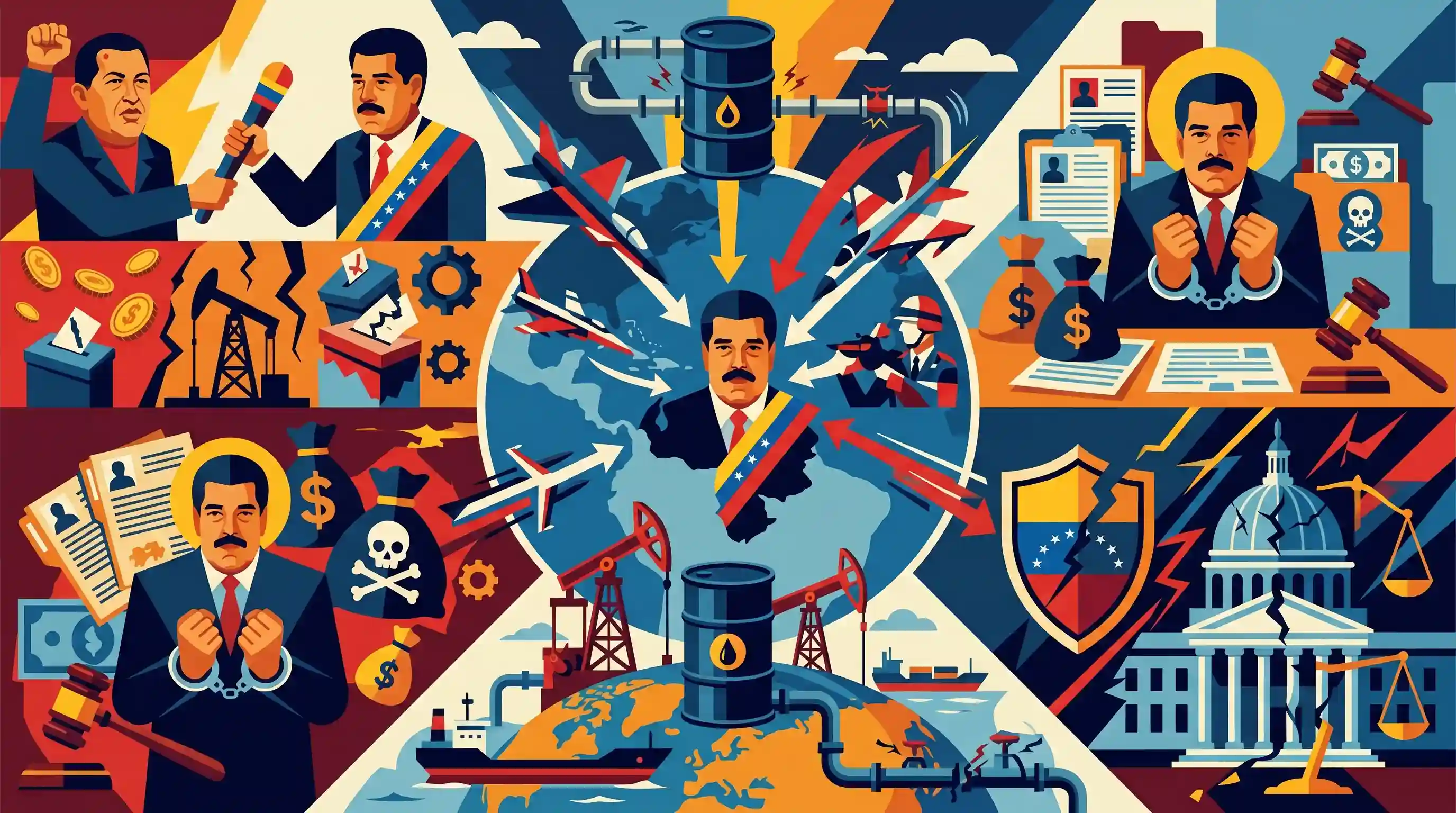
The US has launched military strikes on Venezuela and captured its President, Nicolas Maduro, marking a dramatic escalation in hemispheric geopolitics. Maduro, who succeeded Hugo Chavez in 2013, has presided over a period of severe economic collapse and democratic backsliding, leading the US to previously indict him on narco-terrorism charges. This unprecedented direct military intervention raises critical questions about international law, state sovereignty, and global energy security, given Venezuela's status as the holder of the world's largest proven oil reserves.
Key Points
- US military forces have struck Venezuela and captured President Nicolas Maduro, executing long-standing US indictments against him for narco-terrorism and corruption.
- Maduro has been a deeply polarizing figure, overseeing Venezuela's economic ruin, hyperinflation, and a massive refugee crisis since succeeding Hugo Chavez in 2013.
- The intervention invokes historical precedents of US involvement in Latin America (such as the 1989 invasion of Panama) and sharply challenges contemporary norms of state sovereignty and non-intervention.
- As Venezuela holds the world's largest proven crude oil reserves, this abrupt regime change has immediate and profound implications for global energy markets, OPEC dynamics, and oil-importing nations like India.
- The event is expected to trigger severe diplomatic fallout at the UN and polarized reactions globally, especially from geopolitical rivals opposing US interventionism.
Important Terms
Monroe Doctrine

A 1823 U.S. foreign policy opposing European colonialism in the Americas, asserting the Western Hemisphere as a U.S. sphere of influence and justifying regional military interventions.
UPSC context
GS Paper 2 (International Relations); tests understanding of global powers' strategic doctrines and their impact on regional stability.
OPEC
An intergovernmental organization established in 1960 to coordinate petroleum policies among member nations, aiming to stabilize global oil prices and ensure regular supply.
UPSC context
GS Paper 2 & 3; crucial for analyzing global energy security and oil price volatility's impact on India.
United Nations
Global body founded in 1945 to maintain international peace and security, develop friendly relations among nations, and uphold international law through its Charter.
UPSC context
GS Paper 2 (International Institutions); tests knowledge of multilateralism and the effectiveness of global governance frameworks.
Narco-terrorism
The nexus between drug trafficking and terrorist activities where illegal drug trade funds insurgencies and undermines state governance and security.
UPSC context
GS Paper 3 (Internal Security); focuses on the linkages between organized crime and terrorism.
State Sovereignty
The principle of international law granting states supreme and independent authority over their territory, protected from external interference by the UN Charter.
UPSC context
GS Paper 2 (International Relations); foundational for understanding territorial integrity and the rules-based international order.
Prelims Trap
"Venezuela is the world's largest producer of crude oil."
Venezuela holds the world's largest proven reserves (Orinoco Belt), but due to sanctions and economic collapse, its actual production is dwarfed by the US, Saudi Arabia, and Russia.
Static Concepts Connected
Why is Venezuela's crude oil difficult and costly to process?
- Heavy crude: Unlike Saudi Arabia's easily extractable light sweet crude, most of Venezuela's reserves are extra-heavy crude and bitumen located in the Orinoco Belt.
- Refining complexity: It requires complex, specialized refining to blend with lighter oils, making the extraction and processing highly capital-intensive.
- Sanctions impact: Years of international sanctions and lack of foreign investment have severely degraded the country's technological capacity to process this heavy crude.
What are the UN Charter's foundational rules on unilateral military force?
- Article 2(4): Strictly prohibits the threat or use of force against the territorial integrity or political independence of any sovereign state.
- Article 51: Provides an exception for the inherent right of individual or collective self-defense, but strictly "if an armed attack occurs."
- Chapter VII: Grants the UN Security Council the exclusive authority to authorize military intervention to maintain or restore international peace.
Cross-Topic Patterns
Energy shocks + India's macroeconomic stability
Regime change in Caracas drastically alters global oil supply expectations, directly impacting India's import basket, current account deficit, and the RBI's inflation targeting strategies.
Extraterritoriality & State Sovereignty
Justifying military force for 'narco-terrorism' challenges the ICJ Nicaragua ruling, echoing modern UPSC Mains debates on preemptive strikes and sovereignty vs. non-state actors.

Expect a 2026 Prelims question mapping global oil reserves vs production, specifically highlighting Venezuela's Orinoco heavy crude belt.
Linked PYQs · 3
Linked PYQs · 3
- 2024PrelimsGS1
Consider the following statements : Statement-I : Recently, Venezuela has achieved a rapid recovery from its economic crisis and succeeded in preventing its people from fleeing/emigrating to other countries. Statement-II : Venezuela has the world's largest oil reserves. Which one of the following is correct in respect of the above statements?
- 2025MainsGS2
"With the waning of globalization, post-Cold War world is becoming a site of sovereign nationalism.” Elucidate.
- 2025PrelimsGS1
Consider the following countries : I. Bolivia II. Brazil III. Colombia IV. Ecuador V. Paraguay VI. Venezuela Andes mountains pass through how many of the above countries?
