Narges Mohammadi Iran Prison Sentence and Human Rights Activism
Source:Indian Express ↗
Why It Matters
The article is highly relevant for GS-2 (Role of Civil Society, Human Rights) and GS-4 (Moral Courage, Ethics). It highlights the tension between authoritarian state power and civil rights defenders, and demonstrates how international mechanisms (like the Nobel Peace Prize) are used to draw global attention to domestic human rights violations.
Summary
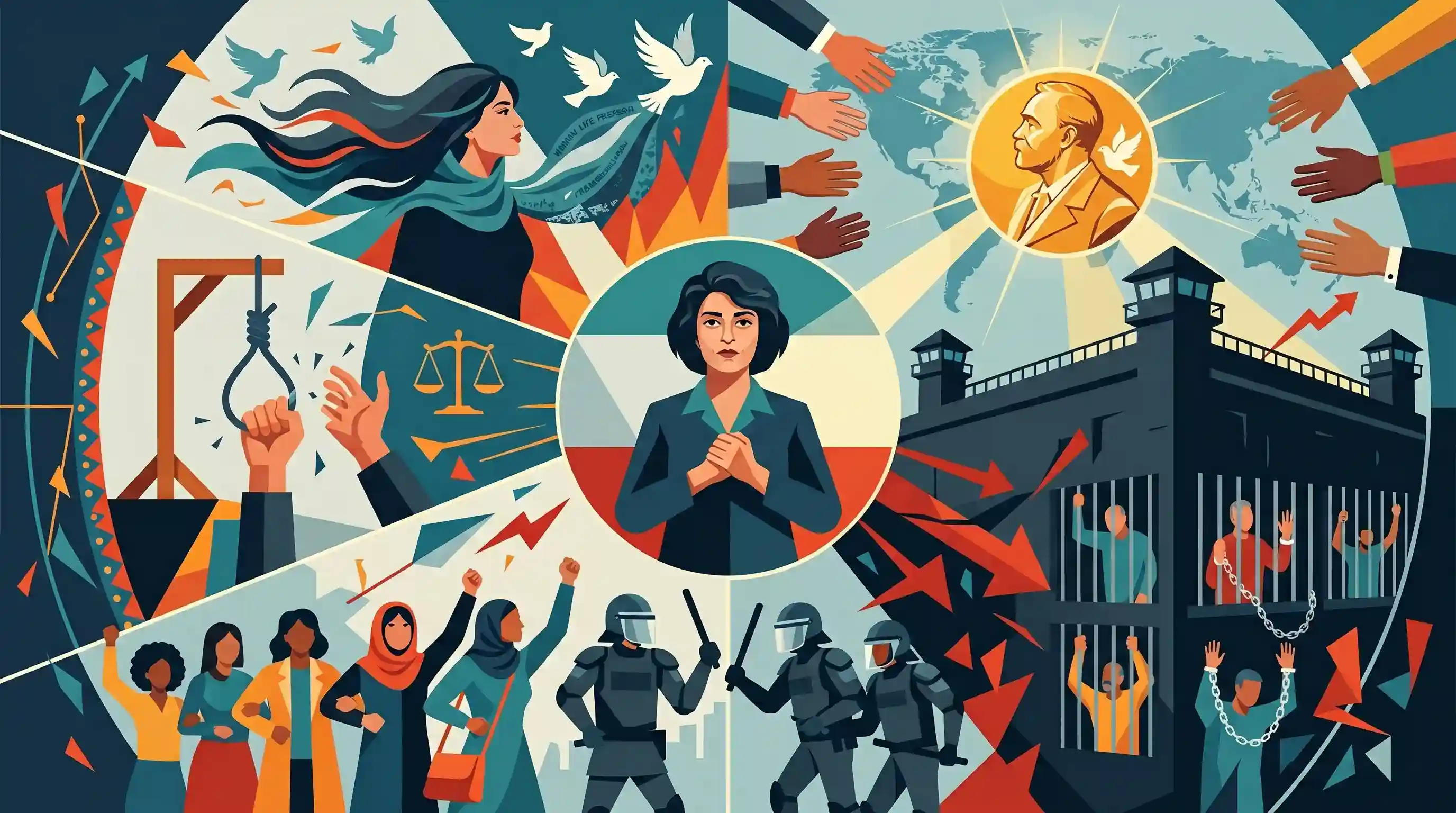
Narges Mohammadi, an acclaimed Iranian human rights advocate and the 2023 Nobel Peace Prize winner, has been sentenced to an additional prison term by Iranian authorities. Incarcerated in Tehran's notorious Evin Prison, Mohammadi has been charged with 'spreading propaganda against the system' as she continues to campaign against the death penalty, compulsory hijab, and state-sponsored violence against women. Her latest sentencing reflects Iran's severe and ongoing repression of civil society actors and dissidents, particularly in the aftermath of the 2022 'Woman, Life, Freedom' protests. Mohammadi's unwavering resistance highlights the intersection of international human rights advocacy, moral courage, and the harsh realities faced by civil rights defenders under authoritarian regimes.
Key Points
- Narges Mohammadi, the 2023 Nobel Peace Prize laureate and prominent Iranian human rights activist, has been handed an additional prison sentence by Iran's Revolutionary Court.
- The charges against her include 'spreading propaganda against the system' due to her continuous advocacy from within Tehran's Evin Prison.
- Her activism focuses extensively on abolishing the death penalty and combating state oppression of women, including the enforcement of compulsory hijab laws.
- The sentencing underscores the Iranian government's intensified crackdown on dissent, civil society, and the legacy of the 'Woman, Life, Freedom' movement triggered by the death of Mahsa Amini.
- The case illustrates the complex impact of international recognition; while the Nobel Prize amplifies her cause globally, it has also provoked harsher punitive responses from the authoritarian state.
Important Terms
Nobel Peace Prize

An international award established by Alfred Nobel, presented annually in Oslo to individuals or organizations for outstanding contributions to peace, conflict resolution, and human rights.
UPSC context
Relevant for GS Paper 2 (International Relations) and GS Paper 1 (Social Issues), testing knowledge of global soft power and humanitarian standards.
Revolutionary Court (Iran)
Specialized judicial bodies in Iran established after the 1979 Revolution to try cases involving national security, political dissent, and 'propaganda against the system' with limited due process.
UPSC context
Relevant for GS Paper 2 (Governance/Constitutional Comparison) and GS Paper 4 (Ethics), focusing on judicial independence and human rights protections.
Defenders of Human Rights Center (DHRC)
An Iranian NGO founded by Nobel laureate Shirin Ebadi that provides legal defense for political prisoners and monitors human rights violations; Narges Mohammadi serves as its Vice President.
UPSC context
Pertinent for GS Paper 2 (Role of Civil Society Organizations) and international human rights advocacy frameworks.
Woman, Life, Freedom
A major 2022 Iranian protest movement triggered by the death of Mahsa Amini, campaigning against compulsory hijab, state-sponsored violence against women, and broader authoritarian repression.
UPSC context
Relevant for GS Paper 1 (Society/Women Empowerment) and GS Paper 2 (International Relations), focusing on global democratic movements.
Evin Prison
A notorious detention facility in Tehran primarily used for incarcerating political dissidents, journalists, and human rights activists, often cited for systematic human rights abuses.
UPSC context
Relevant for GS Paper 2 and GS Paper 4 (Ethics), symbolizing the intersection of state authority and individual civil liberties.
Norwegian Nobel Committee
The five-member body appointed by the Norwegian Parliament responsible for selecting the Nobel Peace Prize laureates, operating independently of the Swedish Nobel Foundation.
UPSC context
Relevant for GS Paper 2 (International Institutions) and understanding the mechanisms of global diplomatic and moral recognition.
Prelims Trap
The Nobel Peace Prize is awarded by the Swedish Academy in Stockholm.
Unlike the other Nobel Prizes which are awarded in Stockholm, Sweden, the Nobel Peace Prize is awarded by the Norwegian Nobel Committee in Oslo, Norway.
Static Concepts Connected
What are the key mechanisms of the UN Human Rights Council (UNHRC)?
- Universal Periodic Review: A peer-review process assessing the human rights records of all UN Member States every 4.5 years.
- Advisory Committee: Serves as a "think-tank" providing expertise and advice to the Council on thematic human rights issues.
- Complaint Procedure: Addresses consistent patterns of gross, reliably attested human rights violations submitted by individuals or organizations.
How is 'Moral Courage' defined in the context of public ethics?
- Core Definition: The willingness to speak truth to power and do what is right, despite facing severe physical, social, or political risks (like imprisonment).
- Catalyst for Change: It is essential for combating unjust state laws, ensuring accountability, and advocating for marginalized groups against authoritarian pressures.
Cross-Topic Patterns
Women's rights + Moral Courage
Mohammadi’s resistance in Evin Prison offers a prime GS4 case study on moral courage, linking feminist protests (GS1) with ethical defiance of unjust state mandates.
State control over civil society
Iran's crackdown mirrors a global trend where states use 'anti-propaganda' or 'national security' laws to paralyze human rights NGOs, directly relevant to GS2 civil society topics.

Expect a GS4 question on the ethical dilemma of obeying unjust state laws vs. conscience, drawing from international civil rights activism.
Linked PYQs · 4
Linked PYQs · 4
- 2025MainsGS2
Civil Society Organizations are often perceived as being anti-State actors than non-State actors. Do you agree? Justify.
- 2021MainsGS2
“Though women in post-Independent India have excelled in various fields, the social attitude towards women and feminist movement has been patriarchal." Apart from women education and women empowerment schemes, what interventions can help change this milieu?
- 2021MainsGS2
Though the Human Rights Commissions have contributed immensely to the protection of human rights in India, yet they have failed to assert themselves against the mighty and powerful. Analyzing their structural and practical limitations, suggest remedial measures.
- 2018PrelimsGS1
"Rule of Law Index" is released by which of the following?
