Justice Surya Kant Assumes Office as 53rd Chief Justice
Source:The Hindu ↗
Why It Matters
The appointment of a new Chief Justice of India is a crucial constitutional event. His stated priority to reduce judicial pendency, alongside his past judgments on high-stakes constitutional matters (Article 370, Sedition, Right to Privacy vs. National Security), provide direct fodder for GS Paper 2 questions on the functioning of the judiciary, the Collegium system, and the dynamic interpretation of Fundamental Rights.
Summary
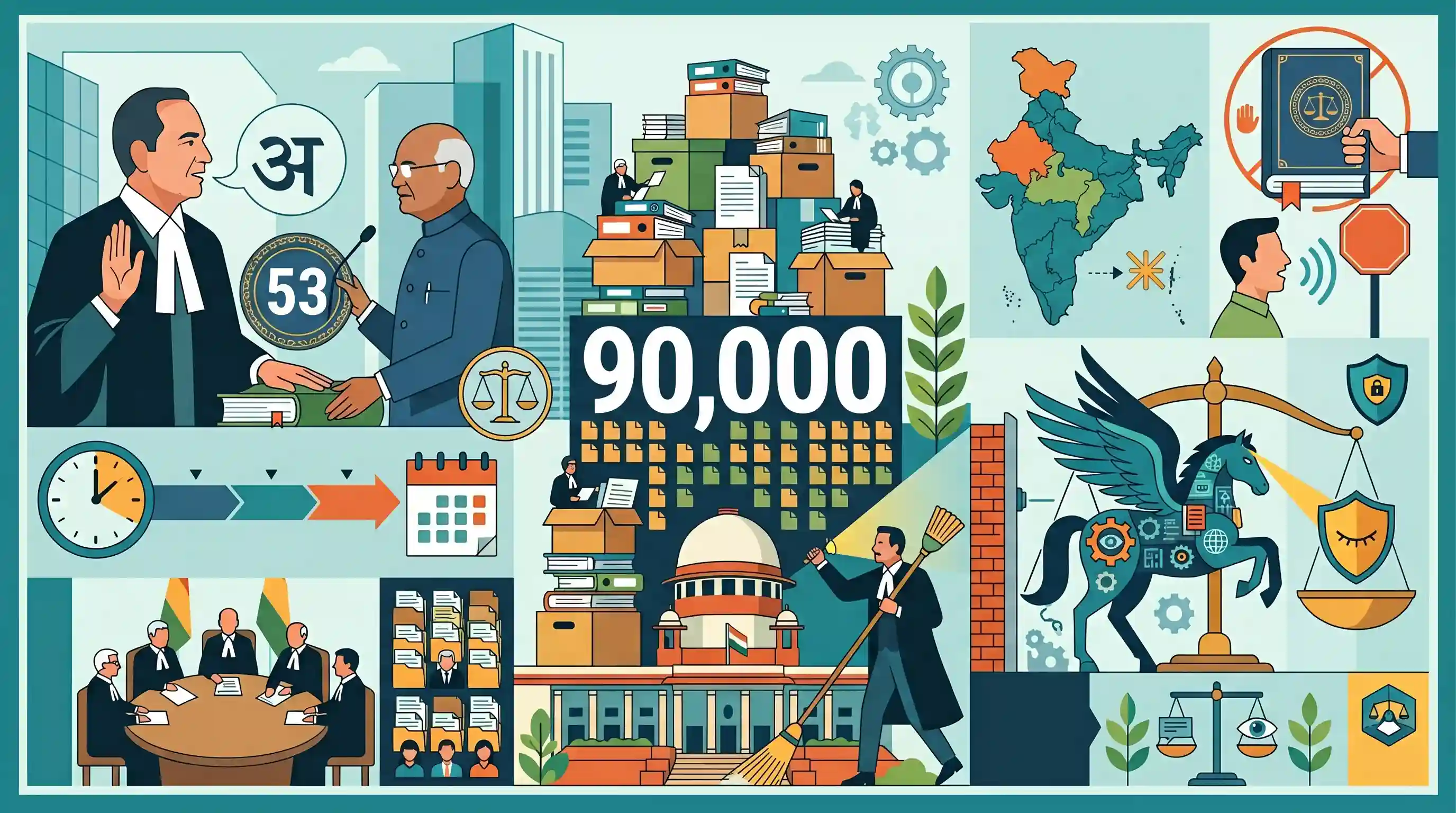
Justice Surya Kant has taken the oath as the 53rd Chief Justice of India (CJI), succeeding the previous CJI and setting his sights on addressing the immense backlog of 90,000 pending cases in the Supreme Court. Having taken his oath in Hindi, he is slated to hold the position for nearly 15 months until his retirement in February 2027. His judicial career features prominent constitutional decisions, including validating the abrogation of Article 370, keeping the Sedition Law in abeyance, and clarifying that 'national security' is not a carte blanche for the state in the Pegasus spyware case. His appointment and past judgments bring to focus UPSC GS-2 themes like the Collegium system, judicial pendency, and the balance between national security and fundamental rights (Right to Privacy).
Key Points
- Justice Surya Kant has been sworn in as the 53rd Chief Justice of India, taking the oath in Hindi, with a tenure expected to last until February 2027.
- A primary focus of his term is aimed at reducing the massive pendency of roughly 90,000 cases currently before the Supreme Court.
- He has authored or been part of crucial rulings, including upholding the abrogation of Article 370, reviewing the Sedition law, and probing the security breach during the PM's visit to Punjab.
- In the Pegasus spyware case, he asserted that the state cannot invoke 'national security' as an absolute free pass, reinforcing the Right to Privacy under Article 21.
- His initial elevation to the Supreme Court witnessed internal disagreements within the collegium, bringing the judicial appointment process back into the spotlight.
Important Terms
Supreme Court Collegium

A non-constitutional system where the Chief Justice of India and four senior-most judges recommend appointments and transfers of judges to the higher judiciary. It evolved through the 'Three Judges Cases' to ensure judicial independence.
UPSC context
GS-2 (Judiciary); tests understanding of judicial appointments, independence, and the 'Three Judges Cases' evolution.
Article 370
A constitutional provision that granted special autonomous status to Jammu and Kashmir. Its core components were abrogated in 2019, a move the Supreme Court subsequently upheld as constitutionally valid.
UPSC context
GS-2 (Constitution); essential for topics on federalism, historical underpinnings, and internal security.
Sedition (Section 124A)
Governed by Section 124A of the IPC, it criminalizes speech or actions bringing hatred or contempt toward the government. The Supreme Court placed the law in abeyance in 2022.
UPSC context
GS-2 (Fundamental Rights); tests the balance between freedom of speech (Article 19) and national security.
Right to Privacy (Article 21)
A fundamental right under Article 21 (Puttaswamy case) protecting individuals from unauthorized state surveillance. It was a focal point in the Pegasus spyware case regarding the limits of 'national security.'
UPSC context
GS-2 (Fundamental Rights); tests application of rights in the digital age and state surveillance.
One Rank-One Pension (OROP)
A policy providing uniform pension to armed forces personnel of the same rank and length of service, regardless of retirement date. The Supreme Court upheld the government's implementation formula as non-arbitrary.
UPSC context
GS-2/GS-3 (Governance); tests understanding of executive policy-making and social security for veterans.
Article 30
Constitutional right for religious and linguistic minorities to establish and administer educational institutions. It is central to the legal debate over the minority status of Aligarh Muslim University (AMU).
UPSC context
GS-2 (Minority Rights); tests knowledge of educational rights and secularism in the Indian Constitution.
Prelims Trap
The Constitution allows Supreme Court proceedings to be conducted in Hindi if the Chief Justice of India so directs.
Article 348(1) strictly mandates that all Supreme Court proceedings be in English. The CJI cannot alter this via directions; only Parliament can enact a law to change it.
Static Concepts Connected
Constitutional provisions for the language of the Higher Judiciary
- Article 348(1): Mandates that until Parliament by law otherwise provides, all proceedings in the Supreme Court and every High Court shall be in English.
- Parliamentary Override: Only Parliament has the authority to alter the language of the Supreme Court. The executive or the judiciary cannot bypass this.
- High Court Exception: The Governor, with the President's consent, can authorize Hindi in High Court proceedings, but decrees and judgments must still be in English.
Procedure for appointing the Chief Justice of India
- Seniority Norm: By convention, the senior-most judge of the Supreme Court considered fit to hold the office is appointed as the CJI.
- MoP Process: The Union Minister of Law and Justice formally seeks the recommendation of the outgoing CJI to initiate the process.
- Collegium Consultation: If there is doubt about the senior-most judge's fitness, the outgoing CJI must consult other judges under Article 124(2).
Cross-Topic Patterns
National Security vs. Judicial Review
The Pegasus ruling denies the state a 'carte blanche' under national security, tightly connecting GS-3 intelligence agency oversight to GS-2 fundamental rights (Article 21).
Judicial Pendency & Structural Reforms
The record 90,000 pending cases in the SC connects to long-standing GS-2 debates on judge-to-population ratios, infrastructural deficits, and the viability of a National Court of Appeal.

Expect a Prelims statement mixing Article 348 (language of courts) with the Sedition Law's current constitutional status in 2026.
Linked PYQs · 5
Linked PYQs · 5
- 2025MainsGS2
Discuss the evolution of collegium system in India. Critically examine the advantages and disadvantages of the system of appointment of the Judges of the Supreme Court of India and that of the USA.
- 2017MainsGS2
Critically examine the Supreme Court's judgement on 'National Judicial Appointments Commission Act, 2014' with reference to appointment of judges of higher judiciary in India.
- 2024PrelimsGS1
Under which of the following Articles of the Constitution of India, has the Supreme Court of India placed the Right to Privacy ?
- 2021PrelimsGS1
'Right to Privacy' is protected under which Article of the Constitution of India?
- 2025MainsGS2
Comment on the need of administrative tribunals as compared to the court system. Assess the impact of the recent tribunal reforms through rationalization of tribunals made in 2021.
