Mexico Drug Cartel Transnational Organized Crime Security Challenges
Source:The Hindu ↗
Why It Matters
This event provides a high-profile contemporary case study of transnational organized crime, narco-terrorism, and bilateral security cooperation, which are essential components of the GS3 syllabus regarding linkages between organized crime and terrorism.
Summary
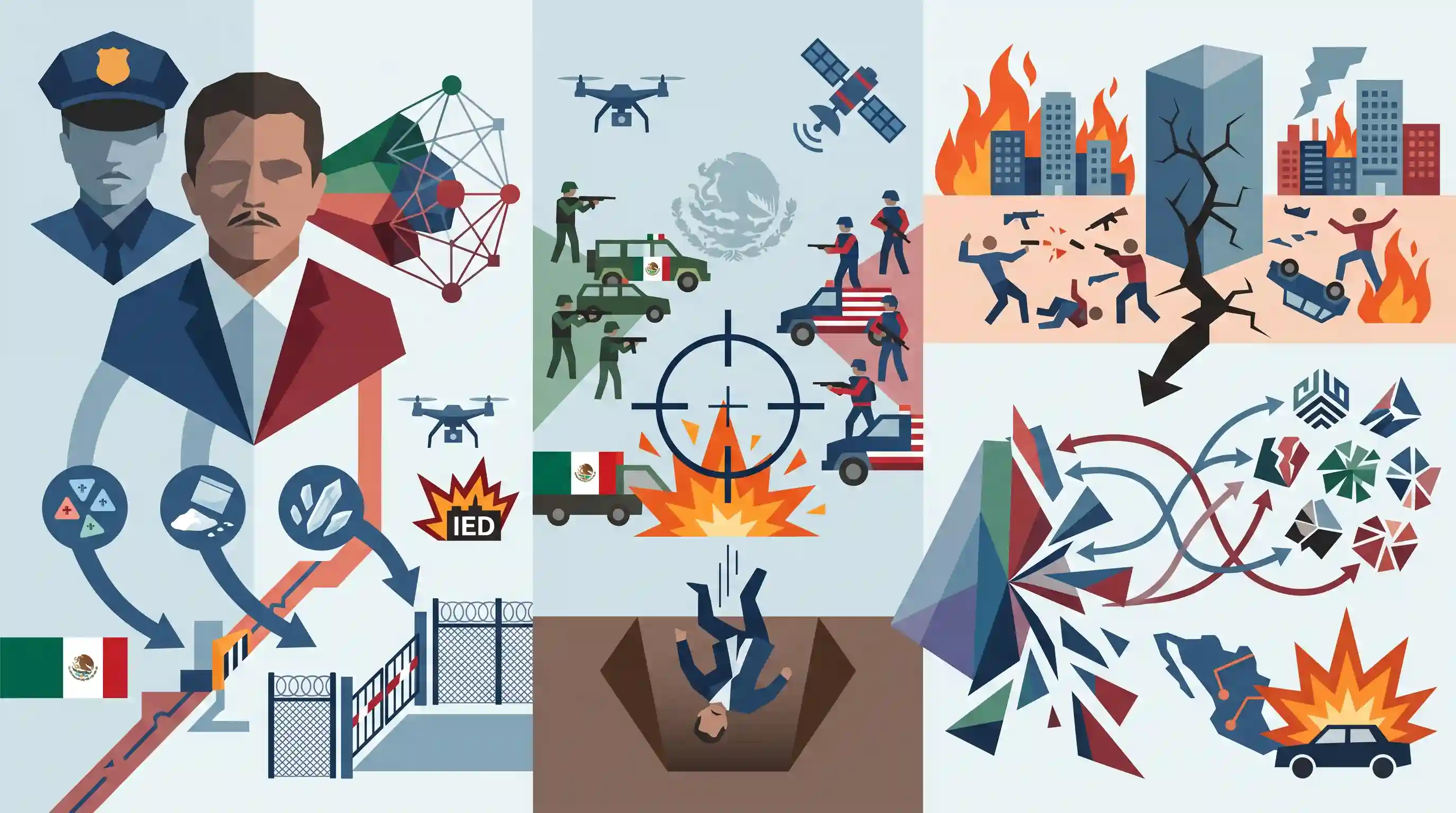
The Mexican army, aided by U.S. intelligence, killed Nemesio Oseguera Cervantes (known as 'El Mencho'), the notorious leader of the Jalisco New Generation Cartel. His death on February 22, 2026, sparked widespread retaliatory violence by cartel members across several Mexican states. A former police officer, El Mencho transformed his cartel into Mexico's fastest-growing criminal syndicate, dominating the trafficking of fentanyl, cocaine, and methamphetamines to the U.S., and employing military-style tactics like drones and IEDs. While the operation represents a major victory in U.S.-Mexico security collaboration, experts warn it could destabilize the cartel landscape, potentially triggering a brutal internal power struggle or full-scale 'narcoterrorism' akin to Colombia in the 1990s.
Key Points
- Nemesio Oseguera Cervantes ('El Mencho'), head of the Jalisco New Generation Cartel, was killed in an intelligence-driven operation by the Mexican army with U.S. support.
- His death triggered a wave of retaliatory violence across Mexico, including road blockades, burning vehicles, and school closures.
- The cartel is heavily involved in trafficking fentanyl, methamphetamines, and cocaine into the U.S. and has used sophisticated tactics such as drones and IEDs.
- Analysts fear the cartel's decapitation could lead to indiscriminate 'narcoterrorism' attacks, drawing parallels to Colombia's security crisis in the 1990s.
- The successful operation highlights cross-border counter-narcotics cooperation and provides Mexico leverage amid pressure from the U.S. administration.
Important Terms
Jalisco New Generation Cartel (CJNG)

A powerful Mexican criminal syndicate known for its militarized tactics, extreme violence, and dominance in the global trafficking of synthetic drugs like fentanyl and methamphetamine.
UPSC context
Relevant for GS III (Internal Security); serves as a case study for the evolution of transnational organized crime and its threat to state sovereignty.
Narco-terrorism
The intersection of drug trafficking and terrorism, where criminal groups use terrorist tactics to influence governments or terror groups utilize drug profits to fund their activities.
UPSC context
Core topic in GS III (Internal Security) regarding the linkages between organized crime and terrorism and the impact on border security.
Transnational Organized Crime (TOC)
Self-perpetuating criminal activities coordinated across national borders for profit, involving diverse illicit trades such as drug trafficking, money laundering, and human smuggling.
UPSC context
Major theme in GS III (Internal Security) testing understanding of global criminal networks and the challenges they pose to international law enforcement.
U.S. Drug Enforcement Administration (DEA)
The primary U.S. federal agency tasked with enforcing controlled substance laws; it frequently engages in international intelligence sharing and joint operations to dismantle global drug cartels.
UPSC context
Relevant for GS II (International Relations) as a mechanism for bilateral security cooperation and intelligence-led policing in transnational security frameworks.
Fentanyl
A highly potent synthetic opioid that has fueled a global public health crisis and become a central focus of international security efforts against drug cartels.
UPSC context
Important for GS III (Internal Security and Social Justice) regarding the impact of synthetic drugs on national health and security stability.
Mérida Initiative
A strategic security framework initiated in 2008 between the U.S. and Mexico to combat drug trafficking and institutionalize the rule of law through intelligence sharing and aid.
UPSC context
Useful for GS II (Bilateral Relations) as a model for international security cooperation and its limitations in addressing domestic organized crime.
Prelims Trap
Fentanyl is a highly potent, naturally occurring opioid derived from intensive poppy cultivation.
Fentanyl is fully synthetic (lab-made), not plant-based. UPSC often tests the distinction between traditional agricultural narcotics (heroin/opium) and modern synthetic drugs (fentanyl, meth).
Static Concepts Connected
How do organized crime and terrorism converge (Narco-terrorism)?
- Financial Linkages: Terrorist groups provide protection, weapons, and safe transit routes in exchange for illicit cartel funding.
- Tactical Convergence: Cartels increasingly adopt terrorist asymmetric tactics, such as IEDs and weaponized drones, to intimidate civilians and erode state authority.
- Shared Networks: Both entities exploit weak state governance, porous borders, and transnational money laundering syndicates (like hawala or crypto) to sustain operations.
What characterizes the geography of the global illicit drug trade?
- Golden Crescent: Comprises Iran, Afghanistan, and Pakistan. It has traditionally been the primary hub for illicit opium and heroin production globally.
- Golden Triangle: Spans Myanmar, Laos, and Thailand. Historically known for opium, it is now a massive production center for methamphetamines.
- The Synthetic Shift: A dangerous transition from land-intensive poppy cultivation to discreet, decentralized, lab-based production of synthetic opioids like Fentanyl.
Cross-Topic Patterns
Cartel drones & border management
Weaponized cartel drones mirror drug/arms payload drones dropped across the India-Pakistan border, emphasizing the urgency of C-UAS (Counter-Unmanned Aircraft Systems) deployment for GS3 Border Management.
Kingpin strategy & security vacuums
The 'decapitation' of cartel leaders often fragments groups, sparking violent turf wars. This paradox directly parallels GS3 counter-insurgency and anti-Naxal policing strategies, where eliminating top commanders triggers internal succession wars.

Expect a GS3 Mains question on the shift from plant-based narcotics (Golden Crescent) to synthetic drugs (Fentanyl) and drone smuggling.
Linked PYQs · 4
Linked PYQs · 4
- 2022MainsGS3
Discuss the types of organised crimes. Describe the linkages between terrorists and organised crime that exist at the national and transnational levels.
- 2024MainsGS3
Explain how narco-terrorism has emerged as a serious threat across the country. Suggest suitable measures to counter narco-terrorism.
- 2018MainsGS3
India's proximity to two of the world's biggest illicit opium-growing states has enhanced her internal security concerns. Explain the linkages between drug trafficking and other illicit activities such as gunrunning, money laundering and human trafficking. What counter-measures should be taken to prevent the same?
- 2011MainsGS2
Write a short note on the strategies adopted by Colombia to eliminate its drug cartels.
