Structure and Functions of Urban Local Bodies in Delhi
Source:Indian Express ↗
Why It Matters
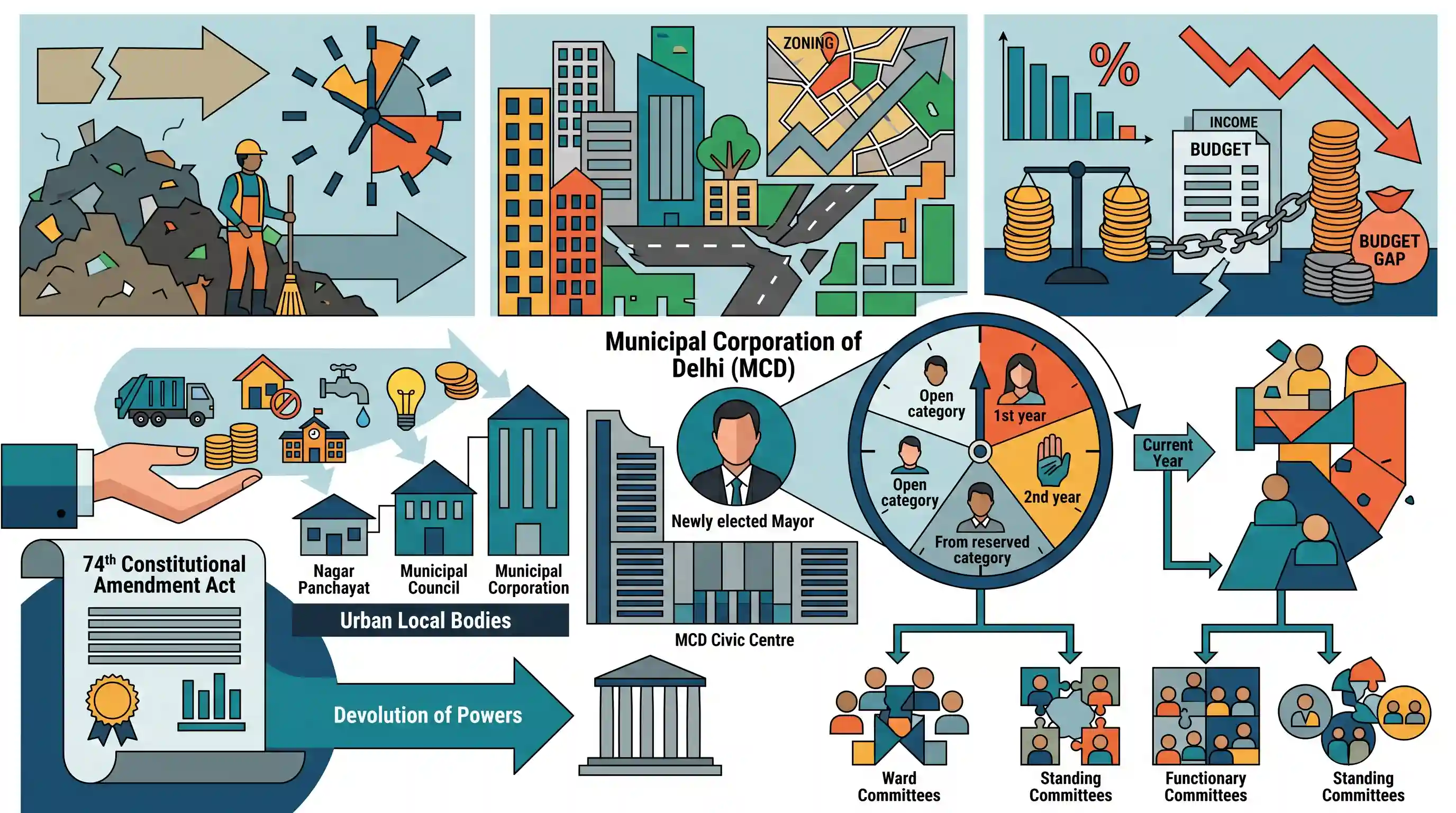
Understanding the functioning of Urban Local Bodies (ULBs) is a core component of the GS2 syllabus (Devolution of powers and finances up to local levels). The specific structure of the MCD, including the limited powers and rotational reservation of its Mayor, serves as an important case study for urban governance challenges in Indian megacities.
Summary
The article profiles the newly elected Mayor of the Municipal Corporation of Delhi (MCD), outlining their political background and the context of their election. It discusses the administrative structure of the MCD, the unique one-year rotating tenure for the mayoral post, and the various civic challenges—such as sanitation, urban planning, and financial management—that await the new leadership in the national capital.
Key Points
- The article details the profile and political trajectory of the newly elected Mayor of the Municipal Corporation of Delhi (MCD).
- Highlights the political dynamics and significance of the mayoral election within the national capital's governance framework.
- Sheds light on the rotational reservation system for the mayoral post in Delhi, where the one-year term rotates among different categories (Women, General, SC).
- Points out the immediate civic, administrative, and financial challenges the new mayor must navigate to improve urban governance in Delhi.
Important Terms
74th Constitutional Amendment Act, 1992

Enacted in 1992, it granted constitutional status to Urban Local Bodies (ULBs), introducing Part IXA and the Twelfth Schedule to strengthen local self-government in urban India.
UPSC context
GS Paper 2: Indian Polity. Essential for understanding democratic decentralization and the constitutional framework of local governance.
Delhi Municipal Corporation Act, 1957
The primary legislative framework governing Delhi's municipal administration. It was significantly amended in 2022 to unify three separate corporations back into a single Municipal Corporation of Delhi.
UPSC context
GS Paper 2: Statutory bodies and governance. Tests knowledge of urban administrative reforms in the National Capital Territory.
Municipal Corporation of Delhi (MCD)
One of the world's largest municipal bodies, responsible for civic services like sanitation and primary education for over 20 million people in the National Capital Territory.
UPSC context
GS Paper 2: Governance. A key case study for urban planning, financial management, and civic challenges in metropolitan areas.
Urban Local Bodies (ULBs)
Self-governing institutions in urban areas, categorized by the 74th Amendment into Nagar Panchayats, Municipal Councils, and Municipal Corporations based on population size and transition.
UPSC context
GS Paper 2: Local Self-Government. Focuses on the "Third Tier" of government and its functional efficiency.
Devolution of Powers
The transfer of 'Funds, Functions, and Functionaries' (3Fs) from State or Central governments to local bodies to enable effective grassroots decision-making.
UPSC context
GS Paper 2: Federalism. Analyzes the gap between constitutional intent and actual empowerment of local institutions.
Twelfth Schedule
A list of 18 functional items (such as urban planning and sanitation) added to the Constitution that municipalities may be empowered to implement by State legislatures.
UPSC context
GS Paper 2: Constitution. Crucial for detailing the functional jurisdiction of urban local governments.
Prelims Trap
"The Mayor of Delhi enjoys a fixed five-year tenure and exercises primary executive and financial authority over municipal administration."
Under Article 243U, the Municipality gets a 5-year term, but the DMC Act limits the Mayor's term to just 1 year (rotational). Executive power rests with the appointed Commissioner, not the Mayor.
Static Concepts Connected
What distinguishes the 'weak-mayor' model in Indian urban local bodies?
- Ceremonial Head: The Mayor acts primarily as the ceremonial 'first citizen' and presides over municipal council meetings.
- Executive Authority: Substantive administrative and financial powers are vested in a state-appointed Municipal Commissioner (usually an IAS officer).
- Global Contrast: This contrasts heavily with 'strong-mayor' systems (like in the US), where mayors have direct executive control, veto power, and budgetary authority.
What are the core constitutional provisions for ULBs under the 74th Amendment?
- Part IXA: Added Part IXA to the Constitution to provide a standardized framework for Municipalities (Nagar Panchayats, Councils, Corporations).
- 12th Schedule: Added to the Constitution, it contains 18 functional items (e.g., urban planning, fire services) devolved to ULBs under Article 243W.
- Reservations: Article 243T mandates the reservation of seats for SC/STs in proportion to their population, and at least one-third of total seats for women.
Cross-Topic Patterns
Overlapping Jurisdictions in Delhi
MCD's functioning is complicated by Delhi's unique status under Article 239AA, leading to administrative friction between the elected UT Government, the LG, and the civic body.
Weak Mayors vs. Smart City SPVs
Special Purpose Vehicles (SPVs) under the Smart Cities Mission often bypass elected ULBs, further eroding the already limited financial and executive powers of city mayors.

Expect a prelims statement contrasting the 5-year constitutional term of municipalities with the 1-year rotational mayoral tenure in Delhi.
Linked PYQs · 3
Linked PYQs · 3
- 2024MainsGS2
Analyse the role of local bodies in providing good governance at local level and bring out the pros and cons merging the rural local bodies with the urban local bodies.
- 2024PrelimsGS1
Which of the following statements are correct about the Constitution of India? 1. Powers of the Municipalities are given in Part IX A of the Constitution. 2. Emergency provisions are given in Part XVIII of the Constitution. 3. Provisions related to the amendment of the Constitution are given in Part XX of the Constitution. Select the answer using the code given below :
- 2017PrelimsGS1
Local self-government can be best explained as an exercise in
