Ashok Kumar Lahiri appointed NITI Aayog Vice Chairperson
Source:Indian Express ↗
Why It Matters
The restructuring of NITI Aayog is highly relevant for UPSC candidates as it directly relates to governance and policy-making bodies in India. Understanding Lahiri's stance on state finances and fiscal discipline provides critical insights into Centre-State financial relations, cooperative federalism, and the macroeconomic challenges posed by populist spending—topics frequently tested in GS Papers 2 and 3.
Summary
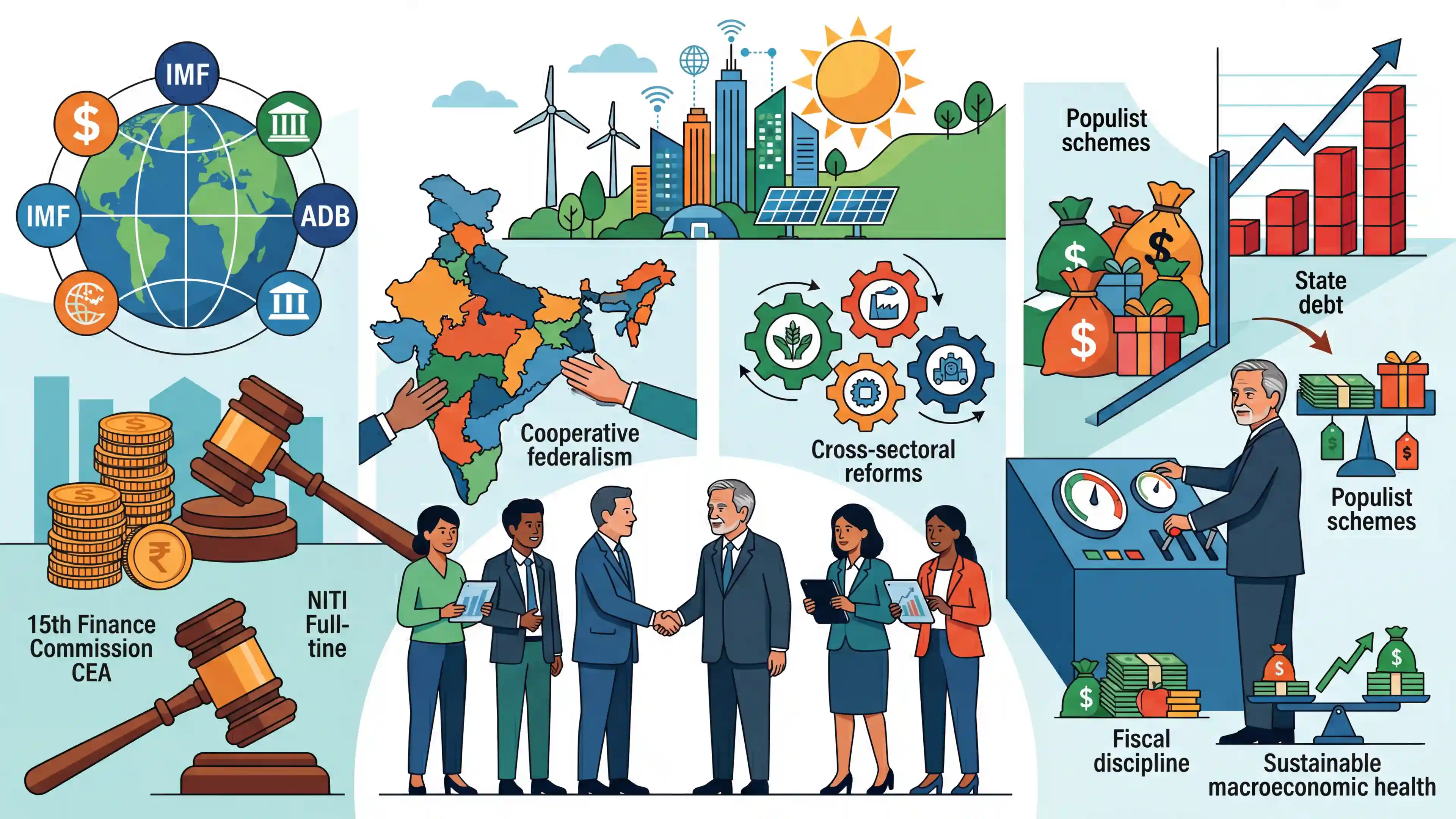
The article discusses the appointment of Ashok Kumar Lahiri as the new Vice Chairperson of NITI Aayog, along with the induction of four new full-time members. Lahiri brings extensive economic expertise, having served as Chief Economic Advisor and a member of the 15th Finance Commission, as well as holding positions at the IMF, World Bank, and ADB. The restructuring comes as NITI Aayog continues its mandate to drive cooperative federalism, formulate policies for a 'Viksit Bharat' by 2047, and implement cross-sectoral reforms. Lahiri's economic philosophy emphasizes fiscal discipline, particularly concerning state finances. He has consistently warned against the proliferation of populist schemes that strain state budgets and inflate debt-to-GSDP ratios, indicating that his leadership may focus heavily on aligning welfare initiatives with sustainable macroeconomic health.
Key Points
- Ashok Kumar Lahiri, a former Chief Economic Advisor and 15th Finance Commission member, has been appointed as the new Vice Chairperson of NITI Aayog, succeeding Suman Bery.
- Four new full-time members—K V Raju, M Srinivas, Abhay Karandikar, and Gobardhan Das—have also been appointed, replacing the outgoing members. Rajiv Gauba has been retained as a member.
- NITI Aayog, established in 2015 as the government\'s premier policy think tank, plays a vital role in formulating cross-sector reforms, fostering cooperative federalism, and driving the vision for a \'Viksit Bharat\' by 2047.
- Lahiri has been a strong advocate for fiscal discipline among states, frequently cautioning against populist welfare schemes ("revdi culture") and the deteriorating debt-to-GSDP ratios in states like Punjab, West Bengal, and Rajasthan.
- His tenure is expected to emphasize balancing essential welfare measures with long-term fiscal sustainability, crucial for India\'s macroeconomic stability.
Important Terms
NITI Aayog

The National Institution for Transforming India is the government's premier policy think tank. It replaced the Planning Commission to foster cooperative federalism and provide strategic, technical advice to Central and State governments.
UPSC context
GS Paper 2 & 3: Tests knowledge of non-constitutional bodies, bottom-up planning, and the shift from centralized resource allocation to collaborative policymaking.
Viksit Bharat
The official vision to transform India into a developed nation by 2047, the 100th year of independence. It targets economic prosperity, social advancement, and environmental sustainability.
UPSC context
GS Paper 3: Relevant for long-term economic growth targets, inclusive development, and national developmental milestones.
Finance Commission
A constitutional body established under Article 280 to recommend the distribution of tax revenues between the Union and States, and among the states themselves, ensuring fiscal federalism.
UPSC context
GS Paper 2: Tests understanding of vertical/horizontal tax devolution and constitutional mechanisms for center-state financial relations.
Chief Economic Advisor (CEA)
A key official in the Ministry of Finance who provides macroeconomic advice to the government and is responsible for preparing the annual Economic Survey of India.
UPSC context
GS Paper 3: Tests awareness of the institutional framework for economic policy and the significance of the Economic Survey.
Debt-to-GSDP Ratio
A metric comparing a state's total public debt to its Gross State Domestic Product. It indicates the sustainability of state finances and their ability to repay borrowed funds.
UPSC context
GS Paper 3: Crucial for analyzing state-level fiscal health, debt sustainability, and the impact of populist spending on macroeconomic stability.
Cooperative Federalism
A administrative concept where the Union and States work as partners to resolve common problems and implement national development agendas through consensus-building and collaboration.
UPSC context
GS Paper 2: Core to Indian federalism; tests knowledge of Center-State relations and the role of bodies like NITI Aayog.
Prelims Trap
"The Vice Chairperson of NITI Aayog is appointed by the President and allocates funds to states."
The Vice Chairperson is appointed by the Prime Minister. Furthermore, NITI Aayog is solely an advisory think tank and, unlike the erstwhile Planning Commission, has no power to allocate financial resources.
Static Concepts Connected
How does NITI Aayog differ structurally from the Planning Commission?
- Fund Allocation: The Planning Commission allocated funds to states; NITI Aayog is strictly an advisory think tank with no financial resource allocation powers.
- Policy Approach: NITI Aayog shifts from the centralized top-down planning of the past to a bottom-up approach that emphasizes cooperative federalism.
- State Inclusion: NITI Aayog's Governing Council directly includes all Chief Ministers, giving states structural representation that was previously relegated to the National Development Council.
What are the primary targets for government debt under the FRBM framework?
- General Government: The N.K. Singh Committee on FRBM Review recommended a combined general government debt-to-GDP ceiling of 60%.
- Centre-State Split: The 60% debt limit is specifically divided into 40% for the Central government and 20% for State governments.
- Fiscal Deficit Limits: The 15th Finance Commission recommended a fiscal consolidation roadmap capping state fiscal deficits at 3% of GSDP for the 2023-26 period.
Cross-Topic Patterns
NITI Aayog & State Fiscal Health
The transition of a 15th FC member to NITI Aayog VC links cooperative federalism (GS2) directly with macroeconomic stability and state debt management (GS3).
Executive vs Constitutional Bodies
NITI Aayog's creation via executive resolution is frequently contrasted in Prelims against constitutional bodies (like the Finance Commission) or statutory bodies.

Expect a Prelims question contrasting NITI Aayog's advisory executive nature with the Finance Commission's constitutional funding mandate.
Linked PYQs · 3
Linked PYQs · 3
- 2015PrelimsGS1
The Government of India has established NITI Aayog to replace the
- 2025MainsGS2
Examine the evolving pattern of Centre-State financial relations in the context of planned development in India. How far have the recent reforms impacted the fiscal federalism in India?
- 2025MainsGS3
Explain how the Fiscal Health Index (FHI) can be used as a tool for assessing the fiscal performance of states in India. In what way would it encourage the states to adopt prudent and sustainable fiscal policies?
