Merchant Discount Rate Economics on UPI Digital Transactions
Source:The Hindu ↗
কেন এটি গুরুত্বপূর্ণ
Understanding MDR and digital payment economics is crucial for GS3 aspirants studying India's financial sector, digital public infrastructure, inclusive growth, and banking regulations.
সারসংক্ষেপ
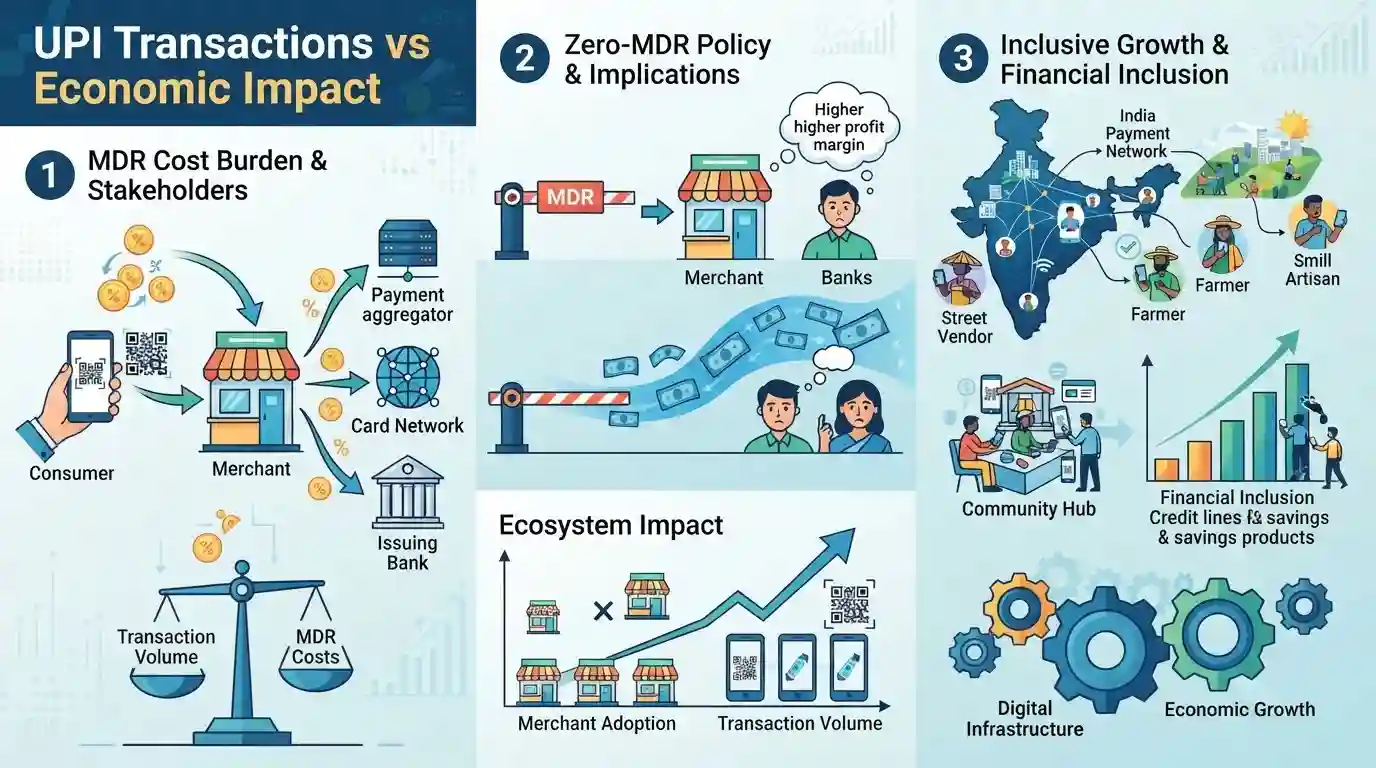
The article discusses the economic dynamics of the Merchant Discount Rate (MDR) on UPI transactions, analyzing cost burdens, stakeholder benefits, and the implications of zero-MDR policies on India's digital payments ecosystem and financial inclusion.
মূল বিষয়
- The article explores the mechanics of Merchant Discount Rate (MDR) on Unified Payments Interface (UPI) transactions, analyzing who bears the cost and who benefits.
- MDR is a fee charged to merchants for processing digital payments, which plays a crucial role in the sustainability of payment infrastructure providers and banks.
- The zero-MDR policy on UPI has driven massive adoption and volume growth, but it raises questions about the long-term economic viability for payment service providers and banks.
- Balancing financial inclusion, digital payment adoption, and the commercial viability of fintech and banking ecosystems remains a key policy challenge for regulators like the RBI.
গুরুত্বপূর্ণ শব্দ
Merchant Discount Rate

A fee paid by a merchant to banks and payment service providers for processing transactions via digital payment channels like credit cards or UPI.
UPSC context
UPSC Prelims/Mains (Economy): Important for digital payments, banking economics, and questions on financial inclusion and transaction costs.
Unified Payments Interface
An instant real-time payment system developed by NPCI that facilitates inter-bank transactions through mobile devices using a Virtual Payment Address.
UPSC context
UPSC Prelims/Mains (Economy - Growth & Development): Essential for understanding India's digital economy, fintech growth, and financial inclusion policies.
Reserve Bank of India
India's central banking institution that regulates the monetary policy, issues currency, and supervises the country's banking and digital payment systems.
UPSC context
UPSC Prelims/Mains (Economy - Monetary Policy & Banking): Core to questions regarding financial regulation, liquidity management, and payment infrastructure.
National Payments Corporation of India
An umbrella organization established by the RBI and IBA under the Payment and Settlement Systems Act, 2007, to operate retail payment and settlement systems in India.
UPSC context
UPSC Prelims/Mains (Economy - Mobilization of Resources): Tests institutional framework of India's retail payment systems like UPI, RuPay, and IMPS.
সংযুক্ত স্থির ধারণা
What is the Merchant Discount Rate (MDR) and how does it function in digital payments?
- Definition: It is a fee levied on merchants by acquiring banks for processing customer payments via cards, QR codes, or digital wallets.
- Distribution: It is typically split among the merchant's bank, the customer's bank (issuer), and the payment network provider (e.g., NPCI).
- Policy Context: A zero-MDR regime for UPI was introduced to boost adoption, shifting infrastructure costs away from merchants and consumers onto the government and banks.
আন্তঃবিষয় প্যাটার্ন
Digital Payments & Banking Viability
The zero-MDR policy drives financial inclusion but burdens banks and payment service providers, raising questions on fiscal support versus market sustainability under RBI oversight.

Zero-MDR on UPI and its impact on banking sustainability will likely feature in a multi-statement Prelims question on digital public infrastructure.
সংযুক্ত PYQ · 3
সংযুক্ত PYQ · 3
- 2026PrelimsGS1
Which one of the following statements about Unified Payments Interface (UPI) and Central Bank Digital Currency (Digital Rupee) is not correct ?
- 2018PrelimsGS1
Which one of the following best describes the term "Merchant Discount Rate" sometimes seen in news?
- 2022MainsGS3
Is inclusive growth possible under market economy ? State the significance of financial inclusion in achieving economic growth in India.
