WHO Global Summit on Traditional Medicine in New Delhi
Source:The Hindu ↗
Why It Matters
The global promotion of traditional medicine aligns with India's efforts to project its cultural heritage (such as Ayurveda and Yoga) as soft power and positions India as a leader in integrated healthcare. For civil service aspirants, this intersects with themes of alternative healthcare management under the AYUSH ministry, global health governance, and the role of international bodies like WHO in addressing sustainable primary healthcare.
Summary
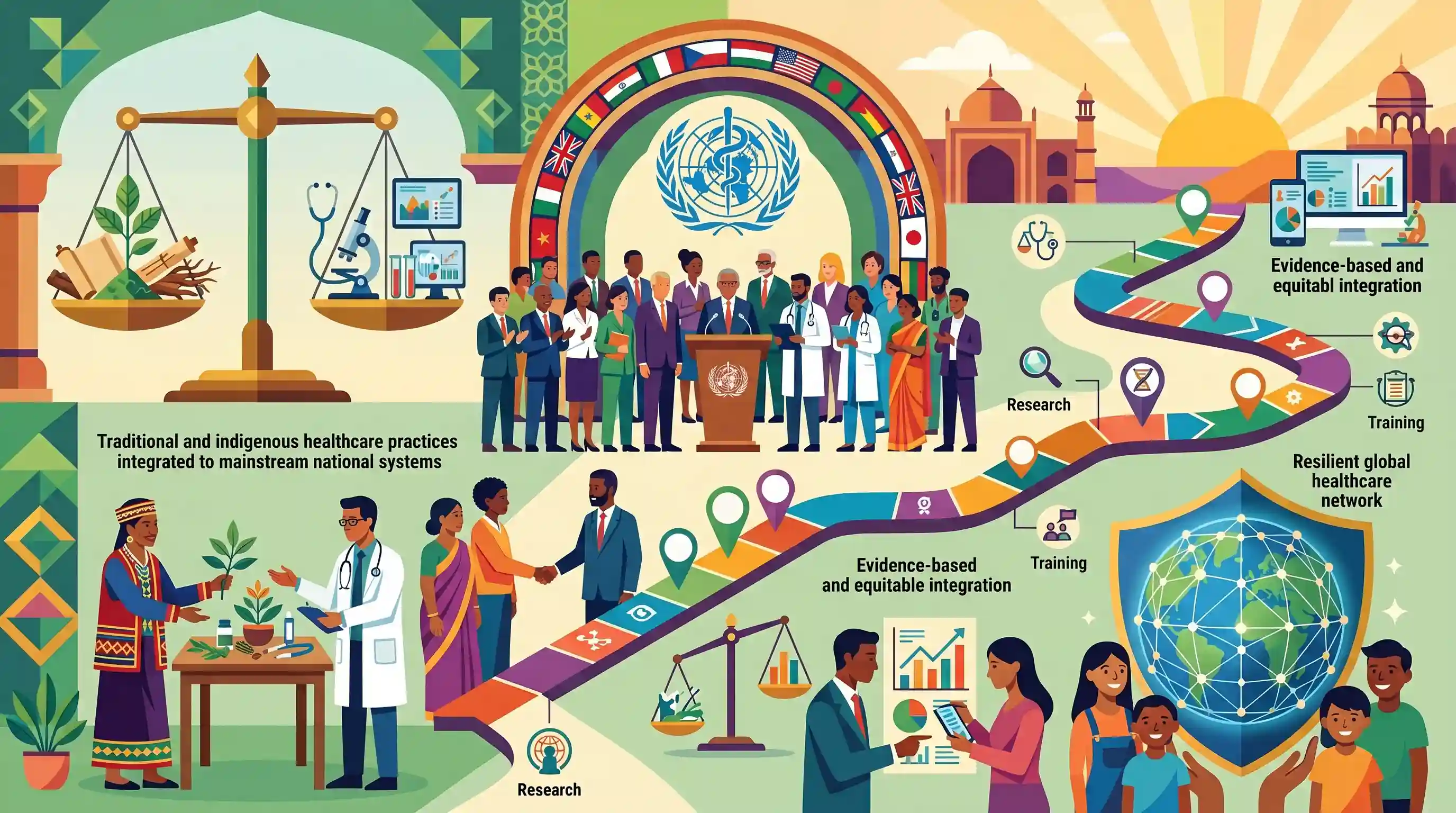
The second WHO Global Summit on Traditional Medicine is scheduled to be held at the Bharat Mandapam in New Delhi, India, focusing on the theme \'Restoring Balance: The Science and Practice of Health and Well-Being\'. The summit will draw policymakers and health practitioners from over 100 nations to develop a 10-year global roadmap. This roadmap will aim to integrate traditional and indigenous healthcare practices into mainstream national health systems in an evidence-based and equitable manner, thereby enhancing global healthcare resilience and addressing existing gaps in research and regulatory frameworks.
Key Points
- The second WHO Global Summit on Traditional Medicine will be held from December 17 to 19 at Bharat Mandapam, New Delhi.
- The theme for the summit is \'Restoring Balance: The Science and Practice of Health and Well-Being\'.
- The objective is to formulate a 10-year global roadmap to ensure an evidence-based, equitable, and sustainable integration of traditional, complementary, integrative, and Indigenous medicine into modern national health systems.
- Over 100 countries are expected to be represented by global health leaders, researchers, policymakers, and traditional medicine practitioners.
- The summit emphasizes strengthening regulatory frameworks, research, and innovation to address global evidence gaps related to alternative medicines.
Important Terms
WHO Global Traditional Medicine Strategy 2025–2034

A 10-year framework to integrate safe, effective, and evidence-based traditional medicine into national health systems to achieve universal health coverage and sustainable development goals.
UPSC context
GS Paper-II (Health/Governance); tests understanding of global health policy and India's role in international healthcare standard-setting.
Delhi Declaration on Traditional Medicine
The summit's outcome document committing over 100 nations to integrate traditional medicine into primary healthcare, strengthen safety regulations, and invest in research-backed data systems.
UPSC context
GS Paper-II (International Relations); relevant for questions on health diplomacy and India's emerging soft power in traditional medicine.
World Health Organization (WHO)
The specialized UN agency responsible for international public health, which co-organized the summit to bridge traditional indigenous wisdom with modern scientific advancements.
UPSC context
GS Paper-II (International Organizations); frequently tested regarding global health mandates, governance, and collaborative frameworks with member states.
WHO Global Centre for Traditional Medicine (GCTM)
The world\'s first and only global hub for traditional medicine, established in Jamnagar, Gujarat, to focus on evidence-based research, data analytics, and global standard-setting.
UPSC context
GS Paper-II/III (Health/S&T); tests knowledge of significant international institutions located in India and the promotion of AYUSH systems globally.
Ministry of Ayush
The Indian ministry overseeing the development of Ayurveda, Yoga, Unani, Siddha, Sowa-Rigpa, and Homoeopathy; it co-hosted the summit as part of India's health leadership.
UPSC context
GS Paper-II (Statutory/Regulatory Bodies); critical for questions on India's healthcare infrastructure and the institutionalization of traditional medicine.
Traditional Medicine Global Library (TMGL)
A massive digital repository launched at the summit containing over 1.5 million records to facilitate global research and clinical standardization of traditional knowledge.
UPSC context
GS Paper-III (Science & Technology/IPR); tests awareness of digital public infrastructure and the protection of traditional knowledge from bio-piracy.
Bharat Mandapam
India’s premier international convention centre in New Delhi; it serves as the venue for global summits like G20 and the WHO Traditional Medicine Summit.
UPSC context
GS Paper-I (Art/Culture) or GS Paper-III (Infrastructure); relevant for questions on modern national symbols and India's capacity for high-level diplomacy.
Prelims Trap
The WHO Global Centre for Traditional Medicine is an Indian statutory body under the Ministry of AYUSH.
The GCTM in Jamnagar is actually the first and only global out-posted United Nations centre focused entirely on traditional medicine, not a national body.
Static Concepts Connected
What mechanisms protect Traditional Knowledge from bio-piracy in India?
- TKDL: The Traditional Knowledge Digital Library acts as a prior art database to prevent international patenting of ancient Indian medical systems.
- Biodiversity Act 2002: Requires National Biodiversity Authority (NBA) approval before applying for intellectual property rights based on Indian biological resources.
What are the core objectives of the National AYUSH Mission (NAM)?
- Mainstreaming AYUSH: Co-locating AYUSH facilities at Primary Health Centres (PHCs), CHCs, and District Hospitals to offset allopathic shortages and boost preventive care.
- Quality Control: Strengthening AYUSH drug enforcement mechanisms, standardizing pharmacopoeia, and upgrading state pharmacies and drug testing laboratories.
Cross-Topic Patterns
Health diplomacy as soft power
India leverages its AYUSH sector, overseas information cells, and WHO collaborations to project cultural soft power, mirroring its Vaccine Maitri and disaster relief outreach in the Global South.
Bio-piracy and Indigenous IPR
Globalizing traditional medicine intersects heavily with WTO TRIPS and the Nagoya Protocol. Balancing global pharmacovigilance with indigenous intellectual property protection is a recurring GS-3 theme.

The WHO GCTM's UN-outpost status, the Gujarat Declaration, and TKDL protections are prime targets for a multi-statement 2026 MCQ.
Linked PYQs · 4
Linked PYQs · 4
- 2024MainsGS2
In a crucial domain like the public healthcare system the Indian State should play a vital role to contain the adverse impact of marketisation of the system. Suggest some measures through which the State can enhance the reach of public healthcare at the grassroots level.
- 2021MainsGS2
“Besides being a moral imperative of a Welfare State, primary health structure is a necessary precondition for sustainable development.” Analyze.
- 2020MainsGS2
Critically examine the role of WHO in providing global health security during the Covid-19 pandemic.
- 2015MainsGS2
Public health system has limitations in providing universal health coverage. Do you think that the private sector could help in bridging the gap? What other viable alternatives would you suggest?
