WHO Declares Ebola Outbreak Due to Bundibugyo Strain in Africa
Source:Indian Express ↗
Why It Matters
Zoonotic diseases and global health emergencies are highly relevant to the UPSC syllabus (GS2 Health/WHO and GS3 Science & Tech). Candidates must understand viral strains, the application of monoclonal antibodies/vaccines, the role of WHO in declaring public health emergencies, and the geographical mapping of outbreak epicenters in Africa.
Summary
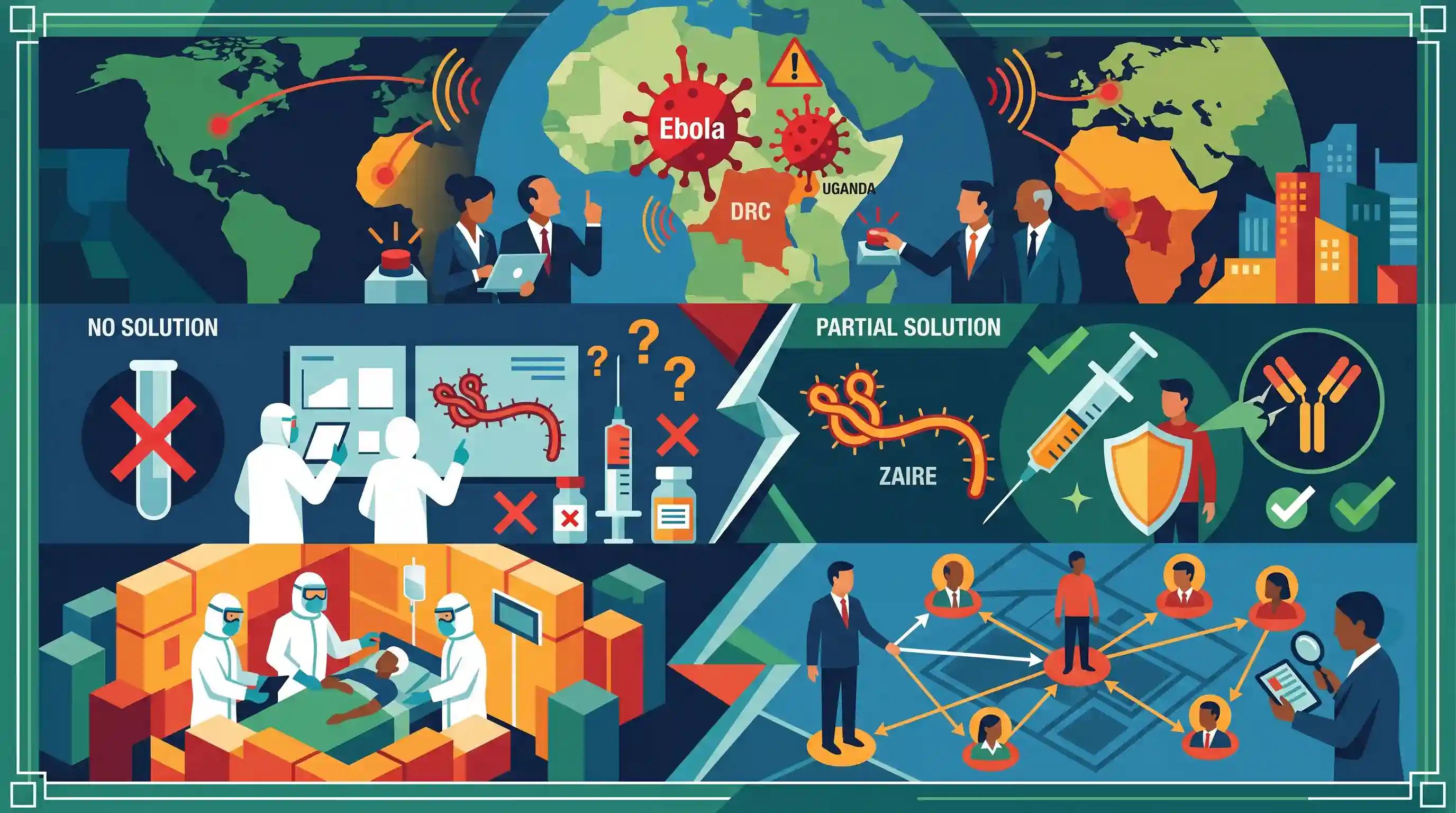
The World Health Organization (WHO) has declared a new Ebola outbreak in the Democratic Republic of Congo (DRC) and Uganda as a Public Health Emergency of International Concern. The current outbreak involves the Bundibugyo strain, for which there are no approved vaccines or specific treatments, presenting a significant public health challenge. While significant medical advancements, such as monoclonal antibodies and vaccines, exist for the more common Zaire strain of the virus, they do not cross-protect against the Bundibugyo variant. Containment currently relies on traditional epidemiological methods, such as isolating patients and contact tracing.
Key Points
- The WHO has declared the Ebola outbreak in the Democratic Republic of Congo (DRC) and Uganda a global health emergency (PHEIC).
- The outbreak is driven by the Bundibugyo strain of the Orthoebolavirus, which currently has no approved vaccines or specific therapeutic treatments.
- Ebola is a zoonotic disease originating from wild animals (like fruit bats of the Pteropodidae family) and spreads rapidly among humans through direct contact with infected bodily fluids.
- While FDA-approved vaccines (Ervebo) and monoclonal antibody treatments (Inmazeb and Ebanga) exist for the Zaire strain, they are ineffective against the Bundibugyo and Sudan strains, making containment heavily reliant on public health measures.
Important Terms
Public Health Emergency of International Concern (PHEIC)

An extraordinary event determined by the WHO to constitute a public health risk to other states through disease spread, requiring a coordinated international response.
UPSC context
GS Paper II (International Relations); critical for understanding global health governance and WHO's emergency response mechanisms.
World Health Organization (WHO)
A specialized United Nations agency established in 1948, responsible for international public health, setting global standards, and coordinating responses to health emergencies.
UPSC context
GS Paper II (Important International Institutions); frequently tested regarding its role in global governance and pandemic management.
Bundibugyo strain
A rare species of Ebolavirus first identified in 2007; it currently lacks approved vaccines or specific treatments and has a lower fatality rate than the Zaire strain.
UPSC context
GS Paper III (Science & Technology); highlights the challenges of viral mutations and the limitations of current medical countermeasures.
Monoclonal antibodies
Laboratory-made proteins designed to mimic the immune system's ability to fight pathogens by binding to specific antigens; used in treatments like Inmazeb for Ebola.
UPSC context
GS Paper III (Science & Tech); relevant to biotechnology applications in healthcare and precision medicine for infectious diseases.
International Health Regulations (IHR)
A legally binding international agreement (2005) involving 196 countries to prevent, protect against, and control the international spread of disease while minimizing interference with traffic.
UPSC context
GS Paper II (Governance/IR); the legal framework governing global health security and member states' obligations during outbreaks.
Prelims Trap
Approved vaccines and monoclonal antibody treatments are effective against all major strains of the Ebola virus.
While vaccines (Ervebo) and monoclonal antibodies work against the Zaire strain, they are highly specific and do not cross-protect against Bundibugyo or Sudan strains.
Static Concepts Connected
What is a Public Health Emergency of International Concern (PHEIC)?
- Legal Framework: A formal declaration by the WHO Director-General under the International Health Regulations (IHR) 2005.
- Criteria: Defined as an extraordinary event posing a public health risk to other States through international spread, demanding coordinated global action.
- Past Declarations: Recent examples include COVID-19, Mpox, Polio, Zika, and past Ebola outbreaks.
What are Monoclonal Antibodies and how do they function?
- Definition: Laboratory-produced proteins designed to mimic the immune system's natural ability to fight off harmful pathogens.
- Mechanism: They bind specifically to targeted antigens (like a unique viral protein) to neutralize the pathogen or tag it for destruction.
- Limitation: Because they are highly specific, variants or different strains (e.g., Bundibugyo vs Zaire) often evade them, lacking cross-protection.
Cross-Topic Patterns
DRC & Uganda Geography
Recurrent outbreaks focus attention on the Congo Basin and Great Lakes. UPSC routinely tests the borders of DRC, Lake Victoria, and the Equator's passage through Uganda.
Zoonosis & Ecological Encroachment
The link between fruit bats (Pteropodidae) and human outbreaks connects Science (virology) with Environment (habitat loss, deforestation, and human-wildlife conflict).

A multi-statement question combining African geography (DRC/Uganda borders) with the biological specificity of monoclonal antibodies.
Linked PYQs · 4
Linked PYQs · 4
- 2015PrelimsGS1
Among the following, which were frequently mentioned in the news for the outbreak of Ebola virus recently?
- 2025PrelimsGS1
With reference to monoclonal antibodies, often mentioned in news, consider the following statements : I. They are man-made proteins. II. They stimulate immunological function due to their ability to bind to specific antigens. III. They are used in treating viral infections like that of Nipah virus. Which of the statements given above are correct?
- 2023PrelimsGS1
Which one of the following is a part of the Congo Basin?
- 2020MainsGS2
Critically examine the role of WHO in providing global health security during the Covid-19 pandemic.
