Medicine Pricing Mechanism and Drug Regulation in India
Source:The Hindu ↗
Why It Matters
Understanding how medicine prices are regulated in India is critical for aspirants studying public health policy, welfare economics, and government intervention in healthcare markets.
Summary
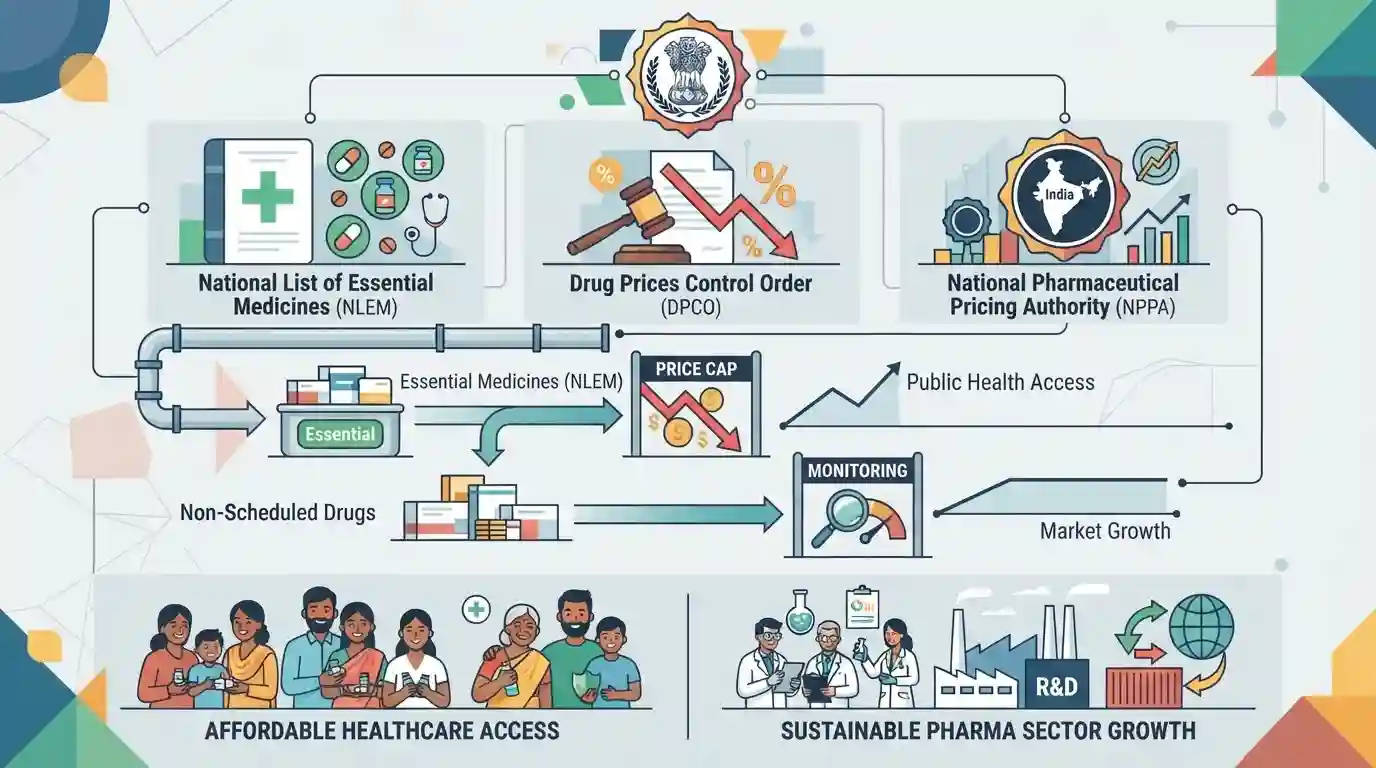
The article details the institutional mechanisms governing medicine pricing in India, highlighting the role of the National Pharmaceutical Pricing Authority (NPPA), the Drug Prices Control Order (DPCO), and the National List of Essential Medicines (NLEM). It explains how essential and non-scheduled drug prices are regulated, monitored, and capped to balance public health priorities with pharmaceutical sector growth.
Key Points
- The National Pharmaceutical Pricing Authority (NPPA) regulates the prices of scheduled formulations in India under the Drug Prices Control Order (DPCO).
- Medicines included in the National List of Essential Medicines (NLEM) are subject to price caps fixed by the government to ensure affordability and public health access.
- For non-scheduled drugs, manufacturers are legally permitted to increase prices by up to 10% annually, while price control violations attract statutory penalties under the Essential Commodities Act.
- Balancing pharmaceutical industry innovation and commercial viability with affordable healthcare access remains a key regulatory challenge in India.
Important Terms
Drug Prices Control Order

An order issued by the government under the Essential Commodities Act to regulate and fix the prices of essential medicines in India to ensure affordability.
UPSC context
GS Paper II (Government Policies & Interventions) and GS Paper III (Health Sector Development). Tests understanding of regulatory mechanisms in healthcare.
National List of Essential Medicines
A curated list of medicines considered vital for public healthcare needs, prioritizing safety, efficacy, and affordability, which forms the basis for price caps under the DPCO.
UPSC context
GS Paper II (Social Sector Development - Health). Tests knowledge of public health priorities and drug accessibility policies.
National Pharmaceutical Pricing Authority
An expert regulatory body under the Ministry of Chemicals and Fertilizers responsible for fixing and revising drug prices and enforcing the DPCO in India.
UPSC context
GS Paper III (Economy / Pharma Sector). Important for evaluating institutional frameworks balancing public health and industry growth.
Static Concepts Connected
What is the statutory framework for pharmaceutical price regulation in India?
- NPPA Mandate: Established in 1997 under the Ministry of Chemicals and Fertilizers as an attached office to enforce drug pricing policies.
- DPCO Statutory Basis: Issued under Section 3 of the Essential Commodities Act, 1955, empowering government to regulate drug prices and availability.
- NLEM Schedule I: Contains essential medicines whose price ceilings are legally binding on all manufacturers across the country.
Cross-Topic Patterns
DPCO Price Caps vs TRIPS Flexibilities
India's push for affordable pharmaceuticals through price capping frequently intersects with TRIPS flexibilities, compulsory licensing debates, and patent linkage disputes under global trade rules.
Pharma Regulation & Out-of-Pocket Expenditure
Out-of-pocket expenditure on medicines remains a major driver of impoverishment, connecting pharmaceutical price regulation directly to social sector vulnerabilities and SDG 3 targets.

NPPA powers under DPCO paragraph 19 and NLEM inclusion criteria frequently recur in multi-statement prelims questions on statutory bodies.
Linked PYQs · 3
Linked PYQs · 3
- 2019MainsGS3
How is the Government of India protecting traditional knowledge of medicine from patenting by pharmaceutical companies?
- 2014MainsGS3
Can overuse and free availability of antibiotics without Doctor's prescription, be contributors to the emergence of drug-resistant diseases in India? What are the available mechanisms for monitoring and control? Critically discuss the various issues involved.
- 2013MainsGS3
Bringing out the circumstances in 2005 which forced amendment to the section 3(d) in Indian Patent Law, 1970, discuss how it has been utilized by the Supreme Court in its judgement in rejecting Novratis' patent application for 'Glivec'. Discuss briefly the pros and cons of the decision.
