Global Pandemic Agreement and International Health Cooperation
Source:The Hindu ↗
Why It Matters
The WHO Pandemic Agreement marks a foundational shift in international health law and multilateral cooperation. For UPSC aspirants, it is a critical example for GS2 (Global Governance, Role of WHO, India's stance on tech transfer) and GS3 (IPR vs. Public Health, Bio-piracy vs. Benefit-Sharing).
Summary
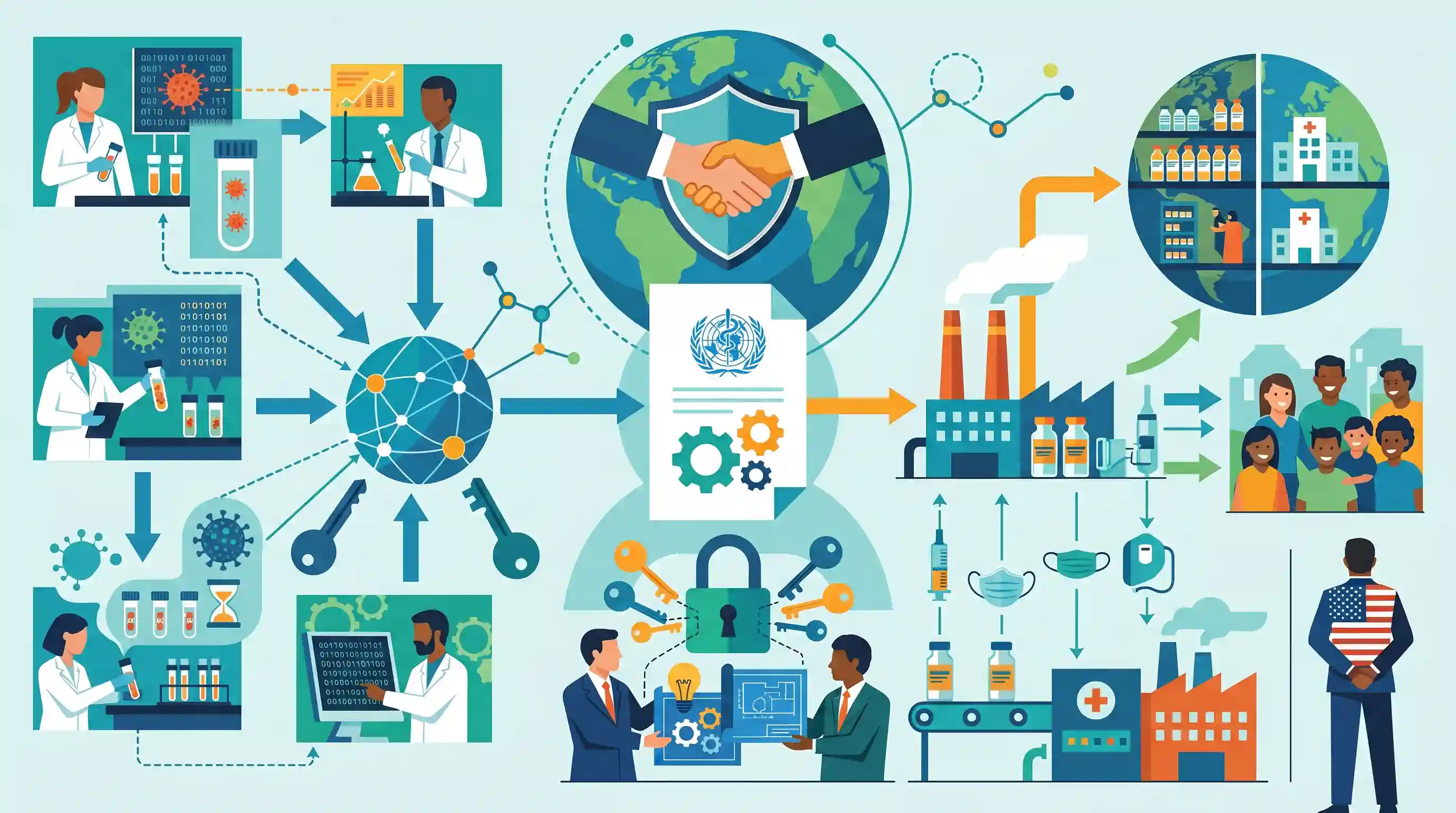
The World Health Organization's member states have finalized a landmark global pandemic agreement aimed at preventing and responding to future health emergencies, aiming to avoid the inequities seen during the COVID-19 crisis. Central to the accord is the Pathogen Access and Benefit-Sharing System (PABS), which facilitates swift pathogen data sharing while ensuring "mutually agreed" technology transfers to developing nations. Despite the absence of the United States, which withdrew from the WHO under the Trump administration, the agreement is hailed as a crucial victory for multilateralism and global health security.
Key Points
- WHO member states successfully negotiated a historic global pandemic agreement to enhance preparedness and response against future global health crises.
- The treaty addresses the North-South divide by establishing the Pathogen Access and Benefit-Sharing System (PABS), which mandates the swift sharing of pathogen data and ensures equitable access to resulting health products.
- Article 11 of the agreement resolves intellectual property disputes by stipulating that technology transfers for pandemic-related health products to developing nations must be "mutually agreed," bridging differences with the pharmaceutical industry.
- The United States, having withdrawn from the WHO under President Donald Trump, was notably absent from the talks, highlighting challenges to multilateralism in global health governance.
Important Terms
WHO Pandemic Agreement

A legally binding international instrument adopted by WHO member states in May 2025 to institutionalize lessons from COVID-19, focusing on equitable access to vaccines and coordinated global pandemic response.
UPSC context
GS-II: Global Health Governance. Tests knowledge of multilateral cooperation and India's role in the global health architecture.
Pathogen Access and Benefit-Sharing System (PABS)
A technical mechanism under the Pandemic Agreement requiring countries to share pathogen data/samples in exchange for guaranteed, equitable access to vaccines and treatments developed from that data.
UPSC context
GS-II: North-South Divide; GS-III: IPR. Tests benefit-sharing mechanisms and the tension between data transparency and technology transfer.
World Health Assembly (WHA)
The supreme decision-making body of the WHO, comprising delegates from 194 member states, responsible for setting health policies, adopting treaties, and appointing the Director-General.
UPSC context
GS-II: Important International Institutions. Essential for understanding the institutional framework and law-making process of global health bodies.
IFPMA
A global trade association representing research-based pharmaceutical companies, which advocates for protecting intellectual property rights and innovation ecosystems during international treaty negotiations.
UPSC context
GS-III: Intellectual Property Rights (IPR). Tests the influence of private industry stakeholders on global health policy and IPR regimes.
North-South Divide (Global Health)
The economic and technological gap between developed and developing nations, manifesting in global health as unequal access to vaccines, manufacturing capacity, and R&D resources.
UPSC context
GS-II: International Relations. A core concept for analyzing vaccine inequity and the 'Global South's' demands in international treaties.
Prelims Trap
The agreement grants the WHO binding authority to mandate national lockdowns and enforce compulsory patent waivers during global health emergencies.
The treaty explicitly features sovereignty safeguards, confirming WHO has no power over domestic travel bans/lockdowns, and relies on 'mutually agreed' tech transfers, not mandatory patent waivers.
Static Concepts Connected
What is the legal basis for the WHO Pandemic Agreement?
- Article 19: Allows the World Health Assembly to adopt legally binding international conventions or agreements with a two-thirds majority vote.
- Sole Precedent: Prior to the Pandemic Agreement, the 2003 Framework Convention on Tobacco Control (FCTC) was the only legally binding treaty adopted under this provision.
How does 'Access and Benefit-Sharing' (ABS) apply to pathogens?
- Nagoya Protocol: Traditionally governs genetic resources of plants and animals under the CBD, requiring bilateral negotiations that can delay research.
- PABS System: The WHO's new multilateral mechanism targets rapid pathogen data sharing globally, exchanging data access for 20% guaranteed vaccine allocations to developing nations.
Cross-Topic Patterns
WTO TRIPS vs. WHO Mutually Agreed Terms
While developing nations pushed for WTO TRIPS patent waivers during COVID-19, the WHO pact settles for 'mutually agreed' tech transfers, preserving pharma IPR and bypassing compulsory licensing.
One Health + Zoonotic Spillovers
With 75% of emerging infectious diseases being zoonotic, the treaty codifies 'One Health', effectively linking biodiversity conservation and deforestation directly to human pandemic prevention frameworks.

Expect a 2026 prelims question comparing the WHO's PABS mechanism with the Nagoya Protocol's framework for genetic resources.
Linked PYQs · 3
Linked PYQs · 3
- 2020MainsGS2
Critically examine the role of WHO in providing global health security during the Covid-19 pandemic.
- 2014MainsGS3
In a globalized world, Intellectual Property Rights assume significance and are a source of litigation. Broadly distinguish between the terms-Copyrights, Patents and Trade Secrets.
- 2023PrelimsGS1
Consider the following statements: 1. In India, the Biodiversity Management Committees are key to the realization of the objectives of the Nagoya Protocol. 2. The Biodiversity Management Committees have important functions in determining access and benefit sharing, including the power to levy collection fees on the access of biological resources within its jurisdiction. Which of the statements given above is/are correct?
