AI Data Centres Energy Demands and Consumer Protection Regimes
Source:The Hindu ↗
Why It Matters
Highlights the hidden economic and infrastructural externalities of rapid AI proliferation. It showcases the real-world policy challenge of balancing technological leadership with energy security and consumer protection, demonstrating the critical role of state intervention and regulatory oversight in managing the burden on public utilities.
Summary
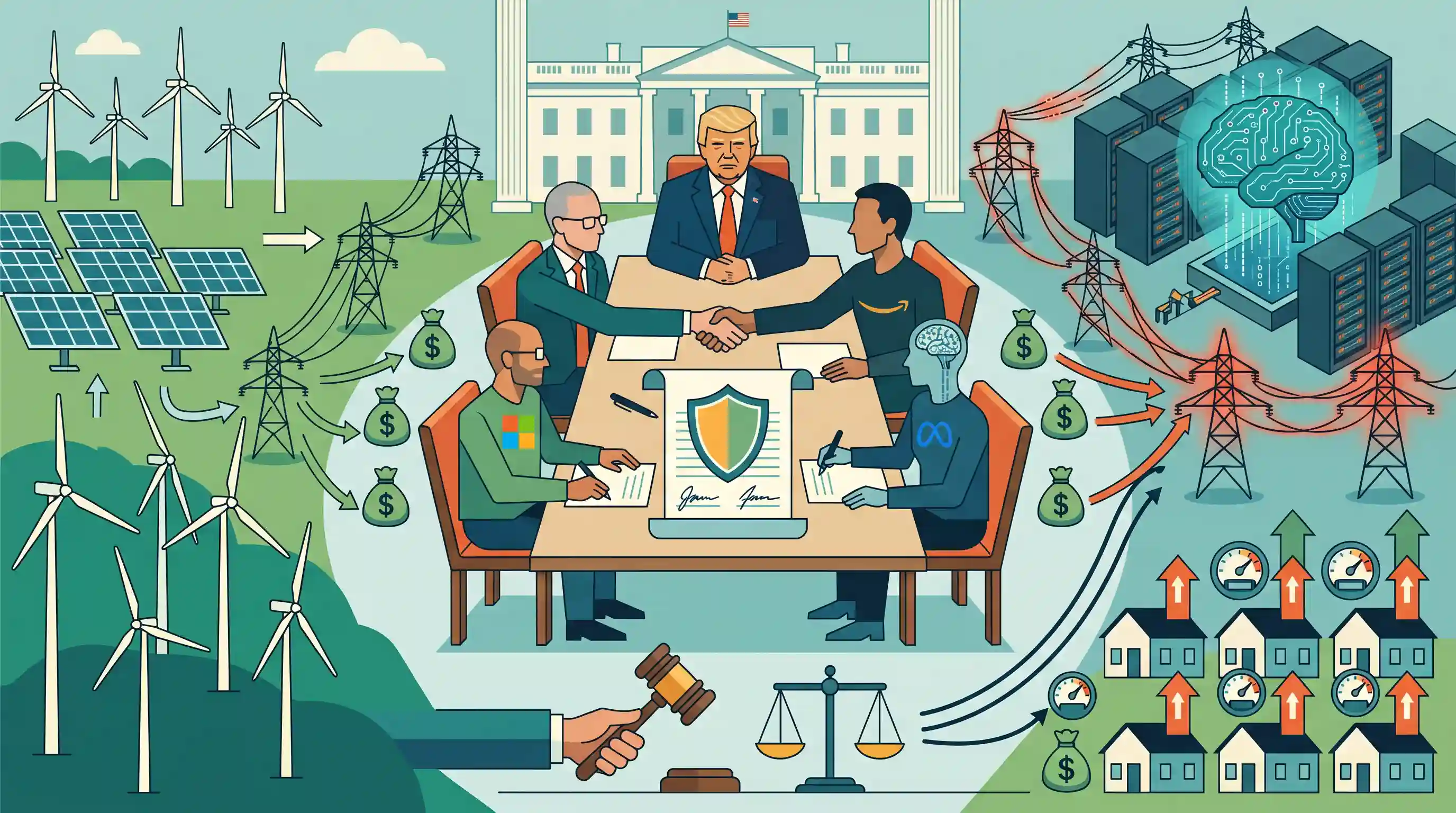
The White House, led by President Donald Trump, is set to convene with Big Tech leaders from Microsoft, Amazon, Anthropic, and Meta to sign the Rate Payer Protection Pledge. The initiative seeks to prevent consumers from bearing the brunt of soaring electricity costs driven by the massive energy demands of new Artificial Intelligence (AI) data centres. With data centre expansion heavily straining infrastructure, particularly in grid systems like PJM Interconnection, the pledge requires tech firms to invest in their own power generation or cover the resulting rate hikes. Experts underline the necessity for state and federal regulatory oversight to ensure costs are effectively allocated to data centres rather than everyday households.
Key Points
- The White House will host major tech firms (Microsoft, Amazon, Anthropic, Meta) to formalise the Rate Payer Protection Pledge aimed at shielding everyday consumers from rising electricity costs.
- The surging energy demands of Artificial Intelligence (AI) data centres have significantly inflated power bills, notably within grids like PJM Interconnection, sparking public protests.
- President Donald Trump's initiative demands that tech giants invest in new power generation, build their own power plants, or directly absorb the rate increases caused by their AI infrastructure.
- Legal and energy experts emphasize that the pledge requires stringent regulatory enforcement to ensure utilities properly allocate grid infrastructure costs to data centres instead of spreading them across all ratepayers.
Important Terms
Rate Payer Protection Pledge

A 2026 voluntary agreement where major technology firms commit to financing the energy and infrastructure costs of their AI data centers to shield residential consumers from price hikes.
UPSC context
GS III: Infrastructure and Energy. Tests understanding of public-private financing models and consumer protection in utility markets.
PJM Interconnection
The largest Regional Transmission Organization (RTO) in the U.S., managing the electricity grid for 13 states; it is currently the primary site of AI-driven energy demand surges.
UPSC context
GS III: Infrastructure (Energy). Relevant for grid management, reliability challenges, and the impact of digital growth on physical utilities.
White House
In this context, the U.S. executive branch acting as a facilitator of industrial policy to balance technological competitiveness with domestic economic stability and inflation control.
UPSC context
GS II: International Relations/Governance. Tests the role of state actors in regulating global technology giants and managing economic externalities.
Microsoft
A leading technology 'hyperscaler' that signed the 2026 energy pledge, reflecting the high energy footprint of its massive AI and cloud infrastructure investments.
UPSC context
GS III: Science & Technology. Represents the role of multinational corporations in driving infrastructure demand and energy security policies.
Amazon
A global e-commerce and cloud leader whose data center expansion significantly impacts regional power grids, requiring new commitments to self-funded power generation.
UPSC context
GS III: Infrastructure/Energy. Illustrates the link between digital services and the tangible environmental and economic costs of energy consumption.
Meta Platforms
The parent company of Facebook and Instagram, involved in the 2026 pledge to prevent 'socializing' its AI infrastructure costs across general electricity ratepayers.
UPSC context
GS III: Science & Tech/Environment. Highlights corporate responsibility in managing the power-hungry externalities of advanced computing technologies.
Prelims Trap
"The Rate Payer Protection Pledge is an initiative under India's Electricity (Rights of Consumers) Rules."
It is a US White House initiative asking Big Tech to absorb power costs, not an Indian or international regulatory framework.
Static Concepts Connected
What defines a Captive Generating Plant under India's Electricity Act 2003?
- Core Definition: A power plant set up by a person, industry, or cooperative society to generate electricity primarily for their own consumption.
- The 51% Rule: To legally qualify as a captive plant, the captive user(s) must consume at least 51% of the electricity generated annually.
- Surcharge Exemption: Captive generation is generally exempt from cross-subsidy surcharges, heavily incentivizing its use for industries with continuous, extreme power needs.
How do negative externalities function in public utility infrastructure?
- Negative Externality: Costs imposed on third parties during an economic transaction. Here, private AI data centers require public grid upgrades, causing tariff hikes for everyday households.
- Internalizing Costs: Policy mechanisms, like mandating tech firms to build their own power generation, force the responsible entity to absorb the true cost of their operations.
Cross-Topic Patterns
Data Centers as Captive Power Generators
AI's massive baseload power requirements mirror traditional heavy industries like metallurgy, pulling frontier tech firms directly into core infrastructure paradigms and captive power generation frameworks.
Reverse Cross-Subsidization Risks in Electricity
In India, industries historically cross-subsidize domestic electricity. AI expansion risks reversing this: costly grid upgrades for tech giants could socialize costs onto households unless regulators intervene.

AI's massive energy/water footprint is ripe for a GS-3 Mains question linking tech expansion to grid stability and economic externalities.
Linked PYQs · 2
Linked PYQs · 2
- 2023MainsGS3
Introduce the concept of Artificial Intelligence (AI). How does Al help clinical diagnosis? Do you perceive any threat to privacy of the individual in the use of Al in healthcare?
- 2021MainsGS3
Explain the purpose of the Green Grid Initiative launched at World Leaders Summit of the COP26 UN Climate Change Conference in Glasgow in November, 2021. When was this idea first floated in the International Solar Alliance (ISA)?
