Alibaba Linked to Chinese Military Targets in US Intelligence Memo
Source:Indian Express ↗
Why It Matters
It demonstrates the national security risks inherent in China's military-civil fusion strategy, serving as a critical case study for India regarding the regulation of foreign tech companies, data sovereignty, and the need to secure critical digital infrastructure from potential state-sponsored cyber espionage or warfare.
Summary
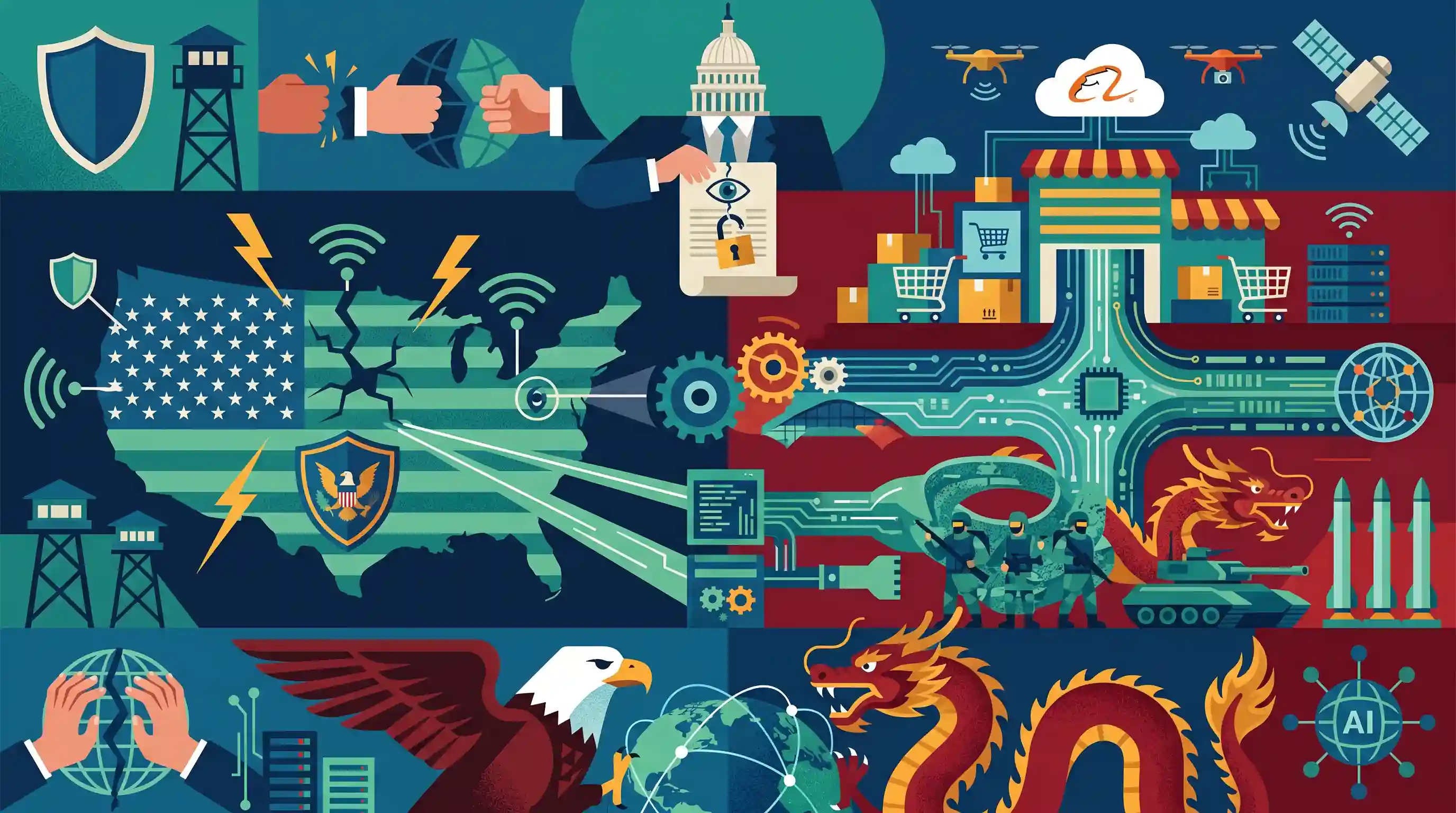
A recently declassified White House intelligence memo accuses the Chinese online marketplace Alibaba of supplying technological capabilities to the People's Liberation Army (PLA), assisting in military operations targeting the United States. The allegation underscores the growing intersection between civilian tech enterprises and state security operations under China's civil-military fusion strategy, exacerbating the broader US-China technological and geopolitical rivalry.
Key Points
- A declassified White House intelligence memo accuses Chinese tech giant Alibaba of providing technological support for Chinese military operations against US targets.
- The memo claims Alibaba supplies the People's Liberation Army (PLA) with capabilities that directly threaten US national security.
- These allegations highlight the practical execution of China's "Military-Civil Fusion" strategy, in which civilian tech platforms are leveraged for military objectives.
- The development further escalates US-China technological decoupling and amplifies global concerns regarding the cybersecurity risks posed by foreign tech conglomerates.
Important Terms
Civil-Military Fusion (CMF)

China's national strategy to eliminate barriers between civilian research/commercial sectors and its military-defense sectors to achieve technological dominance.
UPSC context
GS Paper II/III: Crucial for understanding China's 'Intelligent Warfare' and global security challenges.
People's Liberation Army (PLA)
The armed wing of the Chinese Communist Party (CCP) and the national military of China, institutionally subordinate to the party rather than the state.
UPSC context
GS Paper II: International Relations and neighborhood security; tests knowledge of non-traditional state structures.
Alibaba
A Chinese multinational technology conglomerate involved in e-commerce, cloud computing, and AI, frequently scrutinized for its data-sharing links with the CCP.
UPSC context
GS Paper III: Security/Tech; represents the 'Tech-Nationalism' and 'Digital Silk Road' challenges.
Zero-Day Exploit
A software vulnerability unknown to those who should be interested in its mitigation; often exploited in state-sponsored cyber espionage before a patch exists.
UPSC context
GS Paper III: Cyber Security; tests understanding of advanced persistent threats (APTs) in warfare.
Dual-Use Technology
Products, software, or technologies—like AI or high-end semiconductors—that can be utilized for both commercial applications and military development.
UPSC context
GS Paper III: Science & Technology; central to export control regimes and international trade disputes.
1260H List
A US Department of Defense requirement to identify and list 'Chinese military companies' operating in the US to prevent them from benefiting from US technology.
UPSC context
GS Paper II: Bilateral relations; highlights tools used in the US-China technological 'de-risking' strategy.
Prelims Trap
China's Military-Civil Fusion strategy applies exclusively to its State-Owned Enterprises (SOEs) and defense contractors.
The MCF strategy legally mandates private, civilian tech conglomerates (like Alibaba) to share dual-use technologies, R&D, and data with the PLA, not just state-owned enterprises.
Static Concepts Connected
What are the major multilateral export control regimes for dual-use technologies?
- Wassenaar Arrangement: Regulates export controls for conventional arms and dual-use goods/technologies to prevent destabilizing military accumulations.
- MTCR: Restricts the proliferation of missiles, complete rocket systems, and unmanned aerial vehicles capable of delivering WMDs.
- Australia Group: Coordinates export controls to ensure that dual-use exports do not contribute to chemical or biological weapons development.
How does India define and protect its Critical Information Infrastructure (CII)?
- CII Definition: Computer resources whose incapacitation would have a debilitating impact on national security, economy, public health, or safety.
- NCIIPC Role: Created under the IT Act, the National Critical Information Infrastructure Protection Centre is the nodal agency safeguarding CII.
- Threat Vectors: Foreign state-sponsored cyber espionage via civilian platforms (APTs) represents a primary threat vectors to India's CII.
Cross-Topic Patterns
Data Localization and IT Act Sec 69A
The weaponization of commercial tech platforms reinforces India's rationale for banning Chinese apps under IT Act Sec 69A and prioritizing data localization in its digital data protection framework.
Friend-shoring and India's PLI Schemes
Geopolitical tech-decoupling driven by Chinese military-civil fusion pushes the West toward 'friend-shoring', directly boosting India's PLI schemes and semiconductor initiatives.

Expect a 2026 prelims question linking China's Military-Civil Fusion strategy to dual-use tech and multilateral export control regimes.
Linked PYQs · 5
Linked PYQs · 5
- 2021MainsGS2
“The USA is facing an existential threat in the form of a China, that is much more challenging than the erstwhile Soviet Union.” Explain.
- 2024MainsGS2
‘The West is fostering India as an alternative to reduce dependence on China's supply chain and as a strategic ally to counter China's political and economic dominance.’ Explain this statement with examples.
- 2022MainsGS3
What are the different elements of cyber security ? Keeping in view the challenges in cyber security, examine the extent to which India has successfully developed a comprehensive National Cyber Security Strategy.
- 2015MainsGS3
Considering the threats cyberspace poses for the country, India needs a "Digital Armed Force" to prevent crimes. Critically evaluate the National Cyber Security Policy, 2013 outlining the challenges perceived in its effective implementation.
- 2017MainsGS3
Discuss the potential threats of Cyber attack and the security framework to prevent it.
