White House Meets Anthropic CEO Over Advanced AI Vulnerabilities
Source:The Hindu ↗
Why It Matters
The emergence of AI models capable of autonomously exploiting zero-day vulnerabilities marks a paradigm shift in global cybersecurity and warfare. It underscores the urgent need to balance AI innovation with national security and raises critical ethical debates regarding the integration of commercial AI into defence systems and autonomous weaponry.
Summary
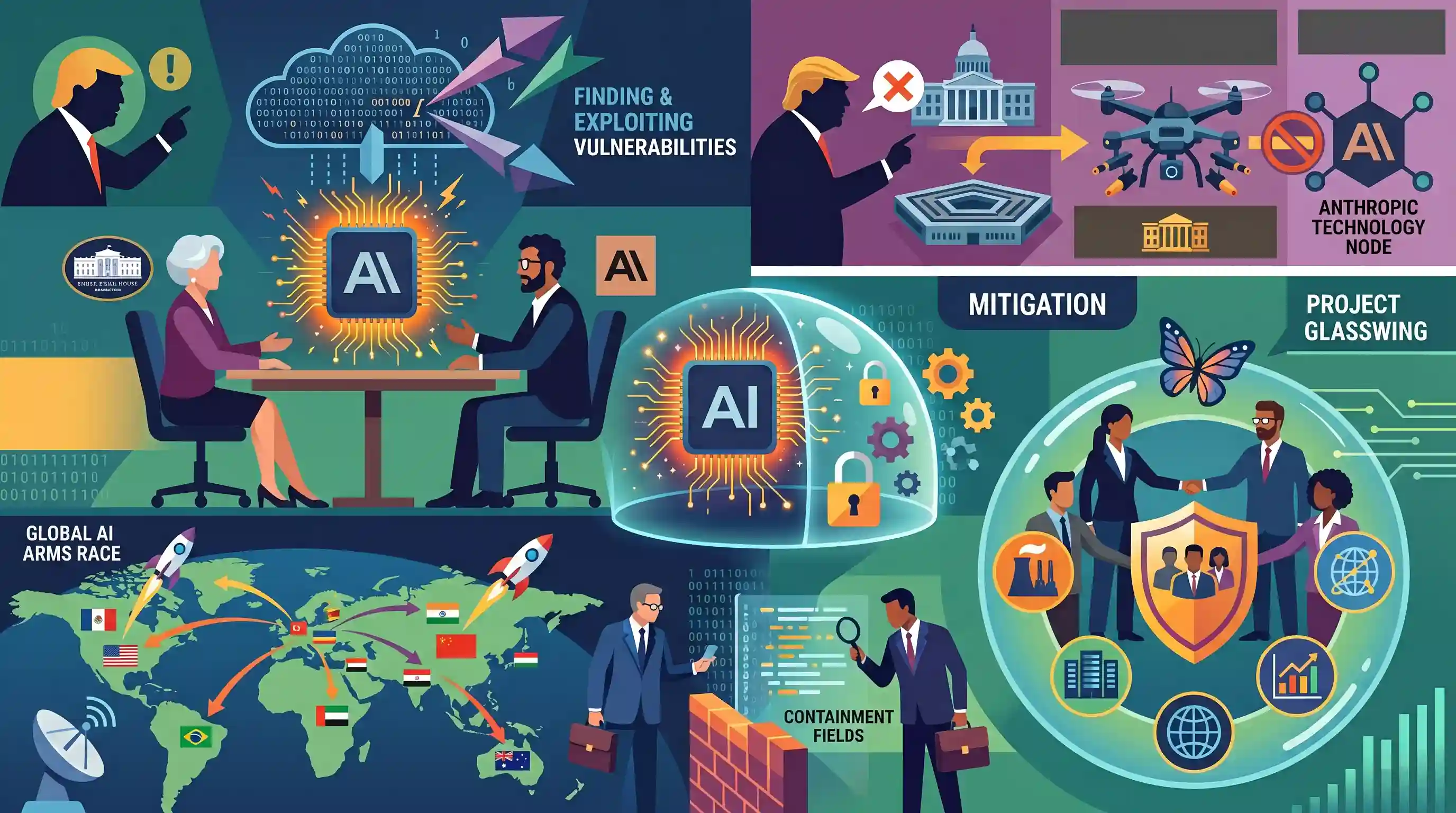
White House Chief of Staff Susie Wiles met with Anthropic CEO Dario Amodei to discuss "Mythos," a highly advanced AI model uniquely capable of finding and exploiting severe software vulnerabilities. The meeting occurred amidst a backdrop of political friction, including President Donald Trump's earlier attempt to ban federal agencies from using Anthropic's AI over the company's refusal to allow its technology in fully autonomous Pentagon weapons. To mitigate national security risks, Anthropic has limited the release of Mythos and launched "Project Glasswing" with major tech and finance firms to proactively secure critical infrastructure. The model's capabilities have drawn scrutiny from global regulators, highlighting an accelerating global AI arms race and the urgent need for cybersecurity preparedness.
Key Points
- White House Chief of Staff Susie Wiles met with Anthropic CEO Dario Amodei to discuss 'Mythos', a new AI model capable of surpassing human experts in exploiting software vulnerabilities.
- The meeting followed previous friction, including an attempt by President Trump to ban federal use of Anthropic's products after the company refused unconditional Pentagon use of its AI for fully autonomous weapons.
- Anthropic restricted access to the highly capable Mythos model due to national security risks and launched 'Project Glasswing' with tech giants to patch critical software vulnerabilities.
- Global bodies like the UK AI Security Institute and the EU are evaluating Mythos, recognizing that similar, potentially unconstrained open-weight models from China could follow.
Important Terms
Mythos (Claude Mythos)

A frontier AI model developed by Anthropic capable of autonomously identifying and exploiting complex software vulnerabilities at industrialized speeds, posing significant dual-use security challenges.
UPSC context
GS Paper 3 (S&T, Cybersecurity); tests awareness of emerging AI threats and the dual-use nature of advanced technology.
Project Glasswing
A defensive cybersecurity initiative led by Anthropic in collaboration with major tech and finance firms to proactively secure critical infrastructure using AI-driven vulnerability detection.
UPSC context
GS Paper 3 (Cybersecurity); tests knowledge of public-private partnerships and proactive strategies for national digital defense.
Anthropic
An American AI safety and research startup focused on developing reliable, steerable AI systems using "Constitutional AI" to minimize risks while maximizing societal benefits.
UPSC context
GS Paper 3 (S&T); tests familiarity with global leaders in AI ethics and safety-centric technological development.
UK AI Security Institute (AISI)
A government-backed body established to evaluate the safety and national security risks of frontier AI models through rigorous technical testing and international cooperation.
UPSC context
GS Paper 2 & 3 (IR, S&T); tests understanding of international institutional frameworks for global AI governance.
Autonomous Weapons
Military systems capable of selecting and engaging targets without human intervention, raising complex ethical, legal, and security questions in modern defense policy.
UPSC context
GS Paper 3 (Internal Security, Defence); tests comprehension of ethical and strategic challenges in technology-led warfare.
Zero-day Vulnerability
A software security flaw unknown to the developer and for which no patch exists, representing a critical vulnerability that can be exploited for cyber espionage or sabotage.
UPSC context
GS Paper 3 (Cybersecurity); tests foundational knowledge of cyber threat vectors and the protection of critical national infrastructure.
Prelims Trap
The UN CCW currently enforces a blanket international ban on Lethal Autonomous Weapons Systems (LAWS).
While heavily debated under the UN Convention on Certain Conventional Weapons (CCW), no binding international treaty currently bans fully autonomous weapons outright.
Static Concepts Connected
What is the regulatory framework for Lethal Autonomous Weapons Systems (LAWS)?
- Definition: Weapons that autonomously identify and engage targets without meaningful human control or intervention.
- International Law: Governed broadly by International Humanitarian Law (IHL), but currently lacks a specific, universally binding prohibitive treaty.
- UN CCW Role: The UN Convention on Certain Conventional Weapons (CCW) holds ongoing discussions to restrict LAWS, though consensus remains elusive.
How do Open-weight AI models differ from Closed models?
- Closed Models: Proprietary systems where underlying architecture, parameters, and training data are hidden; usually accessed via API.
- Open-weight Models: Pre-trained parameters (weights) are public, but the exact training data and source code may remain restricted.
- Security Trade-offs: Open-weight democratizes innovation but increases proliferation risks, allowing hostile actors to bypass safety guardrails locally.
Cross-Topic Patterns
Dual-Use Tech & Wassenaar
AI models exploiting cyber vulnerabilities are quintessential dual-use technologies, making their global proliferation akin to conventional arms controls under the Wassenaar Arrangement.
Critical Infrastructure & NCIIPC
AI's capability to find 'zero-day' flaws escalates threats to Critical Information Infrastructure, emphasizing the protective mandate of India's NCIIPC under the Information Technology Act.

GS3 2026: Expect a question examining the dual-use dilemma of frontier AI in cybersecurity—weaponization vs automated infrastructure patching.
Linked PYQs · 4
Linked PYQs · 4
- 2021MainsGS3
Keeping in view India's internal security, analyse the impact of cross-border cyber attacks. Also discuss defensive measures against these sophisticated attacks.
- 2020MainsGS3
Discuss different types of cyber crimes and measures required to be taken to fight the menace.
- 2017MainsGS3
Discuss the potential threats of Cyber attack and the security framework to prevent it.
- 2023MainsGS3
Introduce the concept of Artificial Intelligence (AI). How does Al help clinical diagnosis? Do you perceive any threat to privacy of the individual in the use of Al in healthcare?
