US budget proposal targets NOAA climate research for elimination
Source:The Hindu ↗
Why It Matters
Highlights the policy conflict between economic/energy development and environmental conservation. It provides a real-world international example of how institutional restructuring and budget cuts can be used to dilute climate research, marine conservation, and environmental protection mandates, serving as a critical case study for environment vs. development debates in GS-3.
Summary
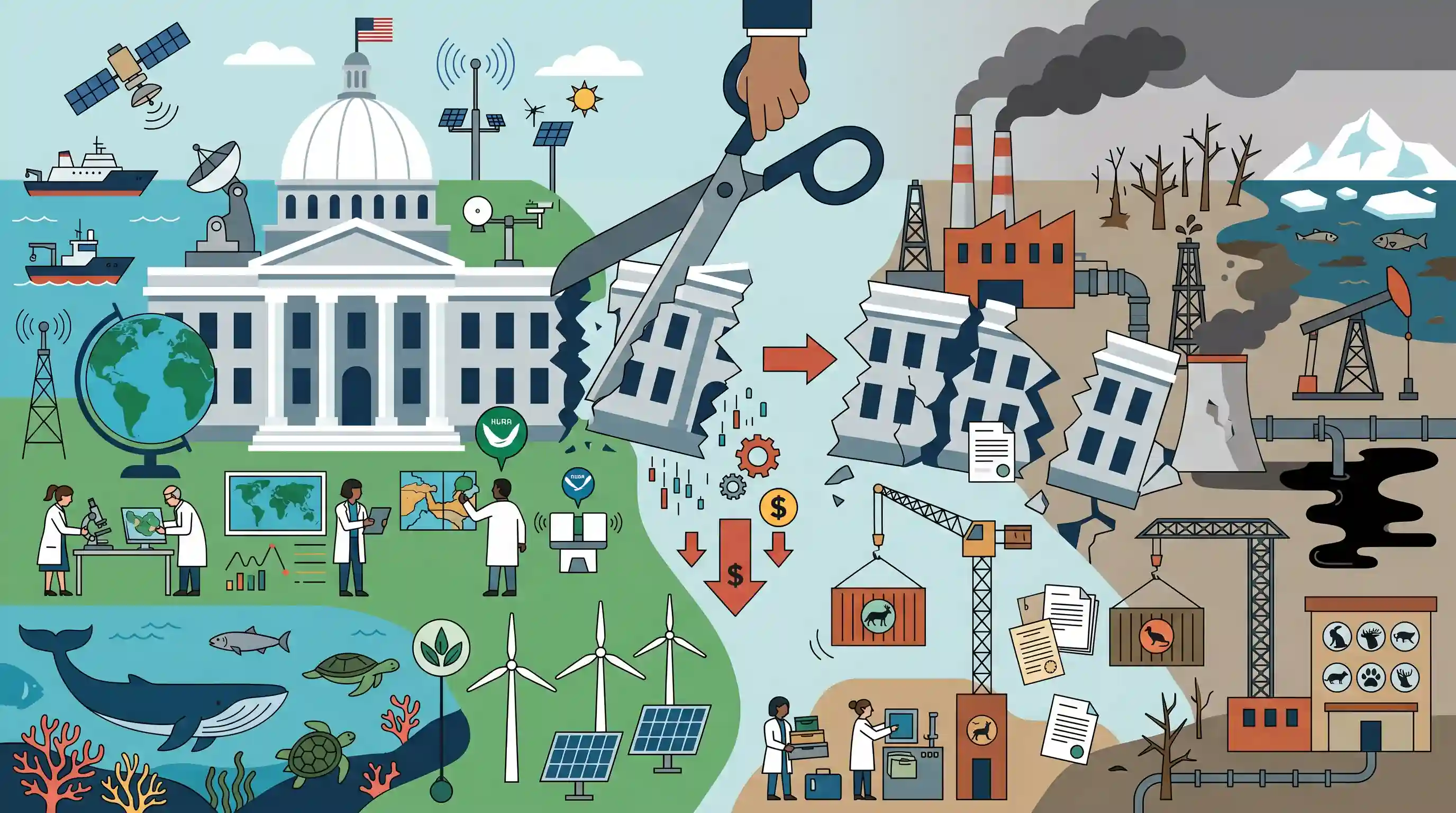
The White House budget proposes a 27% cut to the National Oceanic and Atmospheric Administration (NOAA), aiming to completely eliminate its climate research programs and slash $480 million in funding. The plan would shutter NOAA's Office of Oceanic and Atmospheric Research and transfer the National Marine Fisheries Service's duties for protecting endangered marine species to the U.S. Fish and Wildlife Service. The primary objective behind this institutional restructuring is to expedite energy development projects by easing environmental permitting and consultation processes, signaling a stark policy shift from climate mitigation to resource exploitation.
Key Points
- The White House has proposed a 27% budget reduction ($1.67 billion) for the National Oceanic and Atmospheric Administration (NOAA).
- The budget plan aims to completely eliminate NOAA's climate research programs and shut down its Office of Oceanic and Atmospheric Research.
- Responsibilities of the National Marine Fisheries Service (NMFS) for protecting marine endangered species will be transferred to the U.S. Fish and Wildlife Service.
- The overarching goal of these budget cuts and restructuring is to prioritize and accelerate energy development by minimizing environmental permitting and consultation bottlenecks.
Important Terms
National Oceanic and Atmospheric Administration (NOAA)

A U.S. scientific agency that monitors the atmosphere and oceans. It provides foundational data for global weather forecasting, climate change research, and disaster management.
UPSC context
GS 3 (Environment/Disaster Management); tests knowledge of global climate data sources and international scientific cooperation.
Environmental Impact Assessment (EIA)
A systematic process to evaluate the environmental effects of a proposed project before approval. It ensures ecological risks are balanced against economic benefits during development.
UPSC context
GS 3 (Environment); core topic regarding sustainable development and the trade-offs between economic growth and environmental protection.
National Marine Fisheries Service (NMFS)
A division of NOAA responsible for managing U.S. marine resources and sustainable fisheries. It protects endangered marine life and ensures the health of ocean ecosystems.
UPSC context
GS 3 (Conservation); relevant for marine biodiversity, sustainable blue economy, and international environmental treaties like UNCLOS.
U.S. Fish and Wildlife Service (USFWS)
A U.S. federal agency focused on conserving fish, wildlife, and natural habitats. It primarily manages land-based and freshwater conservation efforts and national wildlife refuges.
UPSC context
GS 3 (Environment); important for comparative study of biodiversity laws and institutional frameworks for wildlife conservation.
Office of Oceanic and Atmospheric Research (OAR)
The research arm of NOAA that manages labs and cooperative institutes. It serves as a global nerve center for climate modeling and long-range weather forecasting.
UPSC context
GS 3 (S&T/Environment); highlights the importance of public funding in climate research and evidence-based environmental policy-making.
Prelims Trap
"NOAA is a specialized intergovernmental agency under the UN that conducts global climate research."
NOAA is a United States federal agency under the Department of Commerce. Despite its massive global influence and international data reliance, it is not an intergovernmental or UN body.
Static Concepts Connected
How is the Environmental Impact Assessment (EIA) process structured in India?
- Statutory backing: Governed by the Environment (Protection) Act, 1986, under the EIA Notification 2006.
- Categorization: Projects are divided into Category A (cleared by the Central Government) and Category B (cleared by State-level authorities).
- Exemptions & Dilution: Like the proposed US easing, India has faced debates over draft EIA norms exempting certain energy and strategic projects from mandatory public hearings.
What is the mandate of the IPCC regarding climate data?
- No primary research: The IPCC does not conduct its own original or primary climate research.
- Assessment role: It comprehensively reviews and assesses the most recent scientific, technical, and socio-economic information produced worldwide.
- Data reliance: It relies heavily on primary observation data and modeling provided by national agencies like NOAA, NASA, and the WMO.
Cross-Topic Patterns
IPCC data reliance + Global climate negotiations
The IPCC does not conduct primary research; it relies on agencies like NOAA. Defunding US federal climate programs weakens the data backbone for international climate modeling and UNFCCC COP negotiations.
EIA dilution: US and India parallels
The US push to ease marine clearances for energy projects mirrors India's recent debates over the Forest Conservation (Amendment) Act, 2023, and EIA exemptions for strategic infrastructure.
ENSO modeling + Indian Monsoon forecasts
NOAA's oceanic research tracks sea surface temperatures in the Pacific. Disruptions in this data can impact the IMD's ability to model ENSO and accurately forecast the Indian Summer Monsoon.

Expect a prelims matching question pairing global climate reports (State of the Climate, Greenhouse Gas Bulletin) with their exact publishing bodies (NOAA, WMO, UNEP).
Linked PYQs · 4
Linked PYQs · 4
- 2023MainsGS3
The Intergovernmental Panel on Climate Change (IPCC) has predicted a global sea level rise of about one metre by AD 2100. What would be its impact in India and the other countries in the Indian Ocean region?
- 2022MainsGS3
Discuss global warming and mention its effects on the global climate. Explain the control measures to bring down the level of greenhouse gases which cause global warming, in the light of the Kyoto Protocol, 1997.
- 2024MainsGS3
What role do environmental NGOs and activists play in influencing Environmental Impact Assessment (EIA) outcomes for major projects in India? Cite four examples with all important details.
- 2014MainsGS3
Environmental Impact Assessment studies are increasingly undertaken before a project is cleared by the Government. Discuss the environmental impacts of coal-fired thermal plants located at coal pitheads.
