Caste identity versus developmental governance in regional politics
Source:Indian Express ↗
Why It Matters
Understanding the interplay between caste identity and development is crucial for analyzing voting behavior, regional political dynamics, and the challenges to governance in India. It directly addresses the GS1 syllabus on features of Indian society and GS2 topics on pressure groups, formal/informal associations, and their role in the polity.
Summary
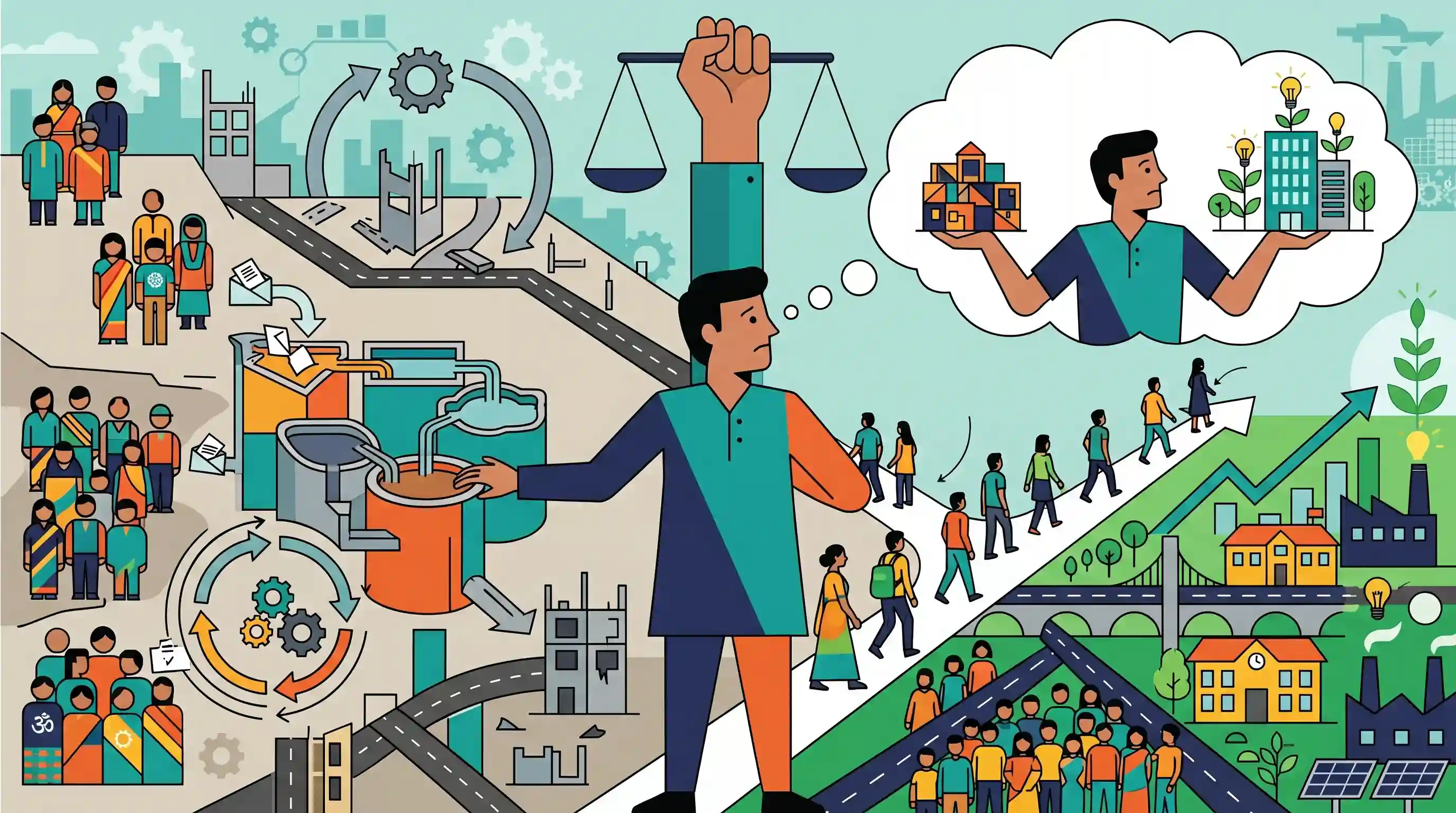
The article explores the persistent dominance of caste in Bihar’s electoral politics ahead of the 2025 assembly elections, framed around a poignant citizen's question: "Which caste is development?" It critiques the political stagnation that arises when parties prioritize caste arithmetic and vote-bank mobilization over substantive economic growth, infrastructure, and governance. The piece highlights the shifting aspirations of voters who are increasingly caught between traditional identity politics and a genuine desire for developmental outcomes, reflecting a broader trend in Indian democracy where the electorate demands accountability beyond mere social representation.
Key Points
- A citizen's query—'Which caste is development?'—highlights the paradox of Indian electoral politics where identity often overrides governance and developmental agendas.
- The impending Bihar elections in 2025 spotlight the deep-rooted political stagnation caused by entrenched vote-bank politics and caste-based mobilization.
- The narrative suggests a growing voter fatigue with traditional caste arithmetic, pointing towards an aspirational electorate demanding tangible socio-economic progress over mere identity representation.
- The debate underscores the tension between systemic social justice (often pursued via caste census and quotas) and broad-based economic development in regional politics.
Prelims Trap
The Constitution mandates a decadal caste census to ensure proportional representation for OBCs in the Lok Sabha.
The Constitution does not mandate a caste census, nor does it provide political reservation for OBCs in the Lok Sabha or State Assemblies (only SCs/STs have reserved seats).
Static Concepts Connected
What is Rajni Kothari’s theory on the "politicisation of caste"?
- Secularisation of Caste: Caste acts as a political pressure group, shifting from a ritualistic hierarchy to a secular interest group in modern democracy.
- Democratic Integration: It integrates historically marginalised communities into the democratic process by providing them with numerical bargaining power.
- Fluidity and Coalitions: Electoral politics fosters pragmatic cross-caste alliances to achieve political dominance, proving caste is a highly adaptable political entity.
How does the decadal Census differ from the Socio-Economic Caste Census (SECC)?
- Statutory backing: The regular Census falls under the Census Act of 1948, which strictly maintains the confidentiality of personal data.
- Utility of SECC: SECC data is explicitly open for use by government departments to identify and target beneficiaries for state welfare schemes.
- Caste Enumeration: Since independence, the regular decadal Census only enumerates SCs and STs, whereas the SECC aims to capture broader caste data including OBCs.
Cross-Topic Patterns
Caste Census & Sub-categorisation debates
The Bihar caste survey parallels the Rohini Commission's mandate on OBCs and the recent Supreme Court ruling allowing sub-classification of SCs to ensure targeted welfare distribution.
Clientelism vs. Structural Development
Caste mobilisation increasingly relies on direct cash transfers and targeted welfare (clientelism) to satisfy vote banks, shifting state fiscal focus away from long-term capital expenditure and infrastructure.

Expect a 2026 Mains question contrasting Rajni Kothari's 'politicisation of caste' with modern demands for economic governance.
Linked PYQs · 4
Linked PYQs · 4
- 2018MainsGS1
Caste system is assuming new identities and associational forms. Hence, caste system cannot be eradicated in India." Comment.
- 2023MainsGS1
Why is caste identity in India both fluid and static?
- 2022MainsGS1
Analyse the salience of 'sect' in Indian society vis-a-vis caste, region and religion.
- 2022MainsGS2
“While the national political parties in India favour centralisation, the regional parties are in favour of State autonomy.” Comment.
