Legal recognition of electronic wills and digital succession laws
Source:Indian Express ↗
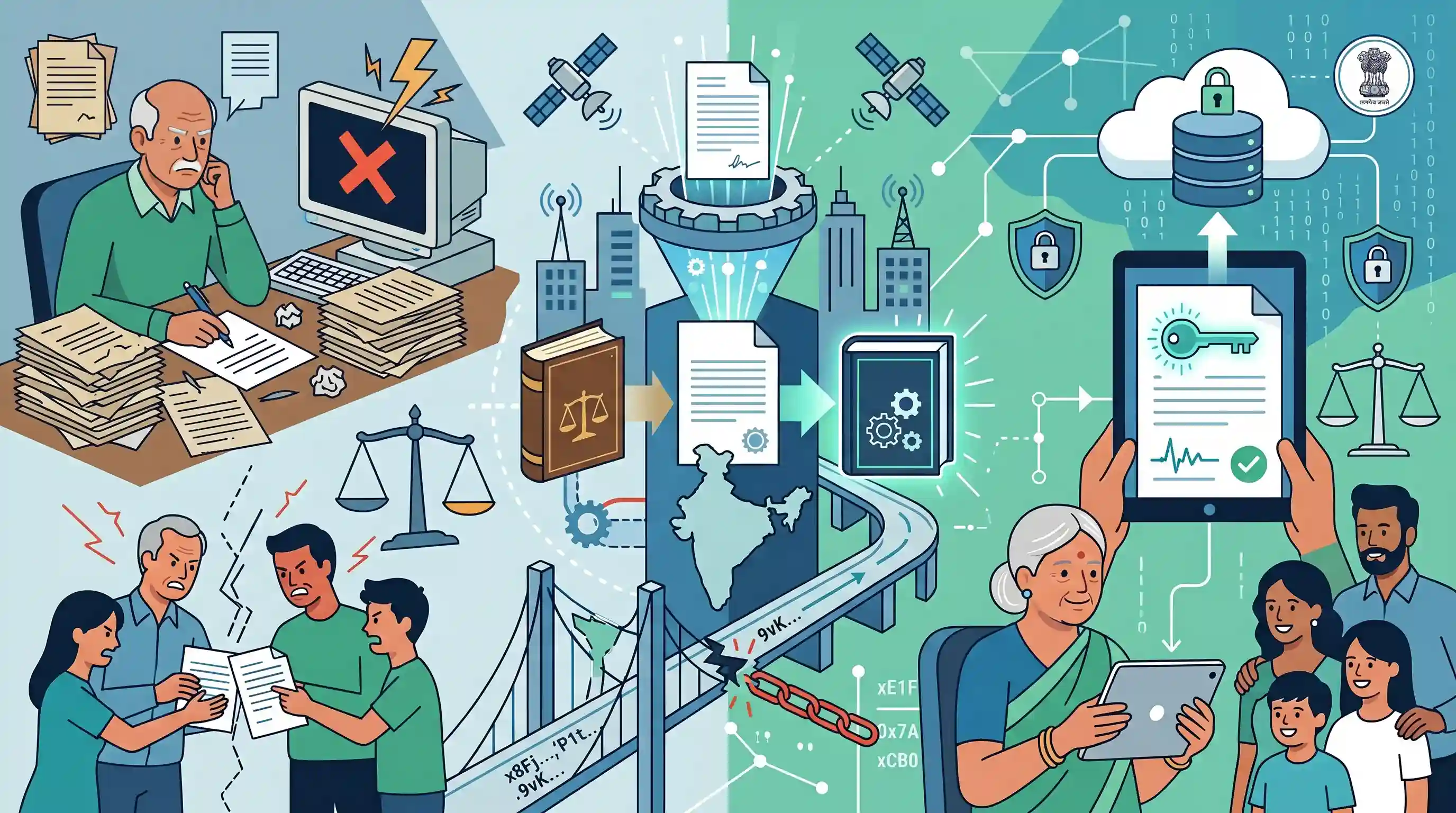
Why It Matters
Highlights a critical policy gap in India's digital transformation journey, showing how archaic succession laws conflict with modern digital governance goals. It is highly relevant for GS-2 (Governance and Policy) and GS-3 (Technology adoption) regarding the legal recognition of digital records and digital signatures.
Summary
The article advocates for the legal recognition of electronic wills (e-wills) in India, highlighting a critical gap in the current legal framework. Currently, the Information Technology Act, 2000 explicitly excludes wills from the scope of legally valid digital documents, and the Indian Succession Act, 1925 requires traditional physical execution and attestation. As the 'Digital India' initiative accelerates the digitization of various sectors, modernizing succession laws to permit the digital drafting, signing (via digital signatures), and registration of wills is essential. This reform would not only improve the accessibility and cryptographic security of estate planning but also help reduce widespread property disputes and litigation.
Key Points
- Electronic wills (e-wills) currently lack legal validity in India as the Information Technology Act, 2000 explicitly excludes testamentary dispositions from its scope.
- The Indian Succession Act, 1925 mandates the physical execution, signing, and attestation of wills, creating a lag between succession laws and the digital economy.
- Legalizing e-wills using digital signatures and secure electronic records would make estate planning more accessible and tamper-proof.
- Updating the legal framework to include digital registration of wills would reduce property disputes and align with the broader goals of the Digital India initiative.
Important Terms
Information Technology Act, 2000

A 2000 law providing legal recognition for electronic records and digital signatures. It excludes certain documents, including wills, from its scope, creating the current legal barrier for e-wills in India.
UPSC context
GS II (Govt Policies) & GS III (Cyber Security). Tests knowledge of India's primary digital legal framework.
Indian Succession Act, 1925
A 1925 statute consolidating laws on inheritance (testamentary and intestate). Section 63 mandates that a valid will must be in writing and attested by at least two physical witnesses.
UPSC context
GS II (Governance/Social Justice). Tests understanding of personal laws and legal requirements for estate planning.
Registration Act, 1908
A 1908 law mandating the registration of property documents to prevent fraud. While property transfers require registration, Section 18 makes the registration of wills optional, though highly recommended for legal security.
UPSC context
GS II (Governance) & GS III (Land Reforms). Tests knowledge of property title security and document validity.
Digital India
Launched in 2015, this flagship initiative aims to transform India into a digitally empowered society by improving digital infrastructure and delivering government services electronically to all citizens.
UPSC context
GS II (E-governance) & GS III (Digital Infrastructure). Tests impact of major schemes on administrative efficiency.
Digital Signature
A cryptographic authentication technique under the IT Act (Sections 2p and 3) that ensures the authenticity, integrity, and non-repudiation of electronic documents using asymmetric cryptography.
UPSC context
GS III (Science & Tech/Cybersecurity). Tests technical knowledge of electronic authentication and secure digital transactions.
E-governance
The application of Information and Communication Technology (ICT) to deliver government services, exchange information, and conduct transactions with improved transparency, efficiency, and accountability.
UPSC context
GS II (Governance). A core syllabus topic testing the transition from traditional to digital public service delivery.
Prelims Trap
"The IT Act, 2000 grants legal recognition to all digital documents, making electronic wills and digital trust deeds legally enforceable."
The IT Act, 2000 explicitly excludes wills, negotiable instruments (other than cheques), and powers of attorney from electronic recognition under Section 1(4).
Static Concepts Connected
Which documents are explicitly excluded from the purview of the Information Technology Act, 2000?
- Wills: Testamentary dispositions (wills) governed by the Indian Succession Act, 1925 are excluded from electronic recognition.
- Financial/Trust deeds: Negotiable instruments (except cheques) and trust deeds are not legally recognized in purely electronic forms.
- Property records: Powers of Attorney and contracts for the sale or conveyance of immovable property are explicitly excluded.
How is the legal validity of Digital Signatures regulated under Indian law?
- Asymmetric Cryptography: They rely on a public-private key pair mechanism to ensure data integrity, authenticity, and non-repudiation under the IT Act.
- Certifying Authorities: The Controller of Certifying Authorities (CCA) under the Ministry of Electronics & IT licenses and regulates entities that issue these signatures.
Cross-Topic Patterns
DILRMP vs. Paper Inheritance
Digitized land records under the Digital India Land Records Modernization Programme (DILRMP) clash with archaic paper-will mandates, creating a statutory bottleneck in seamless rural property transfers.
Judicial Pendency & Property Disputes
Outdated succession laws fuel property disputes, which constitute a massive chunk of civil litigation in the subordinate judiciary, directly hindering broader "Ease of Justice" reforms.

Expect a Prelims question testing explicit exceptions to the IT Act 2000 (wills, trusts) linked with Digital Signature cryptography.
Linked PYQs · 3
Linked PYQs · 3
- 2023MainsGS3
What is the status of digitalization in the Indian economy? Examine the problems faced in this regard and suggest improvements.
- 2020MainsGS2
The emergence of Fourth Industrial Revolution (Digital Revolution) has initiated e-Governance as an integral part of government". Discuss.
- 2019PrelimsGS1
Consider the following statements: A digital signature is 1. an electronic record that identifies the certifying authority issuing it 2. used to serve as a proof of identity of an individual to access information or server on Internet 3. an electronic method of signing an electronic document and ensuring that the original content is unchanged Which of the statements given above is/are correct?
