Weaponized Tariffs and Global Macroeconomic Instability
Source:The Hindu ↗
Why It Matters
The shift from a rules-based global free trade system to unilateral protectionism (and "weaponized tariffs") is a recurrent theme in UPSC Mains (both GS2 IR and GS3 Economy). Understanding why political expediency currently overrides economic consensus is vital for framing answers on India's macroeconomic stability and trade strategy.
Summary
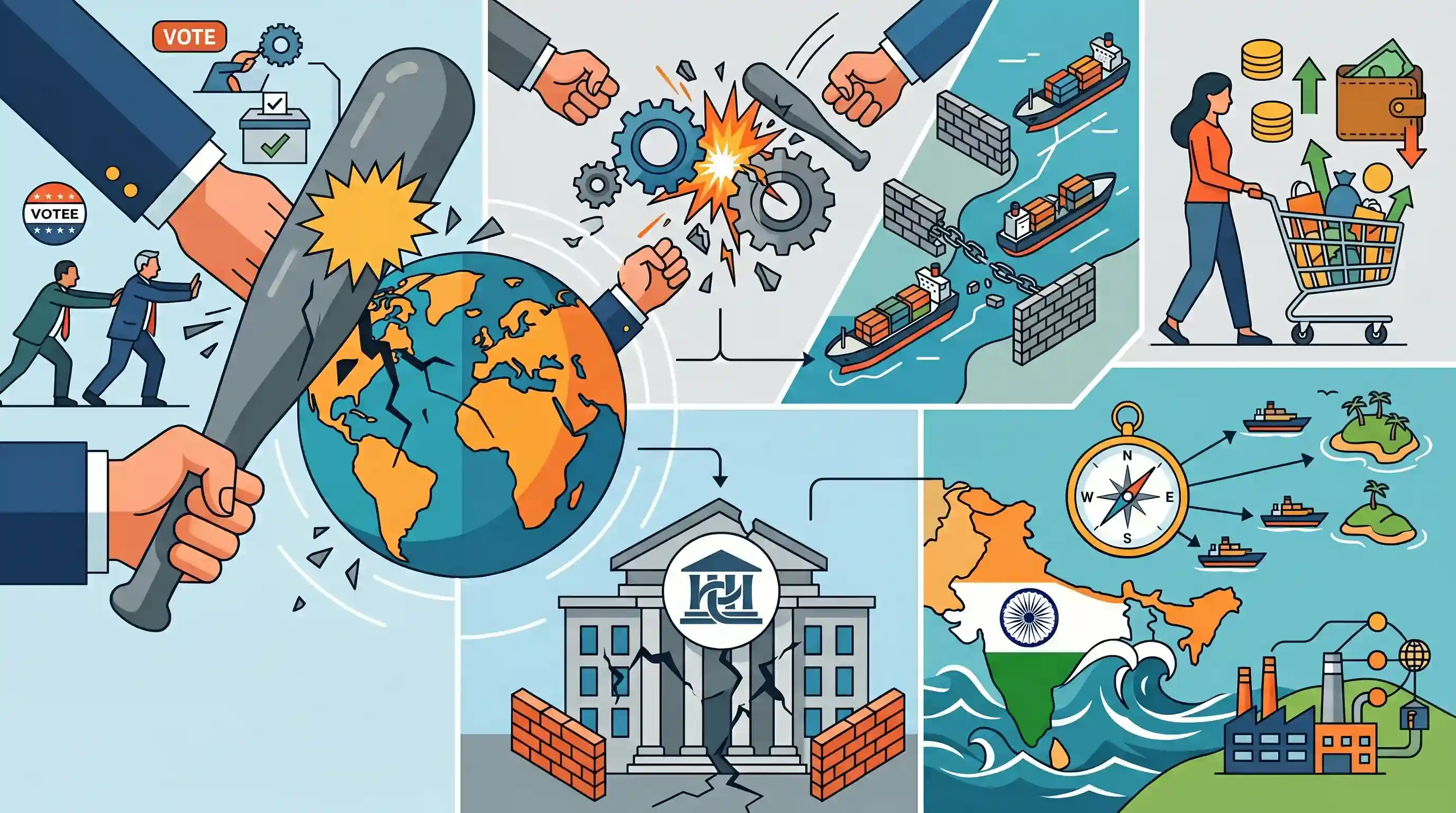
The article analyzes the growing global trend of utilizing tariffs as blunt instruments for political and geopolitical leverage, a practice that frequently overrides standard economic logic. While protectionist policies—often championed in recent U.S. administrations—aim to secure domestic political victories or address non-trade issues, they inevitably result in higher domestic inflation, disrupted global supply chains, and retaliatory trade wars. This paradigm shift from multilateral free trade to unilateral protectionism critically undermines the World Trade Organization (WTO). For developing economies like India, this transition presents profound macroeconomic challenges, necessitating adaptive strategies such as diversifying export markets and strengthening domestic resilience.
Key Points
- Politicization of Trade: Tariffs are increasingly weaponized for geopolitical or domestic political goals (such as border control or domestic signaling), overriding traditional economic principles of comparative advantage.
- Economic Repercussions: Broad, unilateral tariffs often contradict economic logic by sparking retaliatory trade wars, increasing input costs for domestic manufacturers, and shifting the burden of inflation onto consumers.
- Crisis of Multilateralism: The aggressive reliance on protectionist measures weakens the rules-based global trading order and exacerbates the irrelevance of the WTO's dispute settlement mechanisms.
- Challenges for Developing Economies: Emerging markets like India must navigate a volatile global trade environment marked by sovereign nationalism, making it crucial to bolster domestic manufacturing and pursue strategic bilateral trade pacts.
Important Terms
World Trade Organization (WTO)

Global body regulating international trade rules to ensure smooth, predictable, and free trade. It replaced GATT in 1995 and operates through negotiated agreements and a dispute settlement mechanism.
UPSC context
GS-2 (International Institutions) & GS-3 (Global Trade). Tests knowledge of global governance, trade disputes, and India's advocacy for developing nations.
Protectionism
Economic policy of shielding domestic industries from foreign competition via tariffs, quotas, or subsidies. It prioritizes local political or strategic goals over global economic efficiency.
UPSC context
GS-3 (Effects of Liberalization). Tests understanding of trade wars, domestic industry impacts, and the shift from globalization to economic nationalism.
Free Trade Agreements (FTAs)
Formal treaties between two or more countries to reduce or eliminate trade barriers like tariffs and quotas. They aim to enhance market access and strengthen economic cooperation.
UPSC context
GS-2 (Bilateral/Regional Groupings) & GS-3 (External Sector). Vital for evaluating India's trade diplomacy, export competitiveness, and recent deals like CEPA.
Tariffs
Duties or taxes imposed by a government on imported goods. They are used to protect domestic producers, generate revenue, or serve as political leverage in trade negotiations.
UPSC context
GS-3 (Indian Economy). Crucial for analyzing fiscal policy, domestic inflation, and the impact of 'reciprocal tariffs' on international relations.
Multilateralism
Coordination of national policies among three or more states based on common rules and institutions, like the WTO, to solve global problems and maintain order.
UPSC context
GS-2 (International Relations). Tests the ability to analyze the relevance of global bodies versus the rise of unilateral and 'minilateral' trade actions.
Supply Chain Resilience
The capacity of a trade network to absorb shocks, diversify sourcing, and maintain operations during global disruptions or geopolitical shifts.
UPSC context
GS-3 (Economy/Global Trade). Highlights strategies like 'China Plus One' to reduce dependencies and strengthen India's manufacturing and export stability.
Prelims Trap
Tariffs imposed by a nation directly reduce its domestic inflation by substituting expensive foreign imports.
Tariffs inherently cause cost-push inflation. They act as taxes on imported intermediate goods, raising production costs for domestic manufacturers who pass the burden to consumers.
Static Concepts Connected
Why is the WTO's Appellate Body currently facing institutional paralysis?
- Two-tier system: The WTO dispute settlement mechanism relies on initial panels and an Appellate Body (AB) for final binding rulings.
- Judicial blockade: The United States has repeatedly blocked the appointment of new AB judges over the years, citing judicial overreach.
- Enforcement void: Without a functioning AB, appealed cases remain unresolved indefinitely ("appealed into the void"), rendering multilateral trade rules unenforceable.
What is cost-push inflation in the context of protectionist trade policies?
- Import taxes: Broad tariffs artificially raise the domestic landing price of imported raw materials, machinery, and intermediate components.
- Supply-side shock: Increased input costs act as a negative supply shock, forcing domestic manufacturers to raise wholesale prices to maintain margins.
- Consumer burden: The ultimate tax incidence falls on domestic consumers, lowering purchasing power and creating inflation despite the policy's protectionist intent.
Cross-Topic Patterns
Neo-Protectionism vs. PLI Scheme
India's Production-Linked Incentive (PLI) is a strategic response to global tariff wars. Unlike pre-1991 import substitution, PLI builds domestic resilience while attempting to integrate India into disrupted Global Value Chains.
Tariffs and Currency Devaluation
Geopolitical tariffs frequently spark parallel currency wars. Affected nations may engage in competitive currency devaluation (manipulation) to offset the tariff impact and maintain the global competitiveness of their exports.

A 2026 GS-3 Mains question will likely link the WTO Appellate Body crisis with India's defensive pivot to bilateral FTAs and PLI schemes.
Linked PYQs · 4
Linked PYQs · 4
- 2025MainsGS3
What are the challenges before the Indian economy when the world is moving away from free trade and multilateralism to protectionism and bilateralism? How can these challenges be met?
- 2018MainsGS3
How would the recent phenomena of protectionism and currency manipulations in world trade affect macroeconomic stability of India?
- 2025MainsGS2
"With the waning of globalization, post-Cold War world is becoming a site of sovereign nationalism.” Elucidate.
- 2018MainsGS2
What are the key areas of reform if the WTO has to survive in the present context of "Trade War', especially keeping in mind the interest of India?
