India-US Bilateral Trade Negotiations and WTO Disputes
Source:The Hindu ↗
Why It Matters
The US is India's largest trading partner and a crucial strategic ally. The evolution of their trade ties—shifting from multilateral dispute mechanisms (WTO) to bilateral resolutions and issue-specific partnerships (like IPEF)—shapes India's export potential, supply chain resilience, and broader economic diplomacy.
Summary
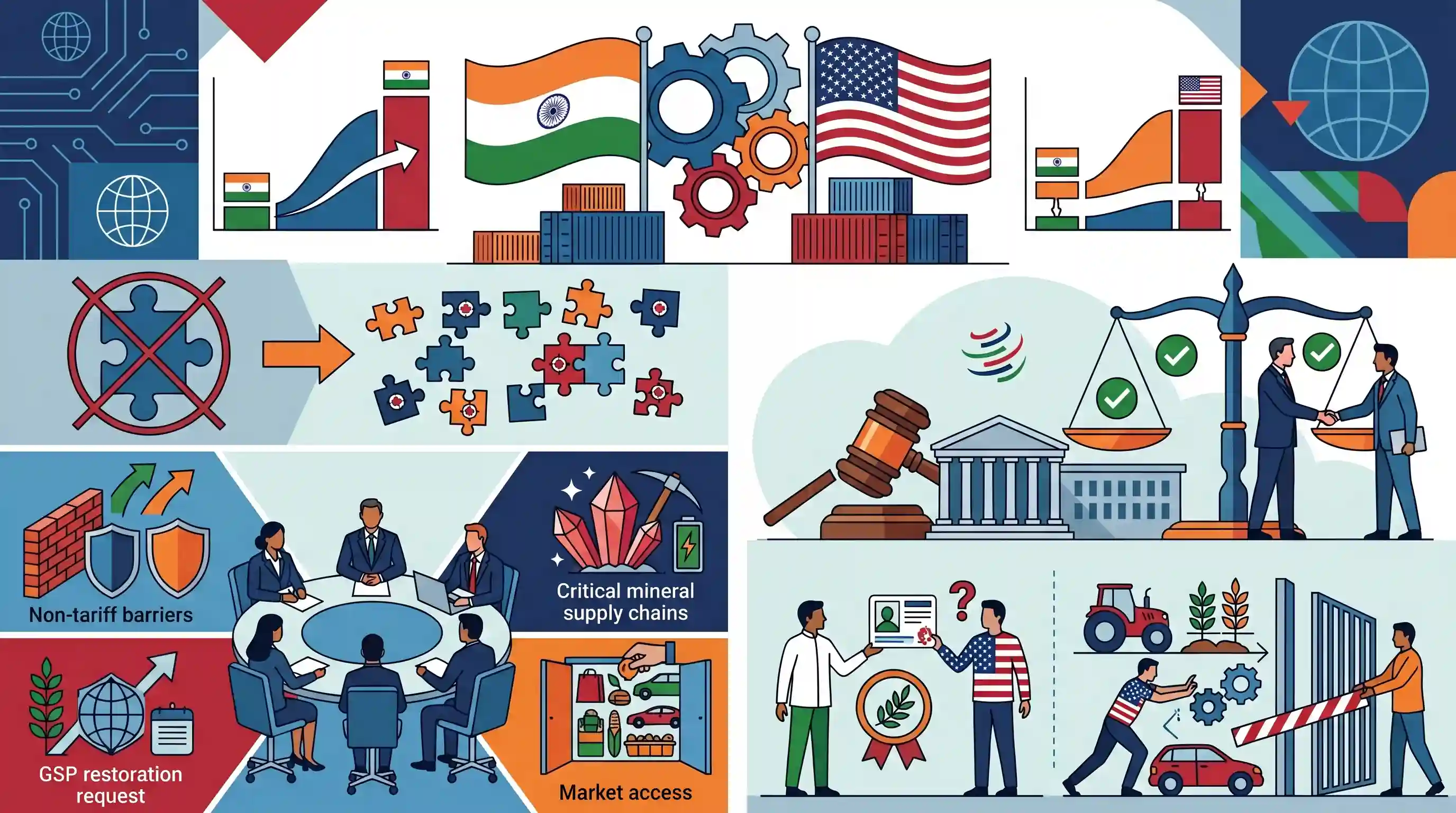
The article explains the current status and trajectory of the India-U.S. trade relationship. Despite the U.S. being India's largest trading partner, the two nations have shifted away from pursuing a comprehensive Free Trade Agreement (FTA) in favor of issue-based, targeted agreements. Through the Trade Policy Forum (TPF), both countries are addressing non-tariff barriers, critical mineral supply chains, and market access issues. A significant recent achievement is the mutual resolution of outstanding World Trade Organization (WTO) disputes. However, friction points remain, notably India's push for the restoration of its Generalized System of Preferences (GSP) status and the U.S. push for greater access to Indian agricultural and manufacturing markets.
Key Points
- The U.S. remains India's largest trading partner, but a comprehensive Free Trade Agreement (FTA) has not materialized due to disagreements over tariffs, market access, and non-tariff barriers.
- Both nations have increasingly utilized the Trade Policy Forum (TPF) to navigate sector-specific issues, including agricultural market access, digital trade, and critical mineral supply chains.
- In a sign of a pragmatic bilateral approach, India and the US have mutually resolved several outstanding disputes at the World Trade Organization (WTO).
- A major priority for India remains the restoration of its beneficiary status under the Generalized System of Preferences (GSP), which the U.S. revoked in 2019.
Important Terms
Trade Policy Forum (TPF)

The premier bilateral mechanism between India and the U.S. for resolving trade and investment frictions. Co-chaired by trade ministers, it focuses on market access, agriculture, and intellectual property.
UPSC context
GS Paper 2 (Bilateral Groupings); tests understanding of institutional frameworks for trade diplomacy and resolving market access barriers.
Generalized System of Preferences (GSP)
A U.S. program providing duty-free market access to developing nations. India, formerly its largest beneficiary, lost this status in 2019 and currently seeks restoration through bilateral negotiations.
UPSC context
GS Paper 2 (Developed country policies); tests knowledge of trade preference schemes and their impact on India's export competitiveness.
Indo-Pacific Economic Framework (IPEF)
A U.S.-led economic initiative of 14 nations, including India, focusing on supply chains and clean energy. India participates in three pillars but opted out of the Trade pillar.
UPSC context
GS Paper 2 (Regional groupings); tests awareness of new economic architectures in the Indo-Pacific and India's strategic trade alignment.
World Trade Organization (WTO)
The global body regulating international trade. India and the U.S. recently resolved their remaining seven long-standing disputes bilaterally using the WTO framework, signaling improved economic ties.
UPSC context
GS Paper 2 (International institutions); tests knowledge of multilateral dispute resolution mechanisms and India’s recent shift toward bilateral settlements.
Office of the United States Trade Representative (USTR)
The U.S. executive agency responsible for trade policy and negotiations. It co-chairs the Trade Policy Forum and monitors global intellectual property enforcement through the Special 301 Report.
UPSC context
GS Paper 2 (International Relations); tests understanding of the U.S. institutional role in negotiations and IP-related pressure on India.
Non-Tariff Barriers (NTBs)
Trade restrictions like quotas, sanitary regulations, or technical standards other than direct tariffs. They are a focus of current India-U.S. talks to facilitate smoother market access.
UPSC context
GS Paper 3 (Economy); tests understanding of subtle trade barriers that replace traditional tariffs in modern international economic relations.
Prelims Trap
"The Generalized System of Preferences (GSP) is a multilateral tariff mechanism administered by the WTO."
GSP is a unilateral preferential tariff system extended by developed nations to developing countries, not a multilateral mechanism administered or mandated by the WTO.
Static Concepts Connected
What is the Generalized System of Preferences (GSP)?
- Unilateral Concession: A non-reciprocal preferential tariff system extended by developed countries to developing ones to aid economic growth.
- UNCTAD Origins: It was instituted in 1971 under the aegis of UNCTAD.
- Exception to MFN: It functions as a formal, recognized exception to the WTO's core Most-Favored-Nation (MFN) principle.
Why are countries mutually resolving WTO disputes outside the WTO?
- Appellate Body Crisis: The WTO's Appellate Body has been functionally paralyzed for years because the U.S. has blocked the appointment of new judges.
- Pragmatic Bilateralism: To avoid legal limbo, nations like India and the U.S. are increasingly using bilateral platforms (like the Trade Policy Forum) for mutual out-of-court settlements.
Cross-Topic Patterns
Issue-based deals replacing comprehensive FTAs
India's pivot from comprehensive FTAs towards targeted mechanisms (like the US-India TPF) parallels its opt-in, pillar-based participation in the US-led Indo-Pacific Economic Framework (IPEF).
Trade talks meet Critical Minerals
Incorporating critical mineral supply chains into bilateral trade negotiations links directly to the US-led Minerals Security Partnership (MSP), highlighting the weaponization of clean energy supply chains.

Expect a 2026 Prelims statement contrasting unilateral GSP concessions with the WTO's non-discriminatory Most Favored Nation (MFN) rule.
Linked PYQs · 3
Linked PYQs · 3
- 2019MainsGS2
‘What introduces friction into the ties between India and the United States is that Washington is still unable to find for India a position in its global strategy, which would satisfy India's national self-esteem and ambitions.’ Explain with suitable examples.
- 2025MainsGS3
What are the challenges before the Indian economy when the world is moving away from free trade and multilateralism to protectionism and bilateralism? How can these challenges be met?
- 2016MainsGS2
The broader aims and objectives of WTO are to manage and promote international trade in the era of globalization. But the Doha round of negotiations seem doomed due to differences between the developed and the developing countries." Discuss in the Indian perspective.
