Congress Questions Silence on Trump India Pakistan Mediation Claims
Source:The Hindu ↗
Why It Matters
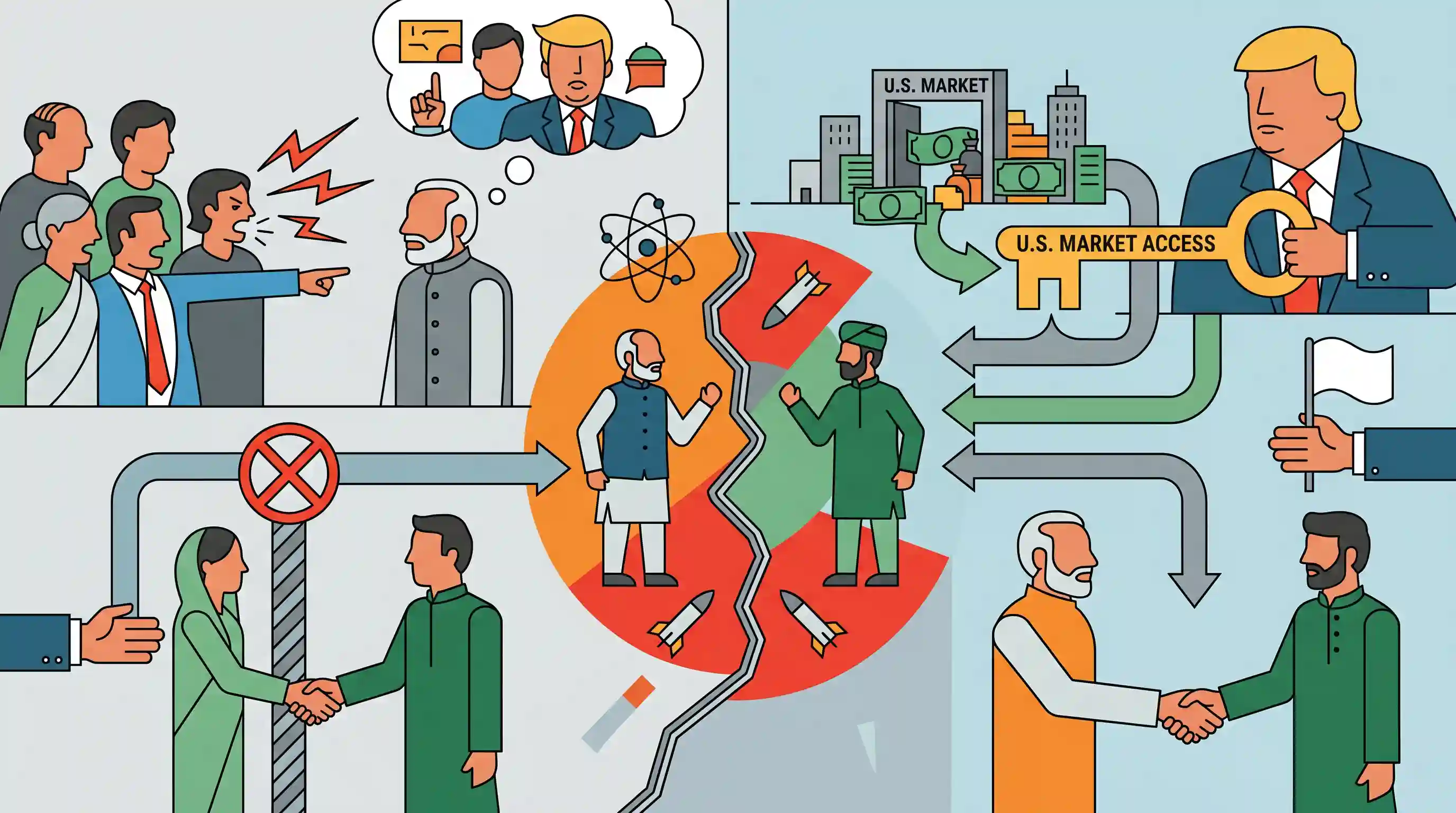
The issue underscores India's fundamental foreign policy doctrine of resisting third-party mediation in its bilateral disputes with Pakistan. It also highlights the complexities of India-U.S. strategic ties, illustrating how major global powers might attempt to leverage economic and trade access to influence regional security dynamics and conflict resolution.
Summary
Political tensions have surfaced as the Congress party demands a response from Prime Minister Narendra Modi regarding U.S. President Donald Trump's repeated claims that he stopped a potential India-Pakistan nuclear conflict (Operation Sindoor). Trump alleges he used the threat of revoking access to U.S. markets to force a ceasefire. Conversely, the Indian government's official stance asserts that the conflict's resolution was bilateral and requested by Islamabad, reflecting India's long-standing doctrine against third-party mediation in the region.
Key Points
- The Congress party has questioned Prime Minister Narendra Modi's silence regarding U.S. President Donald Trump's claims of intervening to stop an India-Pakistan conflict.
- Donald Trump asserted that he prevented a potential nuclear war between the two nations during 'Operation Sindoor' by using American trade access as diplomatic leverage.
- The Indian Union government maintains that the ceasefire during the conflict was initiated solely at Islamabad's request, implicitly denying U.S. intervention.
Important Terms
Operation Sindoor

An Indian military operation (May 2025) involving precision strikes on terror infrastructure in Pakistan-occupied Kashmir following a terror attack in Pahalgam.
UPSC context
GS Paper II (International Relations); represents India's shift toward proactive deterrence and retaliatory precision strikes against cross-border terrorism.
Simla Agreement (1972)
A 1972 peace treaty between India and Pakistan following the 1971 War; it established the Line of Control (LoC) and mandated bilateral resolution of disputes.
UPSC context
GS Paper II (IR) and GS Paper I (Post-Independence History); serves as the legal foundation for India’s rejection of third-party mediation.
Bilateralism
The diplomatic principle that disputes between two nations should be resolved through direct negotiations without the involvement or interference of external parties.
UPSC context
GS Paper II (Foreign Policy); a core tenet of India’s strategic autonomy and its specific approach to the Kashmir issue.
Third-party Mediation
The intervention of an external power or international body to facilitate a resolution in a dispute. India consistently rejects this for its relations with Pakistan.
UPSC context
GS Paper II (IR); tests understanding of India’s resistance to internationalizing the Kashmir conflict and its adherence to the Simla Agreement.
Director General of Military Operations (DGMO)
The high-ranking military official in charge of military operations. India-Pakistan DGMO-level hotlines are essential tools for crisis de-escalation and maintaining ceasefire protocols.
UPSC context
GS Paper III (Security); relates to Confidence Building Measures (CBMs) and border management protocols between nuclear-armed neighbors.
Economic Statecraft
The use of economic tools, such as trade tariffs or market access, as a means to achieve foreign policy objectives or influence geopolitical outcomes.
UPSC context
GS Paper II (IR); relevant to global powers using economic leverage (like U.S. tariffs) to influence regional stability or security decisions.
Prelims Trap
"The Simla Agreement allows for UN or third-party mediation in India-Pakistan disputes if bilateral negotiations reach a deadlock."
The 1972 Simla Agreement strictly mandates that all disputes be resolved exclusively through peaceful bilateral negotiations, legally blocking any third-party mediation or UN intervention.
Static Concepts Connected
What is the legal basis for India rejecting third-party mediation?
- Simla Agreement: Signed in 1972, it legally binds India and Pakistan to resolve all disputes exclusively through peaceful bilateral negotiations.
- Lahore Declaration: Signed in 1999, it reaffirmed the bilateral framework, with both nations pledging to refrain from external intervention in mutual affairs.
How does the US weaponize trade access for geopolitical leverage?
- GSP Withdrawal: Revoking the Generalized System of Preferences status, which provides duty-free entry, to economically penalize developing nations.
- Punitive Tariffs: Threatening or imposing high tariffs on key exports to coerce strategic, diplomatic, or economic concessions from partner countries.
Cross-Topic Patterns
Strategic Autonomy vs. Geoeconomic Coercion
Highlights the tension between India's independent foreign policy and its reliance on US markets, similar to pressures faced over importing Russian oil despite Western sanctions.
Rejecting mediation across borders
Connects India's strict bilateralism with Pakistan to its identical stance against US or UN intervention in the Sino-Indian border dispute, preventing the internationalization of regional conflicts.

Simla Agreement bilateralism + US geoeconomic coercion + Strategic Autonomy likely to merge in a 2026 Mains IR question.
Linked PYQs · 2
Linked PYQs · 2
- 2015MainsGS2
Terrorist activities and mutual distrust have clouded India-Pakistan relations. To what extent the use of soft power like sports and cultural exchanges could help generate goodwill between the two countries? Discuss with suitable examples.
- 2023MainsGS2
‘The expansion and strengthening of NATO and a stronger US-Europe strategic partnership works well for India.’ What is your opinion about this statement ? Give reasons and examples to support your answer.
